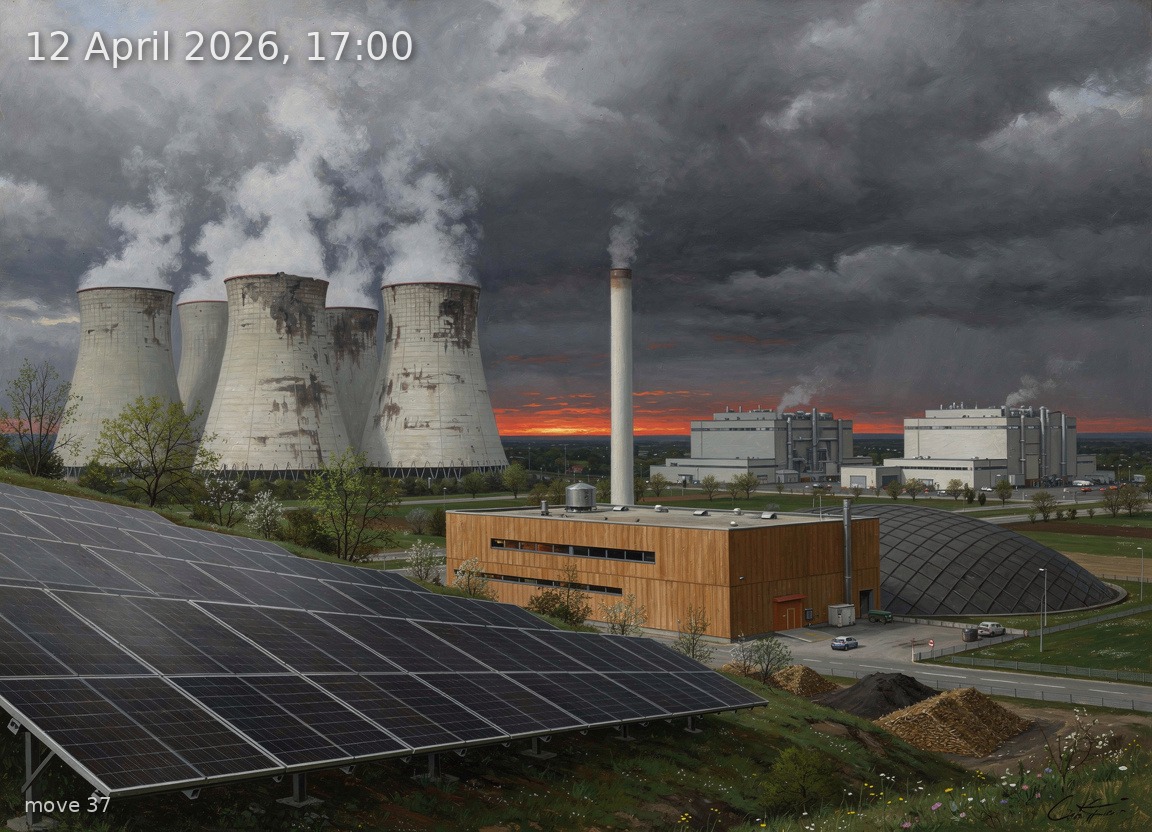
Brown coal leads at 7.7 GW with fading solar and near-absent wind driving 16.8 GW net imports.
Back
Generation mix
Wind onshore 4%
Wind offshore 3%
Solar 26%
Biomass 14%
Hydro 5%
Natural gas 15%
Hard coal 7%
Brown coal 25%
53%
Renewable share
2.0 GW
Wind (on + offshore)
7.9 GW
Solar
30.2 GW
Total generation
-16.8 GW
Net import
110.2 €/MWh
Day-ahead price
12.3°C / 2 km/h
Temp / Wind speed
Open-Meteo, Kassel (51.3°N 9.5°E)
100% / 113.2 W/m²
Cloud cover / Radiation
333
gCO₂/kWh
Image prompt
Brown coal 7.7 GW dominates the left third of the scene as a cluster of massive hyperbolic cooling towers with thick white-grey steam plumes rising into the overcast sky; solar 7.9 GW occupies the centre-left as a wide field of aluminium-framed crystalline silicon PV panels angled south on a gentle hillside, their surfaces dull under heavy clouds; natural gas 4.7 GW appears centre-right as two compact CCGT plants with slender exhaust stacks venting thin plumes; biomass 4.4 GW is rendered as a timber-clad biomass plant with a large woodchip storage dome and a single stack emitting pale vapour; hard coal 2.0 GW sits behind the gas plants as a smaller coal station with a squared-off boiler house and conveyor belt; hydro 1.6 GW is a concrete dam in the right-middle distance with water spilling over its face; wind onshore 1.1 GW appears as a small group of three-blade turbines on a far ridge, rotors barely turning; wind offshore 0.9 GW is suggested by a faint line of turbines on the distant horizon. Time is 17:00 in April—dusk is beginning: the sky is fully overcast at 100% cloud cover with a thick, oppressive grey ceiling, but a faint orange-red glow seeps along the lower western horizon where the sun is setting unseen. The atmosphere feels heavy and close, conveying the high electricity price. Temperature is 12.3°C in early spring: fresh green buds on deciduous trees, pale grass, a few wildflowers. Wind is almost absent—smoke and steam rise nearly vertically. Foreground shows the PV field and biomass plant; middle ground has the gas and coal stations; background features the lignite cooling towers shrouded in their own steam. Rendered as a highly detailed oil painting in the tradition of 19th-century German Romantic landscape art—rich, layered colour, visible confident brushwork, deep atmospheric perspective, dramatic chiaroscuro between the glowing horizon and the darkening overcast above—yet every turbine nacelle, every lattice tower, every panel frame, every cooling tower curve is rendered with meticulous engineering accuracy. No text, no labels.