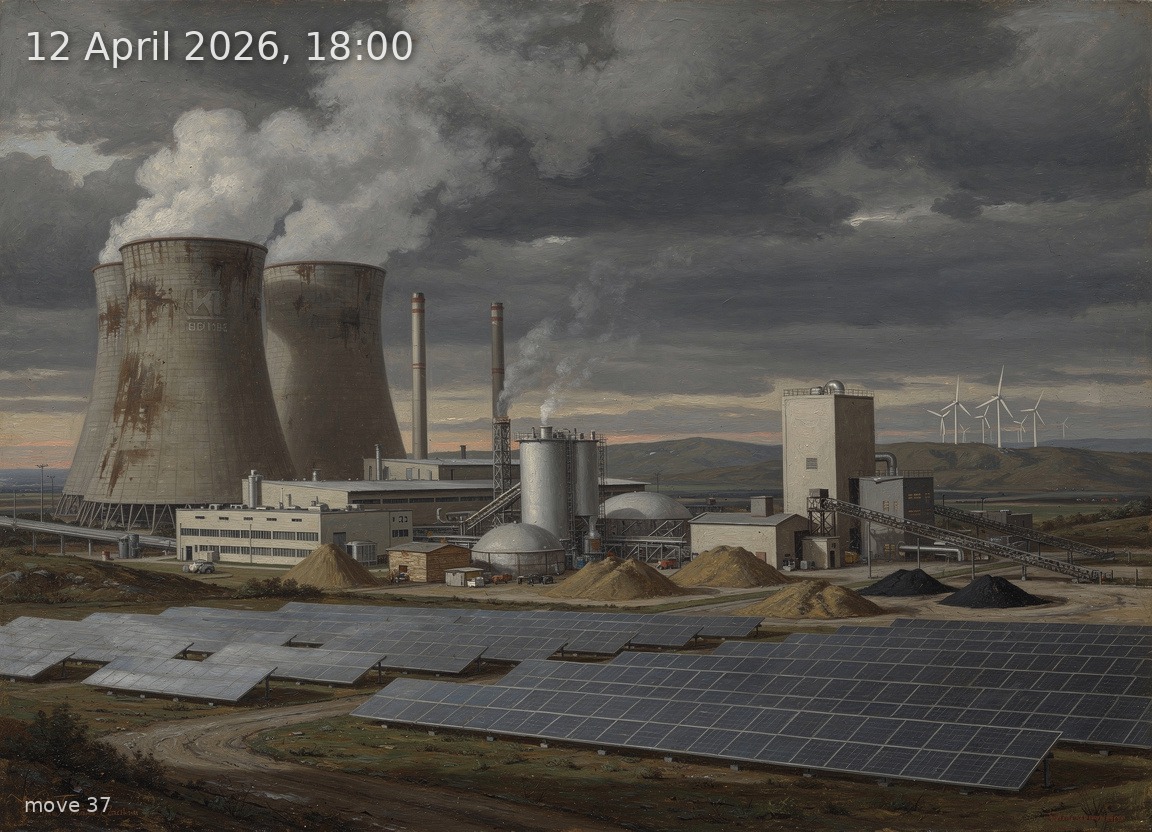
Brown coal and gas dominate domestic supply as overcast calm forces 21 GW of net imports at elevated prices.
Back
Generation mix
Wind onshore 3%
Wind offshore 2%
Solar 14%
Biomass 16%
Hydro 6%
Natural gas 21%
Hard coal 10%
Brown coal 27%
41%
Renewable share
1.6 GW
Wind (on + offshore)
3.9 GW
Solar
28.5 GW
Total generation
-21.1 GW
Net import
135.4 €/MWh
Day-ahead price
11.9°C / 3 km/h
Temp / Wind speed
Open-Meteo, Kassel (51.3°N 9.5°E)
100% / 26.0 W/m²
Cloud cover / Radiation
405
gCO₂/kWh
Image prompt
Brown coal 7.8 GW dominates the left third of the scene as a cluster of massive hyperbolic cooling towers with thick white-grey steam plumes merging into the overcast sky; natural gas 6.1 GW occupies the center-left as a row of compact CCGT plants with tall single exhaust stacks emitting thin heat shimmer; hard coal 2.9 GW appears center-right as a smaller coal plant with a single square cooling tower and conveyor belt; biomass 4.6 GW is rendered as two large industrial biomass facilities with wood-chip storage domes and modest stacks between the coal and gas plants; solar 3.9 GW appears as a mid-ground field of aluminium-framed crystalline silicon panels, their surfaces dull and reflecting only grey sky, producing weakly in the fading light; wind onshore 1.0 GW shows as a small cluster of three-blade turbines on a distant ridge, blades barely turning in the still air; wind offshore 0.7 GW is suggested by tiny turbines on a far horizon line above a grey North Sea sliver; hydro 1.6 GW appears as a concrete dam with modest water flow in the far right background. The sky is completely overcast with heavy, oppressive low stratus clouds in slate-grey and charcoal tones — no blue visible. The lighting is late dusk at 18:00 in April: a narrow band of dim orange-red glow clings to the western horizon beneath the cloud deck, while the sky above darkens rapidly toward deep grey-blue. Temperature is cool spring, 12°C — bare-branched trees are just beginning to bud, with sparse pale-green shoots on brown branches. The air is still, no motion in grass or flags. The overall atmosphere is heavy and brooding, reflecting the high electricity price and strained supply. Highly detailed oil painting in the tradition of 19th-century German Romantic landscape painting — rich, deep colour palette of umber, ochre, slate and iron-grey, visible impasto brushwork, atmospheric perspective with industrial haze, meticulous engineering detail on every facility. No text, no labels.