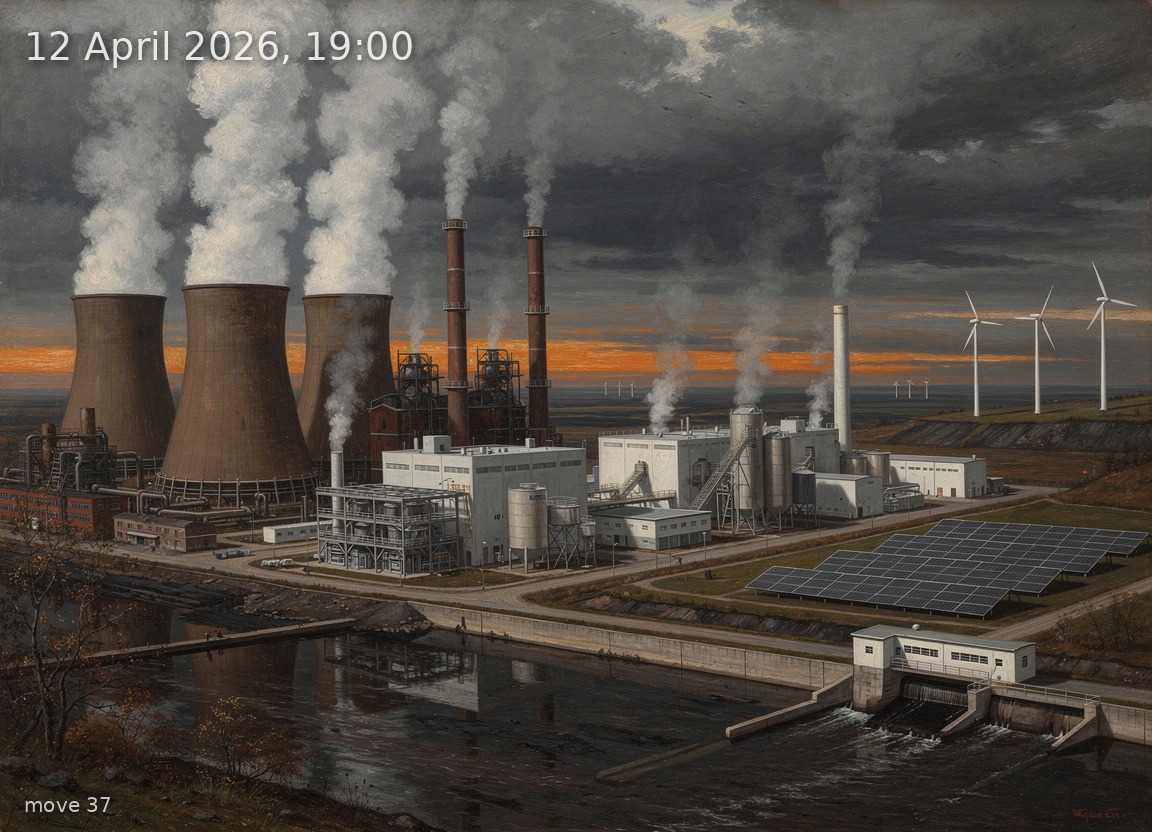
Brown coal and gas dominate a 27.6 GW domestic supply requiring 21.5 GW net imports under overcast, calm conditions.
Back
Generation mix
Wind onshore 4%
Wind offshore 2%
Solar 3%
Biomass 17%
Hydro 6%
Natural gas 26%
Hard coal 12%
Brown coal 29%
32%
Renewable share
1.7 GW
Wind (on + offshore)
0.9 GW
Solar
27.6 GW
Total generation
-21.5 GW
Net import
144.8 €/MWh
Day-ahead price
11.5°C / 4 km/h
Temp / Wind speed
Open-Meteo, Kassel (51.3°N 9.5°E)
100% / 2.5 W/m²
Cloud cover / Radiation
460
gCO₂/kWh
Image prompt
Brown coal 8.1 GW dominates the left third of the scene as a massive lignite power complex with four hyperbolic cooling towers trailing thick white steam plumes into the heavy sky; natural gas 7.1 GW fills the centre-left as a cluster of combined-cycle gas turbine units with tall slim exhaust stacks emitting pale heat shimmer; biomass 4.7 GW appears centre-right as a row of industrial biomass CHP plants with square silos and moderate chimneys; hard coal 3.4 GW sits behind the gas plant as two older coal-fired boiler houses with twin stacks; hydro 1.7 GW is rendered as a concrete run-of-river weir and turbine house along a dark river in the right foreground; wind onshore 1.2 GW appears as three distant three-blade turbines on a ridge, their rotors barely turning; wind offshore 0.5 GW is suggested by a pair of tiny turbines visible far on the hazy horizon; solar 0.9 GW is shown as a small field of aluminium-framed crystalline silicon panels in the right middle ground, their surfaces dark and reflecting only grey sky, receiving no useful light. Time of day is 19:00 in April in central Germany—late dusk with a thin band of deep burnt-orange light clinging to the lowest horizon, the sky above transitioning rapidly from slate grey to near-black, complete overcast with no breaks in the clouds. Temperature is mild at 11.5°C; early spring vegetation—bare-branched oaks with just the first haze of pale green buds, damp brown grass. Wind is nearly still: no motion in tree branches, smoke and steam rise almost vertically. The atmosphere is heavy and oppressive, conveying the economic weight of 144.8 EUR/MWh electricity—thick industrial haze, a brooding low ceiling of cloud pressing down on the landscape. Massive high-voltage transmission pylons march across the middle distance carrying imported power, their cables sagging under load. A small German town glows with warm sodium streetlights in the valley below. Painted in the style of a highly detailed 19th-century German Romantic oil painting—rich, dark palette of umber, ochre, slate blue, and deep orange; visible impasto brushwork; dramatic atmospheric depth and chiaroscuro lighting from the industrial glow against the darkening sky. Meticulous engineering detail on every installation. No text, no labels.