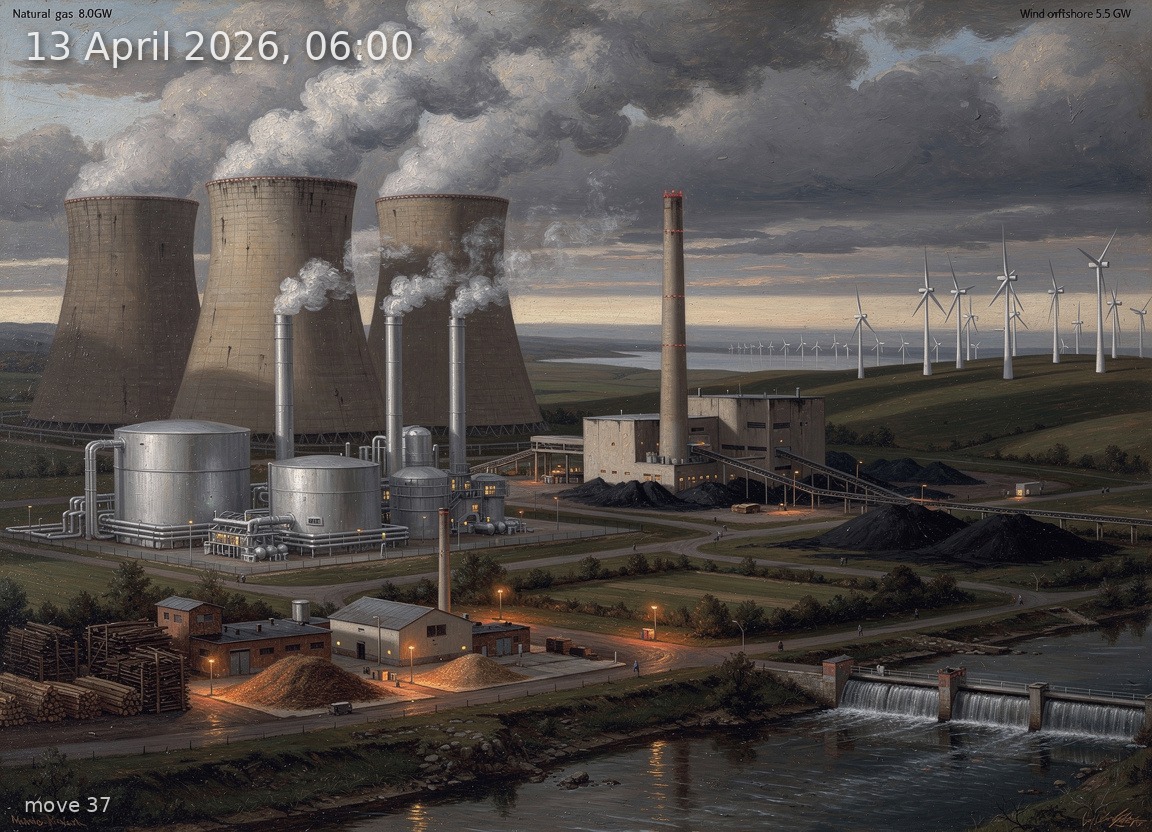
Brown coal, gas, and hard coal dominate early-morning generation as overcast skies and light winds drive 20.5 GW of net imports.
Back
Generation mix
Wind onshore 16%
Wind offshore 6%
Solar 0%
Biomass 13%
Hydro 5%
Natural gas 23%
Hard coal 13%
Brown coal 25%
39%
Renewable share
7.4 GW
Wind (on + offshore)
0.1 GW
Solar
35.0 GW
Total generation
-20.6 GW
Net import
136.1 €/MWh
Day-ahead price
7.8°C / 5 km/h
Temp / Wind speed
Open-Meteo, Kassel (51.3°N 9.5°E)
100% / 0.0 W/m²
Cloud cover / Radiation
415
gCO₂/kWh
Image prompt
Brown coal 8.9 GW occupies the left third of the scene as a massive lignite power complex with four hyperbolic cooling towers emitting thick pale steam plumes; natural gas 8.0 GW fills the centre-left as two modern CCGT plants with tall slender exhaust stacks venting thin white vapour; hard coal 4.4 GW appears centre-right as a coal-fired station with a single large chimney and conveyor belts feeding dark fuel; wind onshore 5.5 GW is rendered as a line of fifteen large three-blade turbines on gentle hills in the right background, rotors barely turning in the still air; wind offshore 1.9 GW appears as a distant cluster of turbines on the far-right horizon above a grey sea inlet; biomass 4.4 GW shows as a wood-chip-fueled CHP plant with a modest stack and timber yard in the centre foreground; hydro 1.8 GW is a small run-of-river dam with spillway visible at the lower right. TIME: early dawn at 06:00 in April — the sky is deep blue-grey with only the faintest pale lavender pre-dawn glow along the eastern horizon, no direct sunlight, no sun disc visible; the landscape is mostly dark, lit by sodium-orange industrial lighting on the power plants and faint amber reflections on wet surfaces. WEATHER: 100% overcast, a thick uniform grey cloud deck presses low and heavy over the entire scene, temperature near 8°C so early spring vegetation is sparse green-brown, bare branches on deciduous trees, patches of dew on grass. ATMOSPHERE: oppressive and heavy, reflecting the high 136 EUR/MWh price — the low clouds seem to press down on the cooling towers, steam merges with cloud base, the air feels dense and costly. NO solar panels visible anywhere. Painted in the style of a highly detailed 19th-century German Romantic oil painting — rich impasto brushwork, Caspar David Friedrich's atmospheric depth combined with meticulous industrial-engineering accuracy: visible turbine nacelles, lattice towers, aluminium-clad plant buildings, steel pipe runs on the CCGT, and hyperbolic concrete cooling tower textures. Warm industrial oranges contrast against cold blue-grey dawn. No text, no labels.