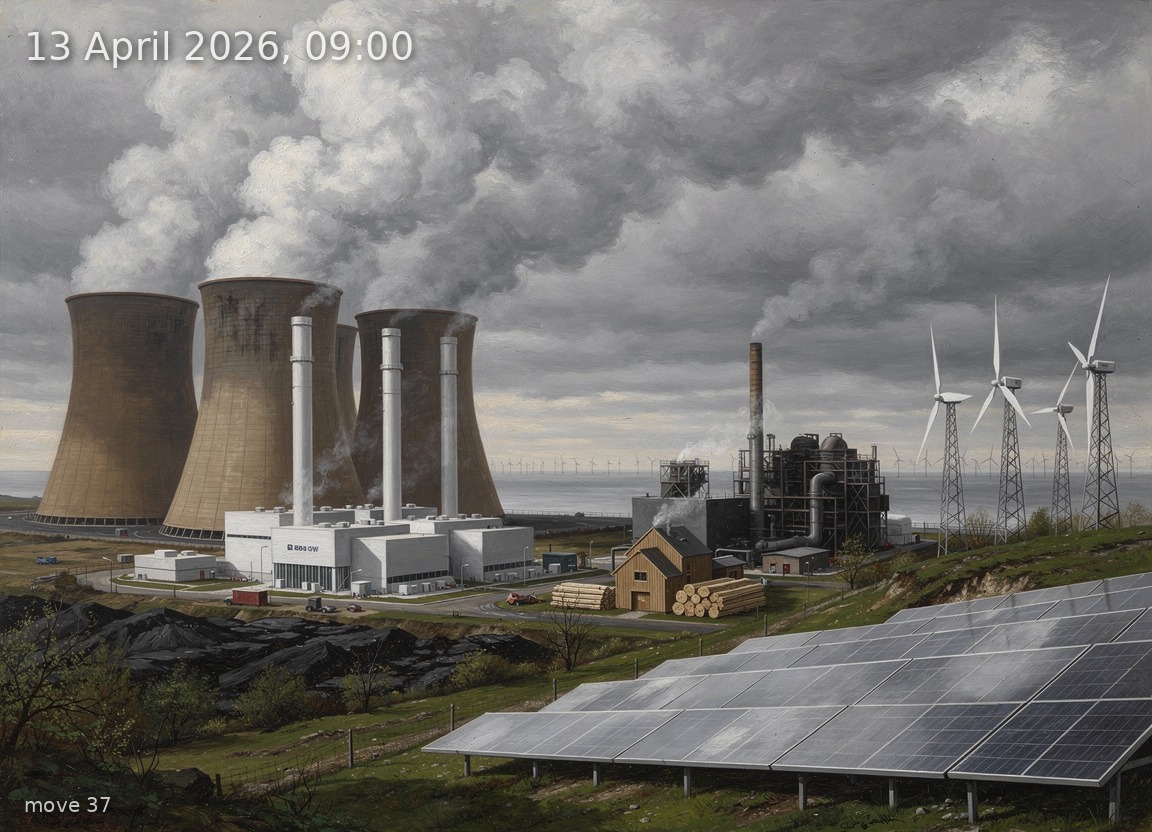
Overcast skies and light winds force heavy coal, gas, and 21.6 GW net imports to meet strong morning demand.
Back
Generation mix
Wind onshore 14%
Wind offshore 2%
Solar 18%
Biomass 10%
Hydro 4%
Natural gas 21%
Hard coal 12%
Brown coal 19%
48%
Renewable share
6.7 GW
Wind (on + offshore)
7.6 GW
Solar
42.6 GW
Total generation
-21.5 GW
Net import
161.0 €/MWh
Day-ahead price
8.3°C / 7 km/h
Temp / Wind speed
Open-Meteo, Kassel (51.3°N 9.5°E)
100% / 2.2 W/m²
Cloud cover / Radiation
349
gCO₂/kWh
Image prompt
Brown coal 8.1 GW dominates the left quarter as a cluster of massive hyperbolic cooling towers with thick white-grey steam plumes merging into the overcast sky; natural gas 8.8 GW fills the centre-left as several compact CCGT plants with tall single exhaust stacks venting translucent heat shimmer; hard coal 5.2 GW appears centre-right as a dark industrial complex with squat rectangular boiler houses and a tall chimney trailing pale smoke; wind onshore 5.8 GW occupies the right portion of the scene as a modest row of three-blade turbines on lattice and tubular towers turning slowly in light wind; wind offshore 1.0 GW is suggested far in the background as tiny turbines on a grey sea horizon; solar 7.6 GW appears as a field of aluminium-framed crystalline silicon panels in the foreground right, their surfaces dull and reflective only of grey cloud, producing weakly under the thick overcast; biomass 4.4 GW is rendered as a wood-clad industrial facility with a modest smokestack and stacked timber beside it, positioned mid-ground between coal and wind; hydro 1.8 GW appears as a concrete dam and spillway nestled into low green hills at the far right edge. The sky is entirely covered by a low, heavy, unbroken blanket of grey stratus cloud — no blue sky visible, no direct sunlight — yet the scene is lit by diffuse April morning daylight at 09:00, casting flat shadowless illumination. The atmosphere feels oppressive and heavy, reflecting the 161 EUR/MWh price. Vegetation is early spring: pale green buds on bare deciduous trees, cool damp grass. Temperature around 8°C gives a chill dampness — faint mist clings to the river valleys. High-voltage transmission lines with lattice pylons cross the entire scene, symbolising the 21.6 GW flowing in from neighbouring countries. Rendered as a highly detailed oil painting in the tradition of 19th-century German Romantic landscape painters — rich earth tones, slate greys, muted greens, visible confident brushwork, atmospheric depth and aerial perspective — but with meticulous engineering accuracy on every turbine nacelle, cooling tower hyperbolic curve, PV panel frame, and CCGT exhaust stack. The composition evokes Caspar David Friedrich's sense of human smallness before vast forces, here industrial rather than natural. No text, no labels.