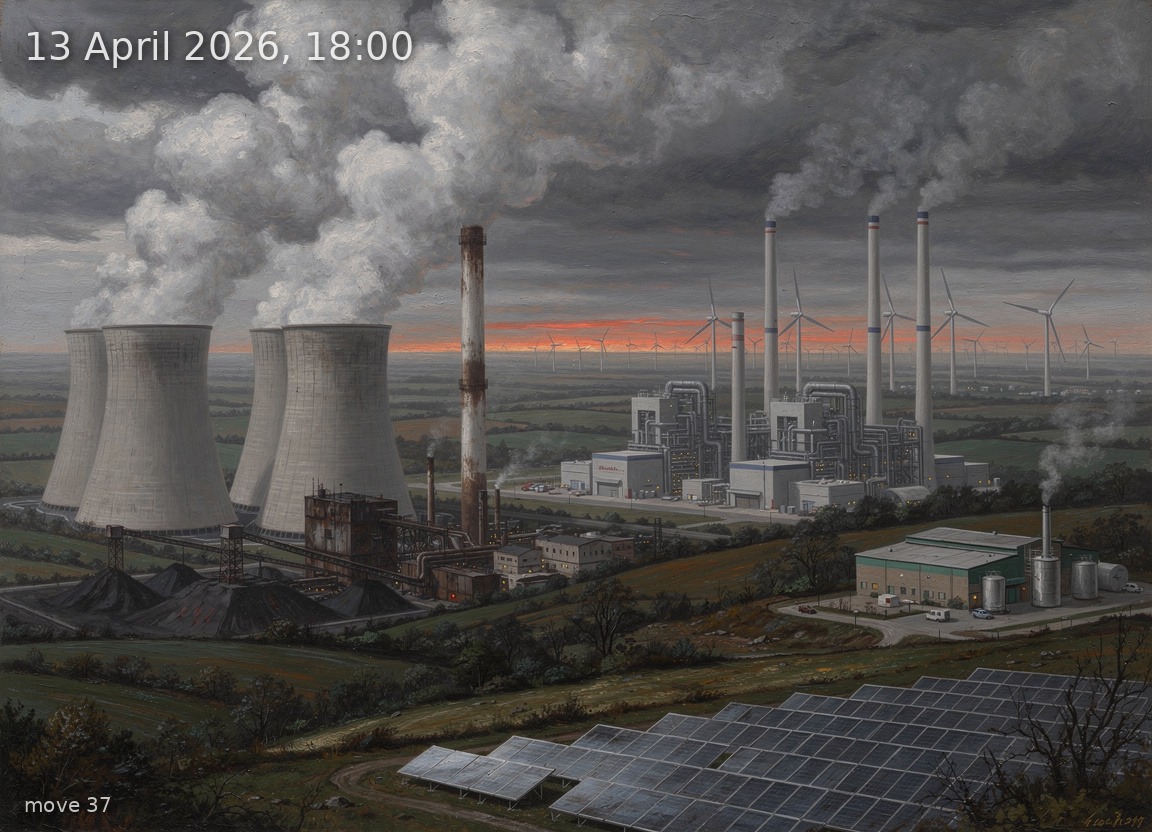
Gas, brown coal, and hard coal dominate as overcast skies and light winds suppress renewables during peak evening demand.
Back
Generation mix
Wind onshore 21%
Wind offshore 5%
Solar 6%
Biomass 11%
Hydro 4%
Natural gas 23%
Hard coal 14%
Brown coal 16%
47%
Renewable share
10.7 GW
Wind (on + offshore)
2.7 GW
Solar
42.0 GW
Total generation
-19.9 GW
Net import
148.2 €/MWh
Day-ahead price
10.9°C / 9 km/h
Temp / Wind speed
Open-Meteo, Kassel (51.3°N 9.5°E)
100% / 0.0 W/m²
Cloud cover / Radiation
351
gCO₂/kWh
Image prompt
Natural gas 9.6 GW dominates the centre-right as a cluster of modern CCGT power plants with tall slender exhaust stacks venting pale steam; brown coal 6.9 GW occupies the left foreground as massive hyperbolic cooling towers with thick white plumes rising into the heavy sky; hard coal 5.8 GW appears as a gritty coal-fired station with conveyors and a single large smokestack slightly left of centre; wind onshore 8.7 GW is represented by a long line of three-blade turbines on a ridge in the middle distance, rotors turning slowly; wind offshore 1.9 GW appears as a faint cluster of turbines on the far horizon; biomass 4.5 GW is a modest wood-chip-fed plant with a green-tinged building and low exhaust near the right edge; solar 2.7 GW appears as a small field of aluminium-framed crystalline silicon panels in the right foreground, their surfaces dull and reflecting only grey sky; hydro 1.8 GW is a small run-of-river station with a weir visible at the far right beside a dark river. Time of day is 18:00 in April—dusk lighting with a thin band of orange-red glow at the lower horizon fading rapidly into a dark, heavy, fully overcast sky above, oppressive and brooding atmosphere reflecting the extreme electricity price. The landscape is early-spring central German rolling hills with sparse fresh green buds on bare deciduous trees, brown-green meadows, wet ground. The air feels damp and still, with almost no wind motion in vegetation despite the slowly turning turbine blades. High-tension transmission pylons stretch across the middle ground, cables sagging with the weight of massive power flows. Highly detailed oil painting in the tradition of 19th-century German Romantic landscape painters—Caspar David Friedrich meets industrial sublime—rich impasto brushwork, dramatic chiaroscuro, atmospheric depth with layers of haze and steam merging into the overcast. Each technology rendered with meticulous engineering accuracy: nacelle housings, lattice tower structures, cooling tower parabolic curves, conveyor belt rigging, transformer substations. The mood is solemn and weighty, a vast industrial tableau under a suffocating grey canopy. No text, no labels.