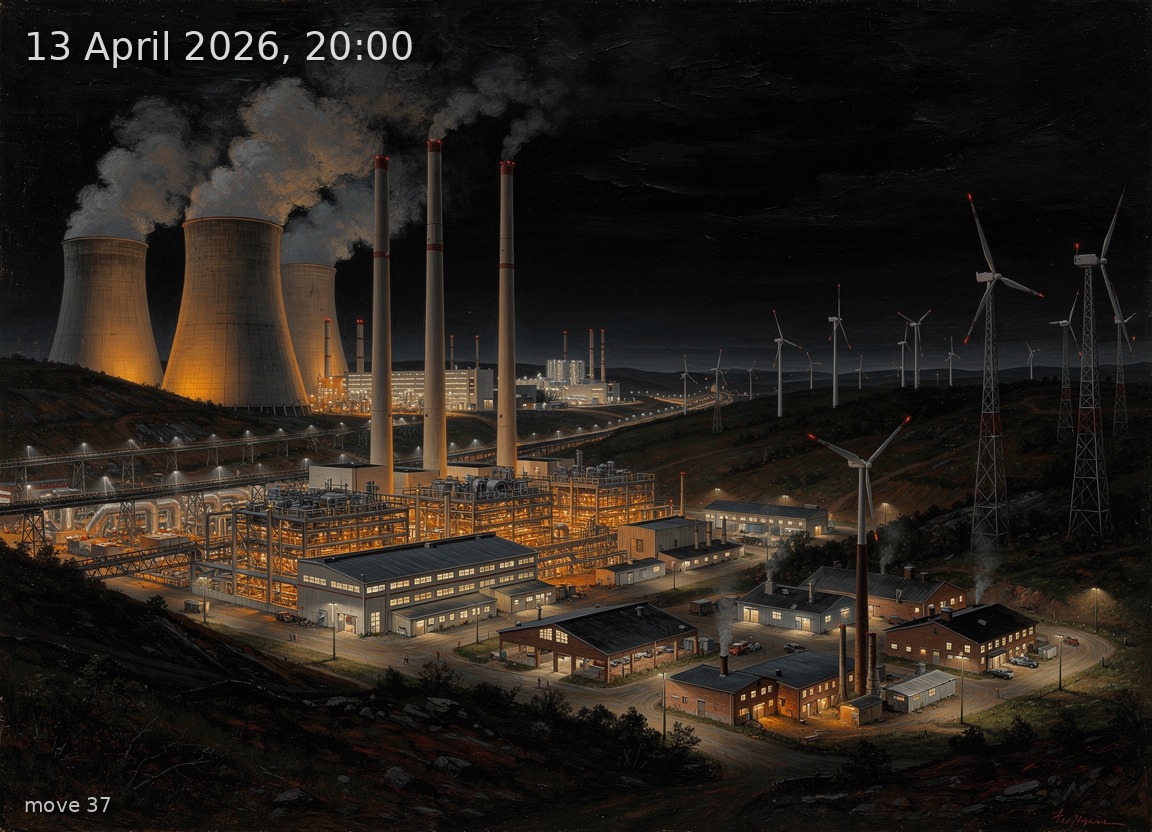
Gas, brown coal, and wind lead domestic generation while 19.6 GW of net imports cover evening peak demand under overcast skies.
Back
Generation mix
Wind onshore 24%
Wind offshore 4%
Solar 0%
Biomass 11%
Hydro 5%
Natural gas 24%
Hard coal 14%
Brown coal 17%
44%
Renewable share
11.7 GW
Wind (on + offshore)
0.0 GW
Solar
40.8 GW
Total generation
-19.6 GW
Net import
156.6 €/MWh
Day-ahead price
9.2°C / 11 km/h
Temp / Wind speed
Open-Meteo, Kassel (51.3°N 9.5°E)
100% / 0.0 W/m²
Cloud cover / Radiation
366
gCO₂/kWh
Image prompt
Natural gas 9.9 GW dominates the center-left as a sprawling CCGT power station complex with tall single-flue exhaust stacks emitting pale heat shimmer, lit by sodium-orange industrial floodlights. Wind onshore 9.9 GW fills the right third of the composition as dozens of three-blade turbines on lattice and tubular towers stretching across rolling dark hills, red aviation warning lights blinking on nacelles. Brown coal 7.0 GW occupies the far left as massive hyperbolic cooling towers releasing thick white steam plumes that dissolve upward into blackness, with conveyor belts of lignite faintly visible under arc lights. Hard coal 5.7 GW appears as a mid-ground coal-fired station with rectangular chimneys and glowing ash, smaller than the lignite plant but prominent. Biomass 4.6 GW is rendered as a cluster of wood-chip-fed CHP facilities with modest stacks and warm amber-lit buildings in the middle distance. Hydro 1.9 GW appears as a concrete dam structure nestled in a valley at the far right, spillway illuminated by white floodlights. Wind offshore 1.7 GW is suggested as a distant row of turbines on a dark horizon line, their red lights forming a faint dotted chain. No solar panels anywhere — it is fully night. The sky is completely black with a heavy 100% overcast ceiling, no stars, no moon, no twilight glow whatsoever — only the oppressive low cloud base faintly reflecting the amber and white industrial lights below. The atmosphere is dense and heavy, suggesting high energy prices — haze and steam merge overhead in a suffocating canopy. Early spring vegetation: bare branches on scattered deciduous trees, damp dark-green grass. Temperature around 9°C conveyed by mist clinging to low ground. Painted in the style of a highly detailed 19th-century German Romantic oil painting — rich impasto brushwork, dramatic chiaroscuro between industrial light and surrounding darkness, atmospheric depth receding into murky distance — yet every turbine nacelle, cooling tower hyperbolic curve, and CCGT exhaust stack rendered with meticulous engineering accuracy. No text, no labels.