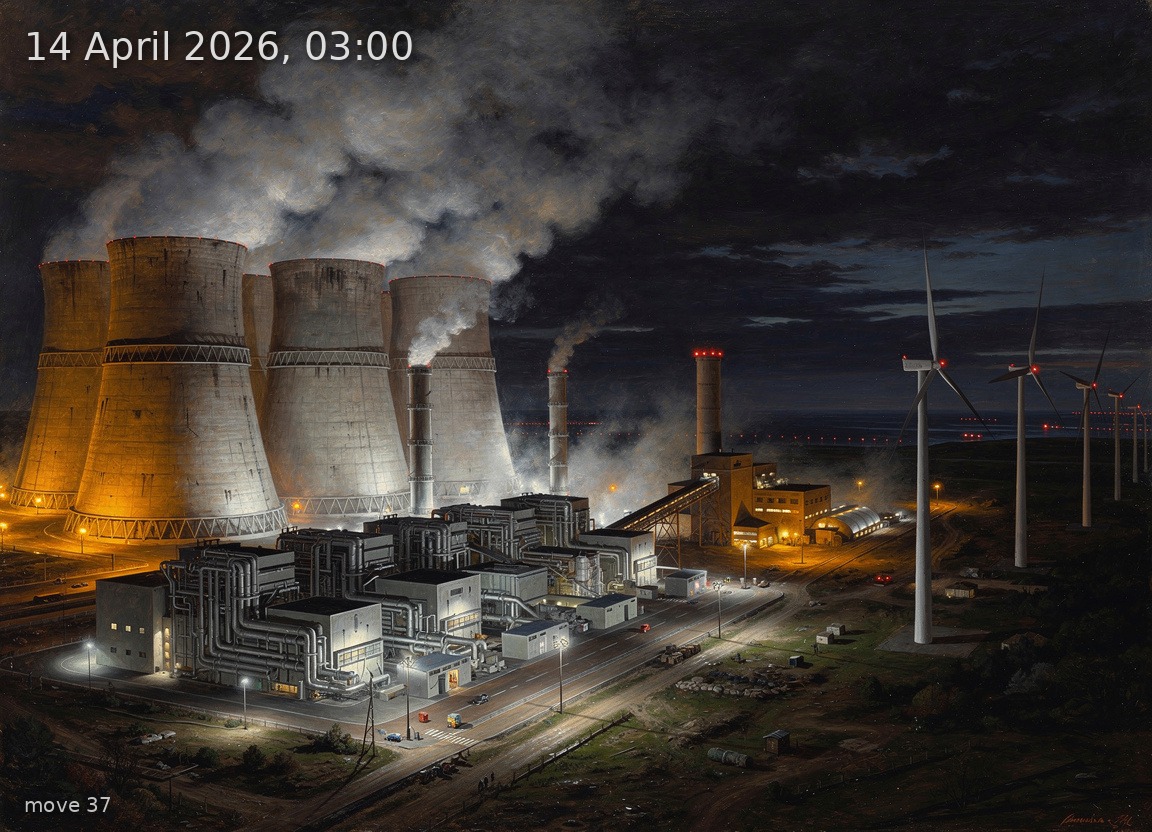
Brown coal, gas, and hard coal dominate overnight generation while 7.8 GW of net imports cover remaining demand.
Back
Generation mix
Wind onshore 20%
Wind offshore 7%
Biomass 11%
Hydro 4%
Natural gas 23%
Hard coal 12%
Brown coal 24%
42%
Renewable share
10.3 GW
Wind (on + offshore)
0.0 GW
Solar
37.9 GW
Total generation
-7.8 GW
Net import
113.4 €/MWh
Day-ahead price
7.2°C / 10 km/h
Temp / Wind speed
Open-Meteo, Kassel (51.3°N 9.5°E)
100% / 0.0 W/m²
Cloud cover / Radiation
392
gCO₂/kWh
Image prompt
Brown coal 9.0 GW dominates the left third of the scene as a cluster of massive hyperbolic cooling towers with thick white steam plumes rising into the black sky, their concrete forms lit from below by sodium-orange industrial floodlights; natural gas 8.5 GW fills the centre-left as a row of compact CCGT power blocks with tall single exhaust stacks venting translucent heat plumes, lit by harsh white security lighting; hard coal 4.4 GW appears centre-right as a smaller coal-fired station with a single rectangular stack and conveyor belts, glowing amber; wind onshore 7.8 GW spans the right third as a line of modern three-blade turbines on lattice-free tubular towers receding into the darkness, their red aviation warning lights blinking; wind offshore 2.6 GW is suggested by distant red dots on the far-right horizon over a dark sea; biomass 4.1 GW appears as a medium-sized industrial plant with a wood-chip storage dome and a single chimney, warmly lit; hydro 1.6 GW is a small dam structure in the foreground with water glinting under floodlights. The sky is completely black to deep navy, no moon, no twilight — 03:00 in April, fully dark. Complete overcast at 100% cloud cover means no stars are visible; the clouds only faintly reflect the industrial glow from below. Temperature is 7°C: early spring, bare branches on deciduous trees, frost on grass edges. Moderate wind animates the turbine blades and bends plumes sideways. The atmosphere feels heavy and oppressive, reflecting the high electricity price — a thick, brooding industrial haze hangs over the scene. Painted in the style of a highly detailed 19th-century German Romantic oil painting — rich impasto brushwork, deep chiaroscuro, atmospheric sfumato in the steam and haze — yet every piece of engineering is rendered with meticulous technical accuracy: nacelle housings, three-blade rotor geometry, aluminium cooling tower lattice rings, CCGT turbine exhaust diffusers. No text, no labels.