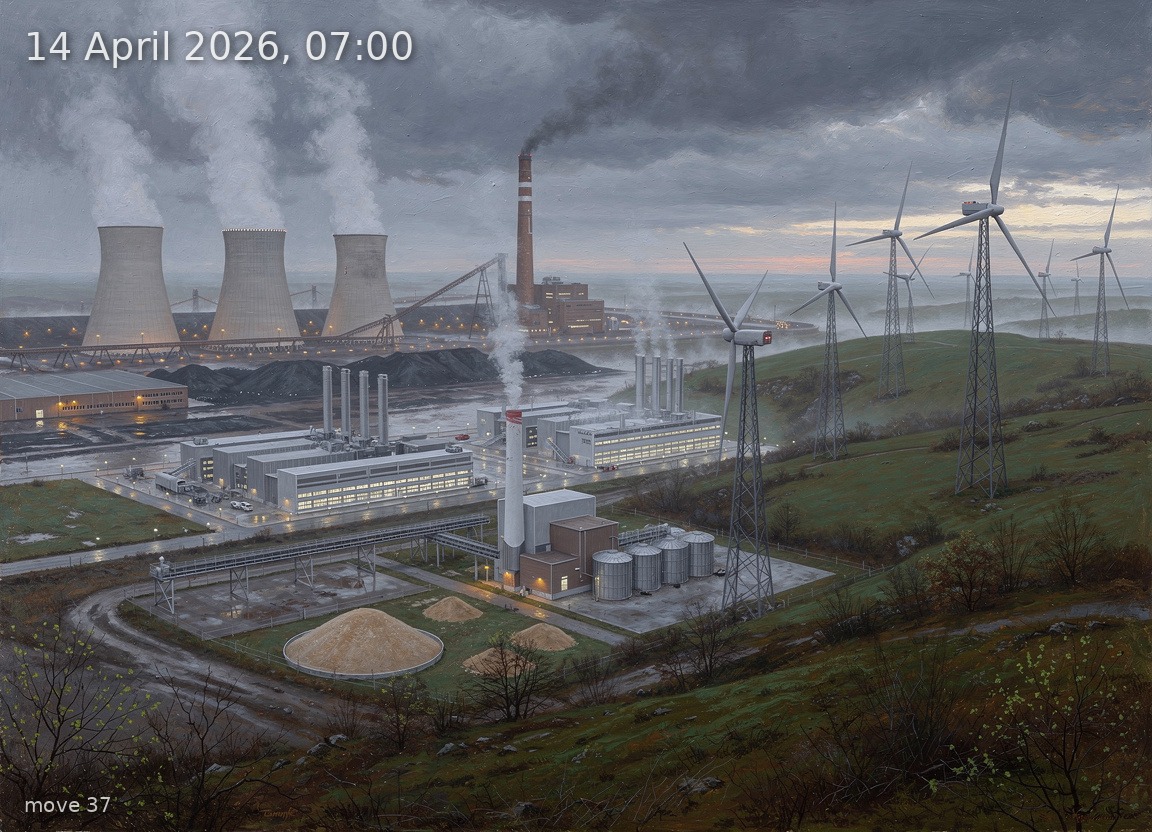
Brown coal and natural gas dominate as overcast skies, light winds, and 20 GW net imports define a tight spring morning.
Back
Generation mix
Wind onshore 16%
Wind offshore 6%
Solar 5%
Biomass 11%
Hydro 4%
Natural gas 24%
Hard coal 10%
Brown coal 23%
42%
Renewable share
9.2 GW
Wind (on + offshore)
2.0 GW
Solar
41.2 GW
Total generation
-20.2 GW
Net import
163.0 €/MWh
Day-ahead price
6.8°C / 4 km/h
Temp / Wind speed
Open-Meteo, Kassel (51.3°N 9.5°E)
100% / 0.0 W/m²
Cloud cover / Radiation
386
gCO₂/kWh
Image prompt
Brown coal 9.6 GW dominates the left quarter of the scene as a massive lignite power station with four hyperbolic cooling towers billowing thick white steam into the grey sky; natural gas 9.9 GW occupies the centre-left as a row of modern CCGT plants with slender exhaust stacks releasing thin transparent plumes; wind onshore 6.7 GW fills the centre-right as a cluster of three-blade turbines on lattice towers across rolling green hills, their rotors barely turning in negligible wind; wind offshore 2.5 GW appears as a distant line of turbines on a grey North Sea horizon at far right; biomass 4.4 GW is rendered as a mid-sized industrial plant with a rectangular stack and wood-chip storage silos between the gas plant and the onshore turbines; hard coal 4.3 GW sits behind the brown coal station as a smaller conventional plant with a single tall chimney and conveyor belt; hydro 1.8 GW appears as a concrete dam and spillway cut into a forested hillside at far left; solar 2.0 GW is shown as a modest field of aluminium-framed crystalline silicon panels in the foreground, their surfaces dull and reflecting only flat grey light. The time is early dawn at 07:00 in April: the sky is deep blue-grey with the faintest pale glow along the eastern horizon, no direct sunlight, and 100 percent cloud cover forming a heavy unbroken overcast that presses down oppressively, evoking the high electricity price. The temperature is a chilly 6.8 °C; vegetation is early spring — bare branches with the first tentative green buds, brown-green grass, patches of mud. High-voltage transmission pylons march across the mid-ground, symbolising the heavy import flows. Rendered as a highly detailed oil painting in the tradition of 19th-century German Romantic landscape painters — rich, sombre colour palette of slate greys, muted greens, and warm amber from industrial lighting, visible impasto brushwork, deep atmospheric perspective with mist and haze clinging to valleys, meticulous engineering detail on every turbine nacelle, cooling tower, and exhaust stack. No text, no labels.