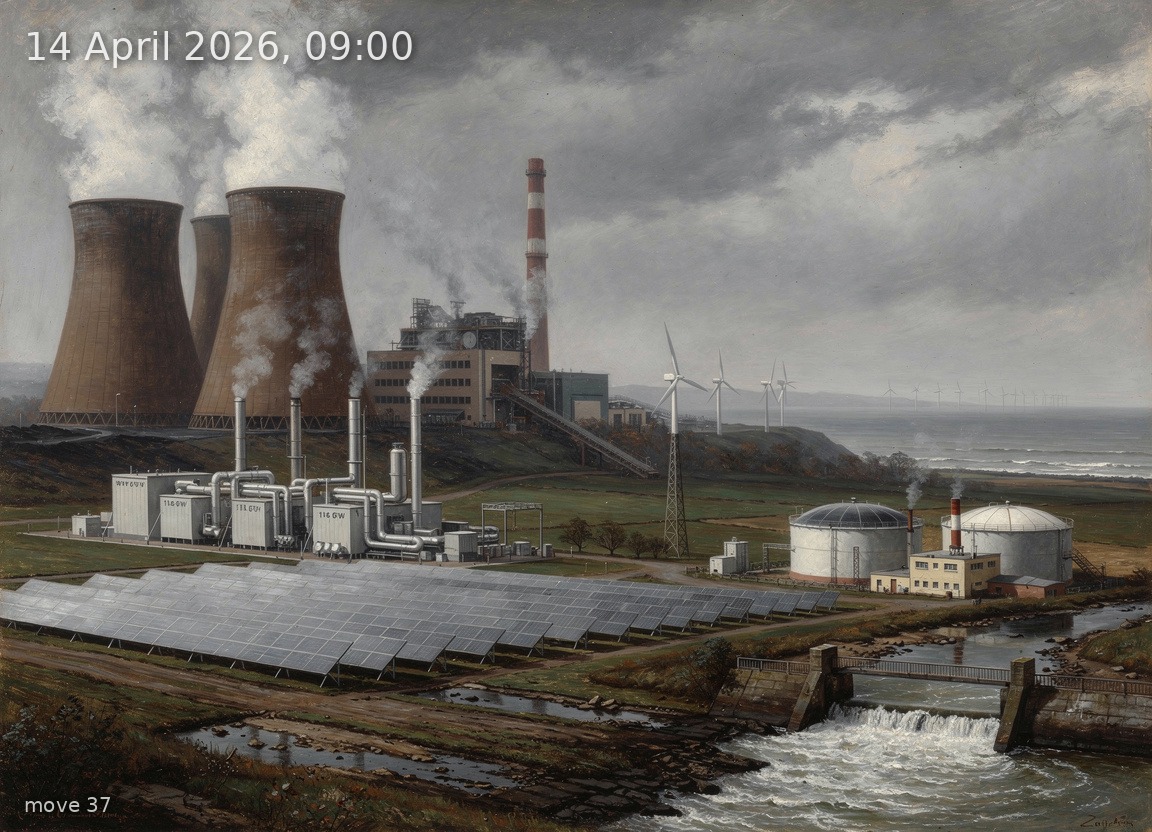
Heavy overcast suppresses solar, forcing brown coal, gas, and 16.6 GW net imports to meet strong morning demand.
Back
Generation mix
Wind onshore 10%
Wind offshore 4%
Solar 24%
Biomass 9%
Hydro 3%
Natural gas 20%
Hard coal 9%
Brown coal 20%
51%
Renewable share
6.8 GW
Wind (on + offshore)
11.6 GW
Solar
47.7 GW
Total generation
-16.5 GW
Net import
144.3 €/MWh
Day-ahead price
7.6°C / 10 km/h
Temp / Wind speed
Open-Meteo, Kassel (51.3°N 9.5°E)
95% / 23.0 W/m²
Cloud cover / Radiation
330
gCO₂/kWh
Image prompt
Brown coal 9.7 GW dominates the left quarter as a massive lignite power station with four hyperbolic cooling towers emitting thick white steam plumes into the overcast sky; natural gas 9.7 GW fills the centre-left as a cluster of modern CCGT plants with tall single exhaust stacks and compact turbine halls trailing lighter exhaust; solar 11.6 GW occupies the centre as a broad field of aluminium-framed crystalline silicon PV panels stretching across flat farmland, their surfaces dull and grey under heavy cloud with no glint or reflection; wind onshore 4.9 GW appears centre-right as a modest line of three-blade turbines on lattice towers, rotors turning slowly in light breeze; wind offshore 1.9 GW is visible in the far right distance as a handful of turbines on a hazy grey horizon above a sliver of the North Sea; hard coal 4.1 GW sits behind the brown coal complex as a smaller conventional power station with a single large smokestack and coal conveyor belts; biomass 4.3 GW appears as a pair of industrial biogas plants with cylindrical digesters and small chimneys with faint heat shimmer; hydro 1.6 GW is represented by a modest run-of-river weir with spillway in the lower right foreground. The sky is entirely overcast at 95% cloud cover—a low, uniform blanket of grey stratus with no blue visible, diffuse daylight at 09:00 Berlin time casting flat, shadowless illumination typical of a dull April morning. The atmosphere feels heavy and oppressive, reflecting 144.3 EUR/MWh pricing—air thick with industrial haze, muted tones, the horizon lost in murk. Temperature 7.6°C: early spring vegetation, bare branches with just the first pale-green buds on deciduous trees, damp brown grass, puddles on unpaved ground. Style: highly detailed oil painting in the tradition of 19th-century German Romantic landscape painters—rich dark palette of slate greys, umber browns, and muted greens, visible impasto brushwork, atmospheric perspective with industrial structures receding into fog, meticulous engineering detail on every turbine nacelle, cooling tower, and panel frame. No text, no labels.