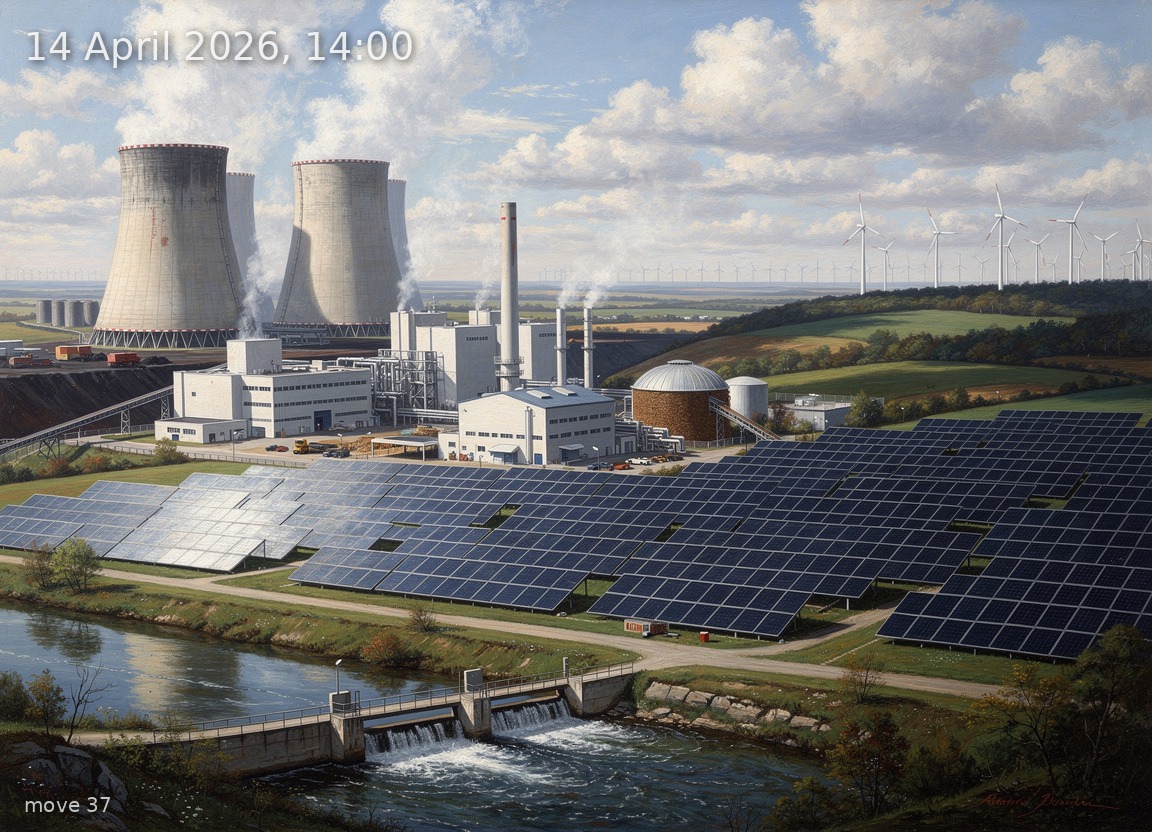
Solar leads at 24.9 GW but thermal plants and 6.3 GW net imports are needed to meet 61 GW demand.
Back
Generation mix
Wind onshore 12%
Wind offshore 2%
Solar 45%
Biomass 7%
Hydro 3%
Natural gas 12%
Hard coal 7%
Brown coal 12%
69%
Renewable share
7.4 GW
Wind (on + offshore)
24.9 GW
Solar
54.7 GW
Total generation
-6.2 GW
Net import
108.9 €/MWh
Day-ahead price
13.2°C / 12 km/h
Temp / Wind speed
Open-Meteo, Kassel (51.3°N 9.5°E)
52% / 418.2 W/m²
Cloud cover / Radiation
209
gCO₂/kWh
Image prompt
Solar 24.9 GW dominates the centre and right of the composition as vast fields of aluminium-framed crystalline silicon photovoltaic panels stretching across gentle rolling hills, angled south, glinting under a partly cloudy spring sky with roughly half cloud cover and strong direct sunlight breaking through. Brown coal 6.7 GW occupies the left background as a cluster of massive hyperbolic concrete cooling towers emitting thick white steam plumes, with conveyor belts carrying dark lignite visible at their base. Natural gas 6.3 GW appears as two modern combined-cycle gas turbine plants with tall slender exhaust stacks and compact turbine halls, positioned centre-left with thin heat shimmer rising from their stacks. Wind onshore 6.4 GW is rendered as a line of white three-blade turbines on lattice and tubular towers along a distant ridge to the right, blades turning slowly in light wind. Hard coal 3.8 GW shows as a single large coal-fired power station with a tall chimney and rectangular boiler house, positioned behind the solar fields on the left. Biomass 4.1 GW appears as a mid-sized industrial plant with a wood-chip storage dome and a modest smokestack near the centre. Wind offshore 1.0 GW is suggested by a faint row of turbines on a hazy horizon line far in the background. Hydro 1.5 GW is a small concrete dam with a narrow river flowing through the lower foreground. The lighting is full spring afternoon daylight at 14:00, sun high in the south casting defined shadows, sky a mix of cumulus clouds and bright blue patches, the atmosphere slightly heavy and hazy suggesting elevated electricity prices — a subtle amber-tinged industrial haze near the thermal plants. Vegetation is early spring: fresh pale-green budding trees, some bare branches, short grass turning green. Temperature around 13°C gives a cool crispness to the air. Style: highly detailed oil painting in the tradition of 19th-century German Romantic landscape painters such as Caspar David Friedrich and Carl Blechen, with rich saturated colour, visible confident brushwork, dramatic atmospheric depth, and meticulous engineering accuracy on every turbine nacelle, PV module frame, cooling tower curve, and smokestack detail. The scene is a panoramic masterwork of Germany's industrial energy landscape, monumental yet intimately observed. No text, no labels.