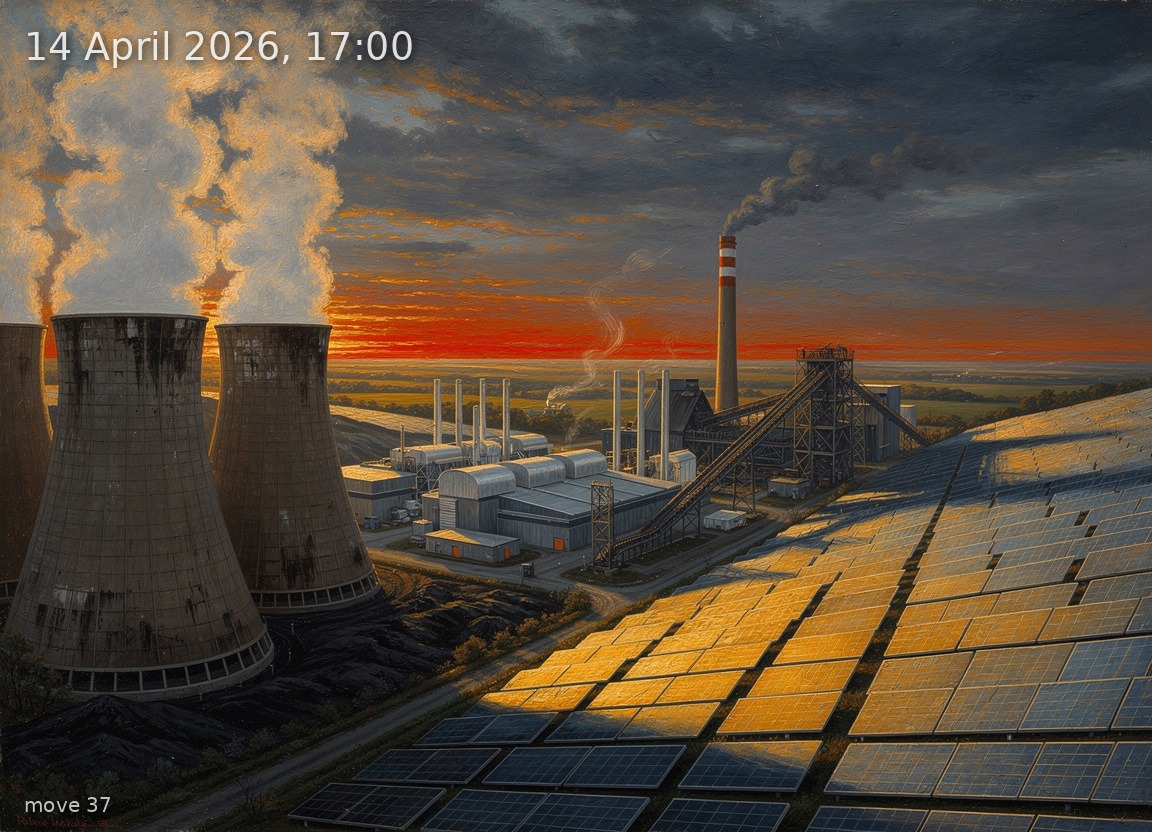
Solar fades at dusk while coal, gas, and 12 GW net imports cover Germany's 58 GW evening demand.
Back
Generation mix
Wind onshore 8%
Wind offshore 0%
Solar 28%
Biomass 9%
Hydro 3%
Natural gas 21%
Hard coal 10%
Brown coal 20%
49%
Renewable share
3.9 GW
Wind (on + offshore)
12.7 GW
Solar
45.7 GW
Total generation
-12.2 GW
Net import
137.4 €/MWh
Day-ahead price
14.6°C / 13 km/h
Temp / Wind speed
Open-Meteo, Kassel (51.3°N 9.5°E)
0% / 341.2 W/m²
Cloud cover / Radiation
340
gCO₂/kWh
Image prompt
Solar 12.7 GW fills the right third of the scene as vast fields of aluminium-framed crystalline silicon PV panels catching the last low-angle sunlight; brown coal 9.1 GW dominates the left quarter as three massive hyperbolic cooling towers emitting tall white steam plumes; natural gas 9.7 GW occupies the centre-left as a cluster of compact CCGT power blocks with slim vertical exhaust stacks releasing thin heat shimmer; hard coal 4.5 GW appears as a mid-ground coal plant with a single large smokestack and conveyor belt infrastructure; biomass 4.3 GW is rendered as a wood-chip-fed CHP plant with a broad cylindrical silo and modest steam vent; wind onshore 3.7 GW shows a short row of three-blade turbines with white tubular towers on a gentle hill in the mid-distance, blades turning slowly in light wind; hydro 1.6 GW appears as a small dam with spillway visible in a valley at far right; wind offshore 0.2 GW is a single distant turbine silhouette on the horizon line. Time is 17:00 dusk in mid-April: the sun sits very low on the western horizon casting a deep orange-red glow along the lower sky, the upper sky transitioning from warm amber to deepening slate blue. The atmosphere feels heavy and oppressive, with a slightly hazy, tense quality reflecting the high electricity price. Spring vegetation — fresh green grass, budding deciduous trees at 14.6 °C — softens the industrial foreground. The landscape is a wide German plain stretching to a distant horizon. Style: highly detailed oil painting in the tradition of 19th-century German Romantic landscape painters such as Caspar David Friedrich and Carl Blechen — rich saturated colour, visible expressive brushwork, deep atmospheric perspective, dramatic chiaroscuro from the setting sun illuminating steam plumes and panel surfaces in golden light while shadows pool beneath the cooling towers. Meticulous engineering detail on every technology: turbine nacelles, lattice towers, panel wiring, cooling tower ribbing, conveyor gantries. No text, no labels.