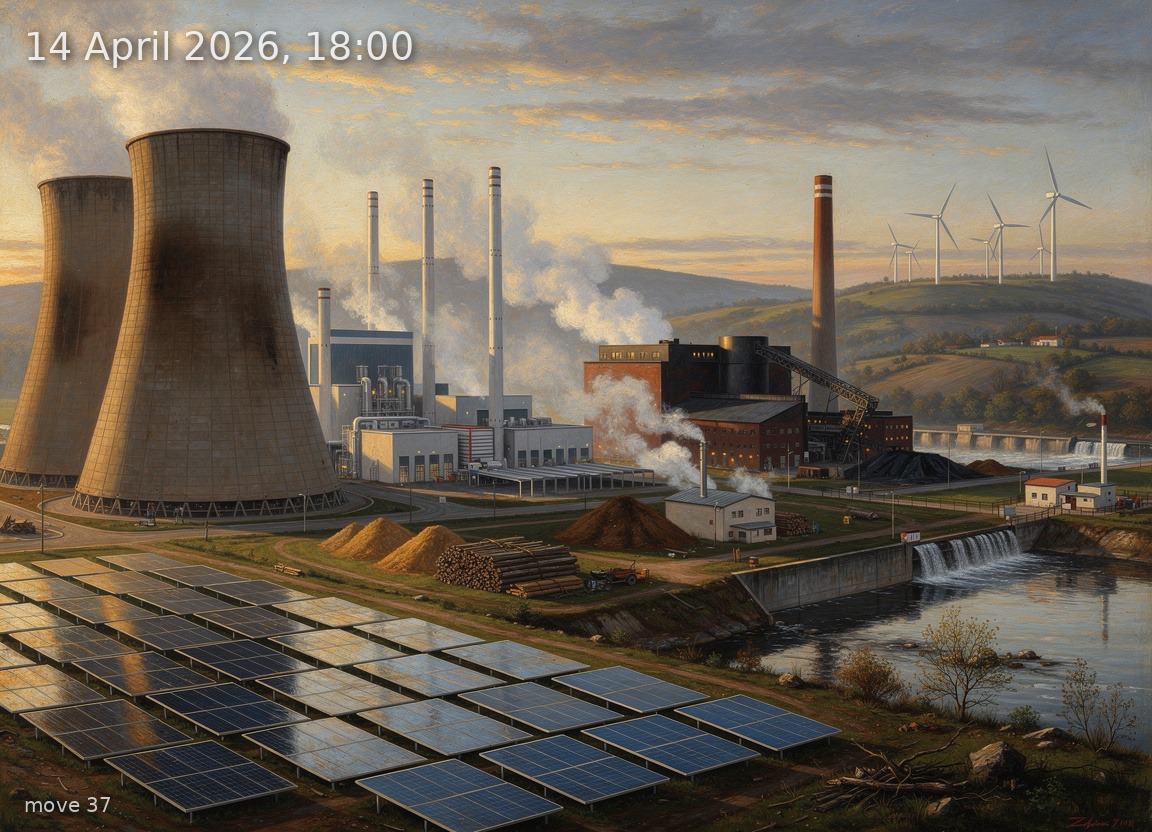
Gas, brown coal, and hard coal dominate as weak wind and fading solar force heavy thermal dispatch and 18.9 GW net imports.
Back
Generation mix
Wind onshore 7%
Wind offshore 0%
Solar 17%
Biomass 11%
Hydro 4%
Natural gas 27%
Hard coal 11%
Brown coal 22%
40%
Renewable share
2.9 GW
Wind (on + offshore)
6.7 GW
Solar
40.0 GW
Total generation
-18.9 GW
Net import
160.0 €/MWh
Day-ahead price
14.2°C / 10 km/h
Temp / Wind speed
Open-Meteo, Kassel (51.3°N 9.5°E)
0% / 206.0 W/m²
Cloud cover / Radiation
400
gCO₂/kWh
Image prompt
Brown coal 8.9 GW dominates the left quarter as a massive lignite power station with four hyperbolic cooling towers emitting thick white-grey steam plumes; natural gas 10.8 GW fills the centre-left as a cluster of modern CCGT plants with tall slender exhaust stacks trailing thin heat shimmer; hard coal 4.5 GW appears centre-right as a dark-bricked conventional power station with a single large chimney and coal conveyors; solar 6.7 GW is rendered as a broad field of aluminium-framed crystalline silicon panels in the right foreground catching the last amber rays; biomass 4.5 GW sits behind the solar field as a wood-chip-fed plant with a modest stack and timber storage yard; wind onshore 2.8 GW appears as a small group of three-blade turbines on a distant hill, rotors turning slowly in light breeze; hydro 1.7 GW is a small run-of-river station with visible weir at the far right edge beside a calm river. Dusk lighting at 18:00 in April: the lower horizon glows deep orange-red, the sky above transitions from warm amber to darkening blue-violet, long shadows stretch eastward across the landscape. The atmosphere feels heavy and oppressive — a faint industrial haze hangs in the middle distance, emphasising the high electricity price. Spring vegetation: fresh bright-green leaves on scattered birch and beech trees, green grass in the foreground, wildflowers just beginning. Light wind barely stirs the grass. Clear sky, zero cloud cover, with the first hint of Venus visible in the deepening upper sky. Highly detailed oil painting in the tradition of 19th-century German Romantic landscape painters — Caspar David Friedrich meets industrial sublime — rich saturated colour, visible confident brushwork, atmospheric aerial perspective with depth layers from foreground panels through mid-ground power stations to distant misty hills. Meticulous engineering detail on every technology: turbine nacelles, lattice tower structures, cooling tower curvature, PV cell grid patterns, conveyor belt mechanisms. No text, no labels.