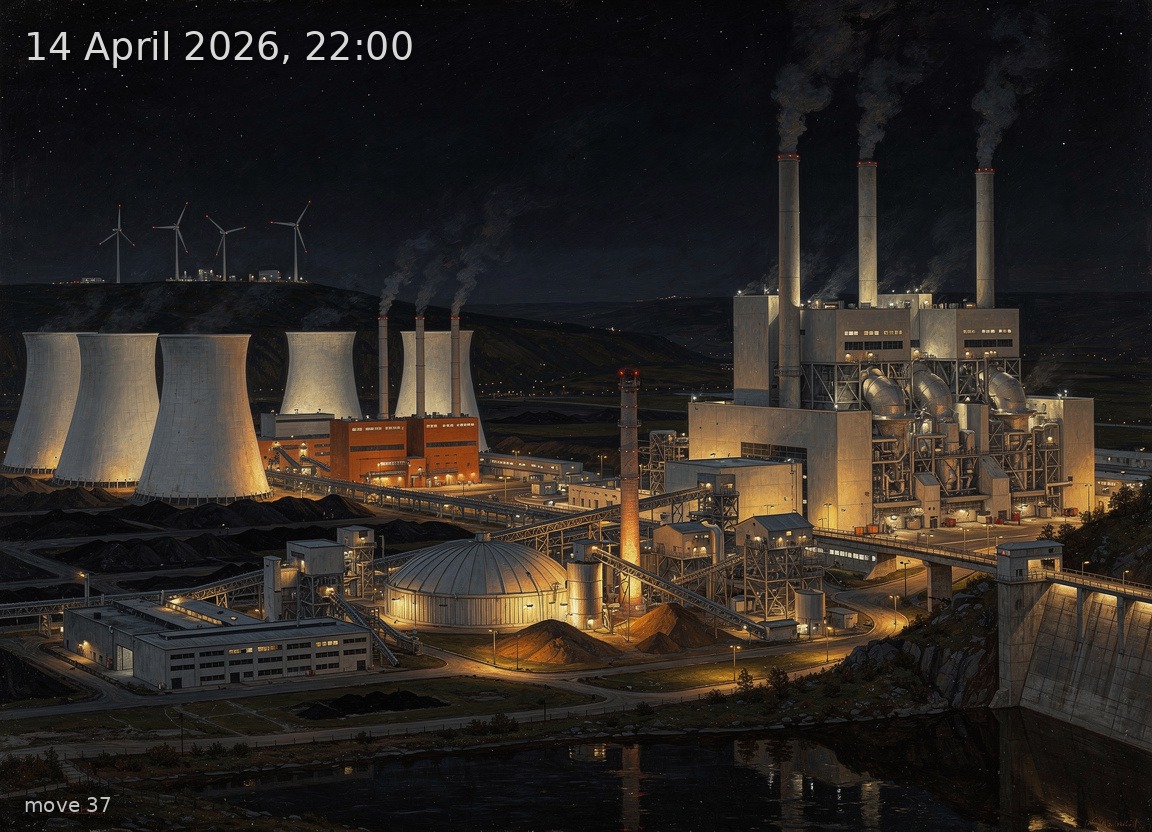
Gas, brown coal, and hard coal dominate a 33 GW domestic supply requiring ~20 GW net imports on a calm, dark night.
Back
Generation mix
Wind onshore 6%
Wind offshore 0%
Biomass 13%
Hydro 5%
Natural gas 33%
Hard coal 14%
Brown coal 28%
25%
Renewable share
2.3 GW
Wind (on + offshore)
0.0 GW
Solar
33.0 GW
Total generation
-20.3 GW
Net import
148.3 €/MWh
Day-ahead price
7.2°C / 3 km/h
Temp / Wind speed
Open-Meteo, Kassel (51.3°N 9.5°E)
0% / 0.0 W/m²
Cloud cover / Radiation
494
gCO₂/kWh
Image prompt
Natural gas 11.0 GW dominates the centre-right of the composition as a large cluster of CCGT power plants with tall single exhaust stacks venting pale plumes into the night; brown coal 9.2 GW fills the left third as massive hyperbolic cooling towers with thick white steam columns rising from a sprawling lignite complex, coal conveyors dimly visible; hard coal 4.5 GW appears as a smaller conventional power station with twin chimneys and orange-lit boiler houses in the centre-left middle ground; biomass 4.4 GW is rendered as a mid-sized industrial facility with a wood-chip storage dome and a single smokestack with a faint warm glow, positioned at centre; wind onshore 2.1 GW appears as a small cluster of three-blade turbines on a distant ridge, their rotors barely turning in the still air, red aviation lights blinking; hydro 1.6 GW is a concrete dam structure at the far right with water barely visible in reflected artificial light; offshore wind 0.2 GW is omitted. The sky is entirely black and cloudless, studded with faint stars, absolutely no twilight glow or sky brightness — deep night at 22:00 in April. All facilities are illuminated only by sodium-orange industrial floodlights, casting harsh pools of amber on concrete and steel. The atmosphere is heavy and oppressive, haze drifting between cooling towers, reflecting the high electricity price. Early spring vegetation — bare-branched trees with the first hints of leaf buds — lines a cold river in the foreground at 7°C, its surface glassy and still, mirroring the orange industrial glow. The landscape is flat central German lowland. Highly detailed oil painting in the tradition of 19th-century German Romantic landscape painters — rich, dark colour palette of deep navy, amber, and ash grey, visible confident brushwork, atmospheric depth and chiaroscuro, with meticulous engineering accuracy on every turbine nacelle, lattice tower, cooling tower hyperbolic curve, and exhaust stack. The scene conveys the monumental scale of thermal generation labouring through a windless night. No text, no labels.