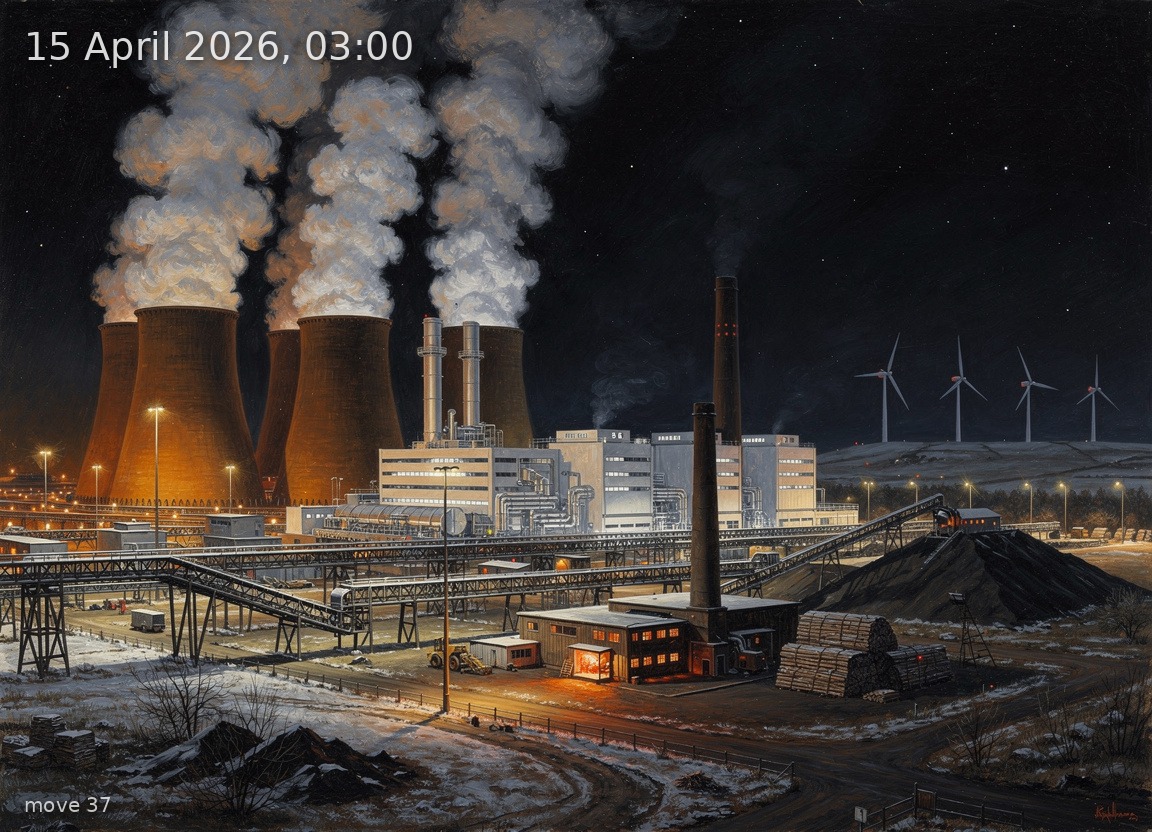
Brown coal, gas, and hard coal anchor a 34.7 GW overnight dispatch while 10.8 GW of net imports cover remaining demand.
Back
Generation mix
Wind onshore 11%
Wind offshore 4%
Biomass 12%
Hydro 4%
Natural gas 28%
Hard coal 13%
Brown coal 29%
31%
Renewable share
5.2 GW
Wind (on + offshore)
0.0 GW
Solar
34.7 GW
Total generation
-10.8 GW
Net import
110.0 €/MWh
Day-ahead price
3.5°C / 2 km/h
Temp / Wind speed
Open-Meteo, Kassel (51.3°N 9.5°E)
0% / 0.0 W/m²
Cloud cover / Radiation
465
gCO₂/kWh
Image prompt
Brown coal 9.9 GW dominates the left third of the scene as a cluster of massive hyperbolic cooling towers with thick white steam plumes rising into the black sky, lit from below by amber sodium lamps illuminating the lignite plant's conveyor belts and boiler houses; natural gas 9.6 GW fills the centre-left as a row of compact CCGT power blocks with tall single exhaust stacks venting thin heat shimmer, their metallic facades glowing under industrial floodlights; hard coal 4.4 GW appears centre-right as a smaller coal-fired station with a single rectangular chimney and coal stockpile, lit by yellow arc lights; biomass 4.1 GW is rendered as a modest wood-chip combustion facility with a low smokestack and glowing furnace windows near centre; wind onshore 3.9 GW appears as a line of five three-blade turbines on a low ridge in the right background, their red aviation warning lights blinking against the pitch-black sky, blades barely turning in the near-calm 2.4 km/h breeze; hydro 1.5 GW is suggested by a small dam structure with illuminated spillway at far right; wind offshore 1.3 GW is hinted at by tiny red navigation lights on the distant horizon line. The sky is completely dark — deep black to navy, no moon, perfectly clear with faint stars visible, zero cloud cover. The foreground shows a frost-dusted early-spring German lowland with bare trees just beginning to bud, dried grass silvered by facility light spill. The atmosphere is heavy and oppressive, conveying the tension of high electricity prices — a thick industrial haze hangs at low altitude, trapping the amber and white artificial light in a dense luminous fog near ground level. Rendered as a highly detailed oil painting in the tradition of 19th-century German Romantic landscape art — rich impasto brushwork, dramatic chiaroscuro between the blazing industrial facilities and the surrounding void of night, atmospheric depth receding into blackness, meticulous engineering detail on every cooling tower, turbine nacelle, lattice tower, and exhaust stack. No text, no labels.