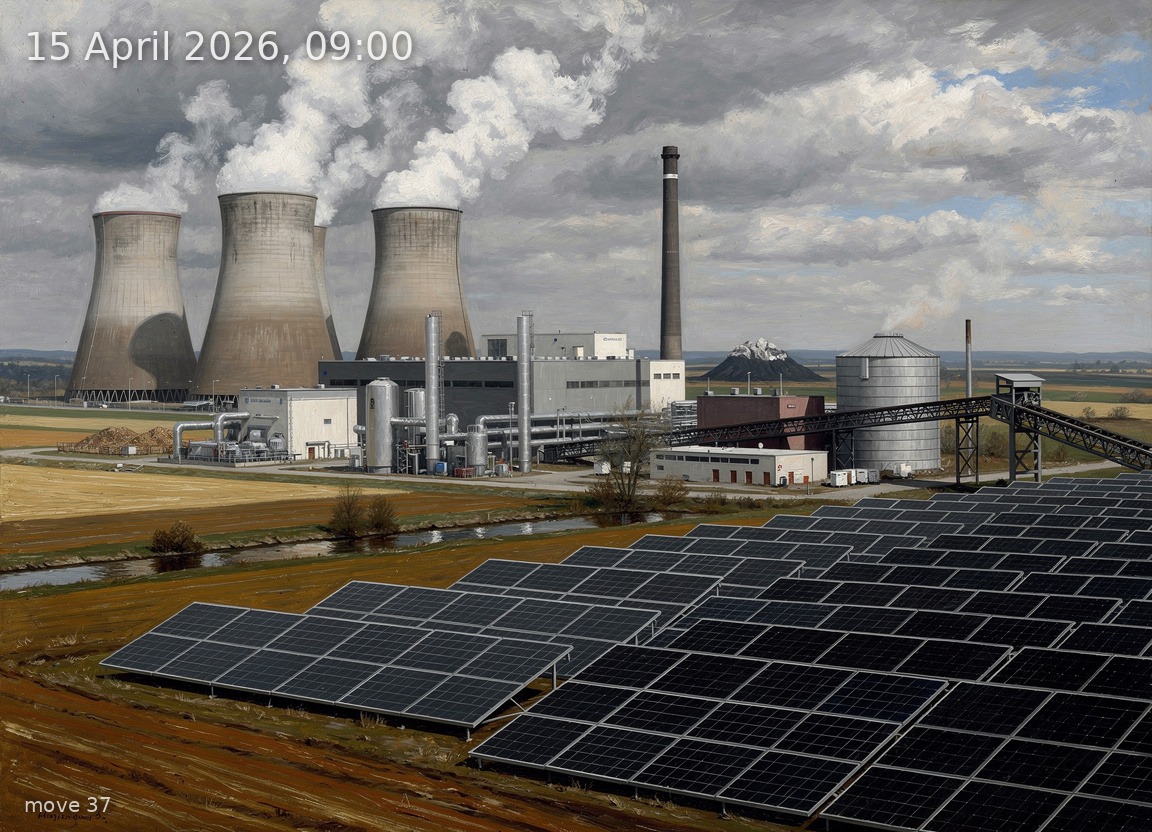
Solar leads at 24.8 GW but near-zero wind forces heavy coal and gas dispatch with 6.4 GW net imports.
Back
Generation mix
Wind onshore 4%
Wind offshore 2%
Solar 44%
Biomass 8%
Hydro 3%
Natural gas 14%
Hard coal 8%
Brown coal 17%
61%
Renewable share
3.3 GW
Wind (on + offshore)
24.8 GW
Solar
56.2 GW
Total generation
-6.4 GW
Net import
116.3 €/MWh
Day-ahead price
5.1°C / 1 km/h
Temp / Wind speed
Open-Meteo, Kassel (51.3°N 9.5°E)
66% / 97.8 W/m²
Cloud cover / Radiation
269
gCO₂/kWh
Image prompt
Solar 24.8 GW dominates the right half of the scene as vast fields of aluminium-framed crystalline silicon PV panels stretching across flat farmland, angled south, catching diffuse morning light; brown coal 9.5 GW occupies the far left as a massive lignite power station with four towering hyperbolic cooling towers emitting thick white steam plumes rising into grey sky; natural gas 8.1 GW appears left of centre as a cluster of modern combined-cycle gas turbine plants with slender cylindrical exhaust stacks releasing thin heat shimmer; hard coal 4.4 GW sits behind the gas plant as a smaller coal-fired station with a single large smokestack and conveyor belt; biomass 4.4 GW is rendered as a medium-sized industrial plant with a rounded wood-chip silo and short chimney releasing pale vapour, positioned centre-right at the edge of the solar fields; wind onshore 2.2 GW appears as a sparse handful of three-blade turbines on a distant ridge, their rotors virtually still in the calm air; wind offshore 1.0 GW is glimpsed as two or three tiny turbines on the far horizon suggesting a distant North Sea coast; hydro 1.6 GW is a small run-of-river weir with a stone powerhouse visible along a creek in the middle ground. The sky is an overcast April morning at 09:00 in Germany—full daylight but muted, with a 66% cloud layer of grey-white stratocumulus partially veiling a low sun that casts soft diffuse light with no sharp shadows; patches of blue peek through gaps in the clouds. The atmosphere feels heavy and oppressive, reflecting the high electricity price—a brooding, leaden quality to the air. The landscape is early spring in central Germany at 5°C: bare deciduous trees just beginning to show tiny green buds, pale brown dormant grass, patches of frost lingering in shadowed hollows, a chill stillness with no wind movement in branches or flags. Painted in the tradition of 19th-century German Romantic landscape art—Caspar David Friedrich meets industrial realism—with rich oil-paint textures, visible confident brushwork, atmospheric aerial perspective lending depth, warm ochres and cool slate greys in tonal contrast. Every technology is rendered with meticulous engineering accuracy: three-blade rotor assemblies on lattice towers, nacelle housings, PV panel grid lines, cooling tower parabolic curvature with condensation drift, CCGT heat-recovery units. No text, no labels, no human figures prominent—just the vast industrial energy landscape under a brooding spring sky.