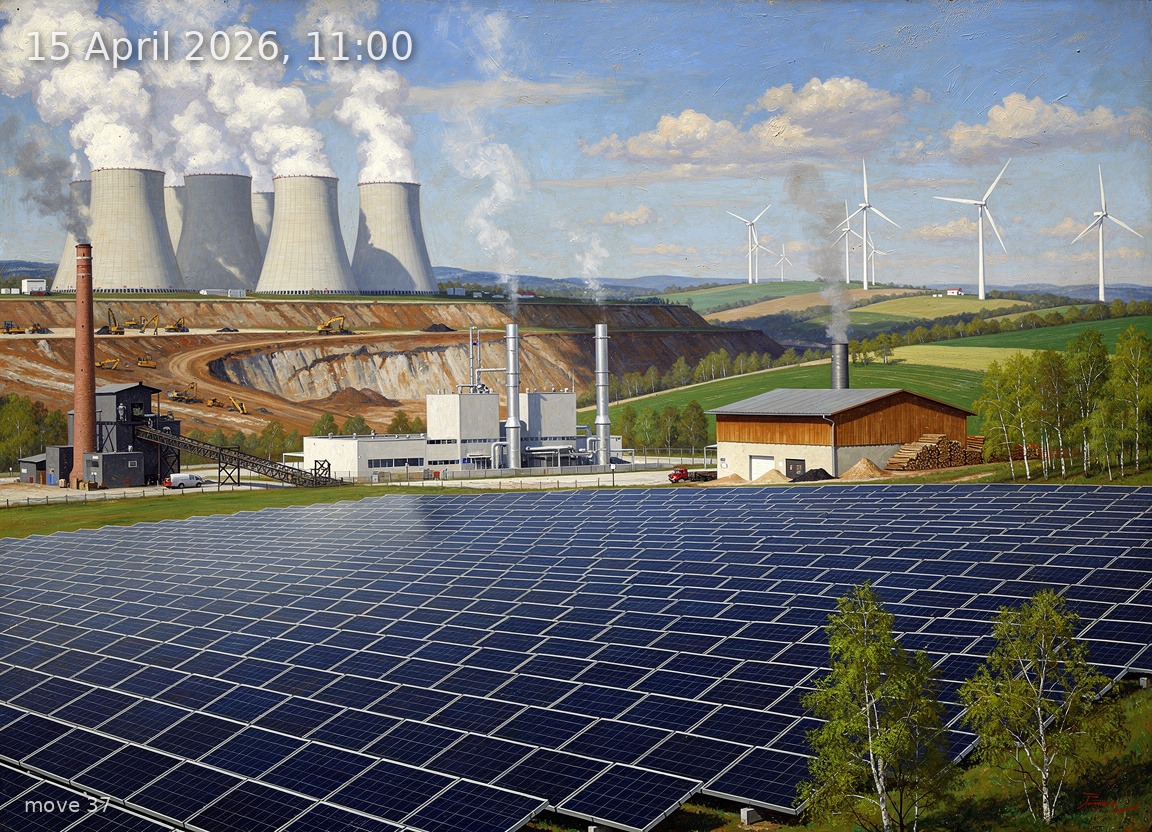
Solar at 41 GW dominates under clear skies; brown coal and gas persist despite 77% renewable share.
Back
Generation mix
Wind onshore 3%
Wind offshore 2%
Solar 63%
Biomass 6%
Hydro 2%
Natural gas 7%
Hard coal 4%
Brown coal 12%
77%
Renewable share
3.3 GW
Wind (on + offshore)
41.0 GW
Solar
64.7 GW
Total generation
+3.3 GW
Net export
78.9 €/MWh
Day-ahead price
11.6°C / 3 km/h
Temp / Wind speed
Open-Meteo, Kassel (51.3°N 9.5°E)
7% / 444.2 W/m²
Cloud cover / Radiation
161
gCO₂/kWh
Image prompt
Solar 41.0 GW dominates the scene as an immense expanse of crystalline silicon photovoltaic panels stretching across rolling central German farmland, covering roughly two-thirds of the composition, their aluminium frames glinting under intense late-morning sunlight. Brown coal 7.8 GW occupies the left background as a cluster of massive hyperbolic cooling towers with thick white steam plumes rising into the sky, adjacent to a lignite open-pit mine with terraced brown earth. Natural gas 4.2 GW appears as a pair of compact CCGT power plants with slender exhaust stacks and thin heat shimmer, positioned centre-left behind the solar field. Hard coal 2.6 GW is rendered as a single dark industrial power station with a tall chimney and coal conveyors, smaller in visual proportion, at the far left. Biomass 4.1 GW is shown as a wood-clad biomass plant with a small smoking stack beside stacked timber, nestled among spring-green trees at centre-right. Wind onshore 1.9 GW appears as a handful of three-blade turbines on a distant ridge to the right, their rotors nearly still in the calm air. Wind offshore 1.5 GW is suggested by tiny turbines on the far horizon where land meets a faint strip of sea. Hydro 1.5 GW is a small concrete run-of-river dam with a thin cascade of water at the far right edge. The sky is nearly cloudless — only 7% wispy cirrus — with brilliant spring sunshine from a high south-east position casting crisp shadows; the atmosphere carries a faintly oppressive, hazy quality reflecting the 78.9 EUR/MWh price, with a warm yellowish cast to the air near the horizon. Early spring vegetation: fresh pale-green leaves on birch and beech trees, yellow rapeseed just beginning to bloom, meadow grass bright and new. Temperature around 12°C gives a cool crispness. Style: highly detailed oil painting in the tradition of 19th-century German Romantic landscape painters such as Caspar David Friedrich and Carl Blechen — rich saturated colour, visible impasto brushwork, dramatic atmospheric depth and luminous sky treatment — but with meticulous modern engineering accuracy for every turbine nacelle, PV panel, cooling tower, and smokestack. No text, no labels.