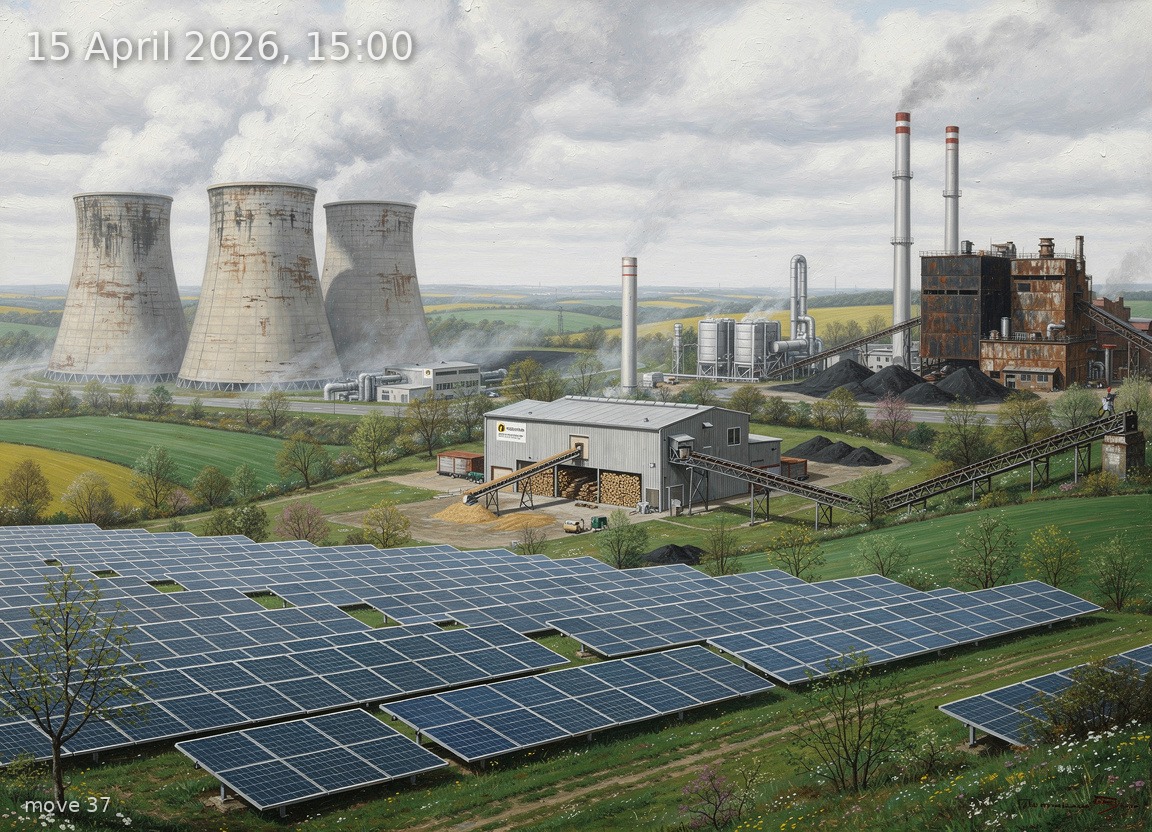
Solar leads at 31.4 GW under high cloud, with 14.9 GW of thermal generation filling a low-wind, net-import afternoon.
Back
Generation mix
Wind onshore 3%
Wind offshore 2%
Solar 58%
Biomass 7%
Hydro 3%
Natural gas 7%
Hard coal 6%
Brown coal 15%
73%
Renewable share
2.6 GW
Wind (on + offshore)
31.4 GW
Solar
54.3 GW
Total generation
-1.3 GW
Net import
81.5 €/MWh
Day-ahead price
16.3°C / 3 km/h
Temp / Wind speed
Open-Meteo, Kassel (51.3°N 9.5°E)
100% / 566.8 W/m²
Cloud cover / Radiation
198
gCO₂/kWh
Image prompt
Solar 31.4 GW dominates the scene as vast fields of aluminium-framed crystalline silicon photovoltaic panels stretching across rolling green spring farmland, occupying well over half the canvas; brown coal 8.0 GW appears as a cluster of massive hyperbolic cooling towers on the left, thick white steam plumes drifting slowly in still air; biomass 4.0 GW is rendered as a mid-sized plant with a wood-chip conveyor and single smokestack beside stacked timber; natural gas 3.8 GW shows two compact CCGT units with tall slender exhaust stacks and thin heat shimmer; hard coal 3.1 GW is a gritty older power station with conveyor belts and a blocky boiler house; wind onshore 1.7 GW and wind offshore 0.9 GW appear as a small group of three-blade turbines on distant hills and a few turbines on the far horizon over a faint sea line, their blades nearly still; hydro 1.4 GW shows a modest concrete run-of-river dam with white water spilling over. Time is 15:00 in April: full daylight but the sky is entirely overcast with a uniform, bright, milky-white cloud layer—no blue sky visible—yet strong diffuse light illuminates everything with a flat, luminous quality. The atmosphere feels heavy and slightly oppressive, reflecting an 81.5 EUR/MWh price: a faint haze thickens the air near the thermal plants. Temperature is 16.3 °C in spring: fresh green grass, budding deciduous trees, wildflowers in meadow margins, no snow. Air is completely still—no leaf movement, no ripple on water, smoke and steam rise vertically. Style: highly detailed oil painting in the tradition of 19th-century German Romantic landscape painters such as Caspar David Friedrich and Carl Blechen—rich saturated colour, visible impasto brushwork, atmospheric depth and aerial perspective—but with meticulous engineering accuracy for every technology. Deep layered composition from foreground solar panels through mid-ground thermal plants to distant wind turbines. No text, no labels, no people.