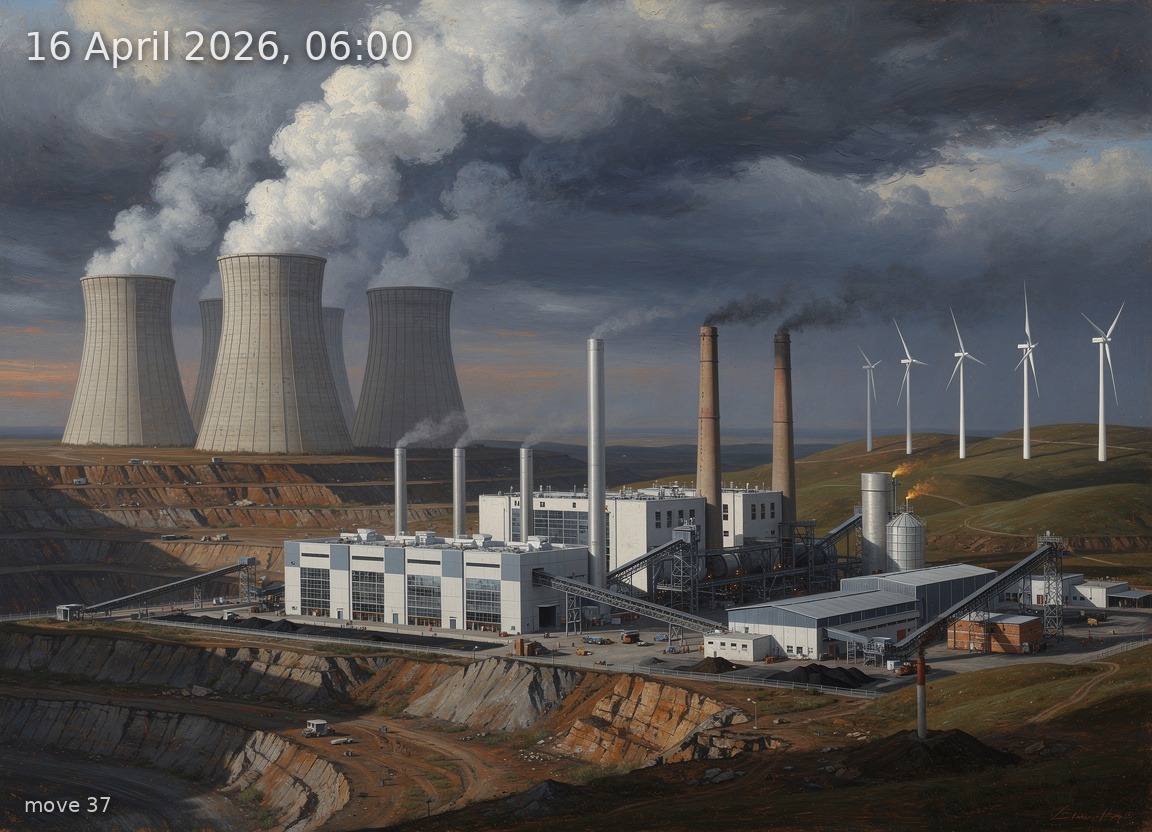
Gas, brown coal, and hard coal dominate early-morning generation as low wind, negligible solar, and 19 GW net imports meet high demand.
Back
Generation mix
Wind onshore 15%
Wind offshore 5%
Solar 1%
Biomass 12%
Hydro 4%
Natural gas 25%
Hard coal 14%
Brown coal 24%
37%
Renewable share
7.4 GW
Wind (on + offshore)
0.3 GW
Solar
36.2 GW
Total generation
-19.3 GW
Net import
139.5 €/MWh
Day-ahead price
8.8°C / 3 km/h
Temp / Wind speed
Open-Meteo, Kassel (51.3°N 9.5°E)
77% / 0.0 W/m²
Cloud cover / Radiation
424
gCO₂/kWh
Image prompt
Brown coal 8.8 GW dominates the left third of the scene as a cluster of massive hyperbolic cooling towers rising from an open-pit lignite landscape, thick white steam plumes merging into the overcast sky; natural gas 9.0 GW fills the centre-left as a row of modern CCGT power stations with tall slender exhaust stacks trailing thin grey exhaust; hard coal 5.0 GW appears centre-right as a classical coal plant with large rectangular boiler houses, conveyor belts, and a pair of tapered chimneys; wind onshore 5.4 GW is rendered as a line of three-blade turbines on rolling hills in the right portion, blades turning very slowly in nearly still air; wind offshore 1.9 GW is suggested by distant turbines on the far-right horizon above a strip of grey sea; biomass 4.4 GW appears as a mid-sized industrial facility with a wood-chip silo and modest stack near the coal plant; hydro 1.4 GW is a small concrete dam and powerhouse nestled in a wooded valley in the far background; solar 0.3 GW is barely present — a few dark aluminium-framed panels on a warehouse roof, unlit, reflecting nothing. Time is early dawn at 06:00 in April: the sky is deep blue-grey with the faintest pale lavender light along the eastern horizon, no direct sunlight, 77% cloud cover forming a heavy low stratus layer that presses down oppressively on the landscape, conveying the tension of a 139.5 EUR/MWh price. Temperature is a cool 8.8°C — spring vegetation is tentative, grass pale green, bare-branched trees just beginning to bud. The atmosphere is heavy, humid, slightly hazy. Rendered as a highly detailed oil painting in the tradition of 19th-century German Romantic landscape painters such as Caspar David Friedrich and Carl Blechen — rich dark tones of indigo, slate, umber, and ochre, visible impasto brushwork, deep atmospheric perspective, meticulous engineering accuracy on every turbine nacelle, cooling tower ribbing, and smokestack detail. The industrial sublime — monumental human infrastructure against a brooding pre-dawn sky. No text, no labels.