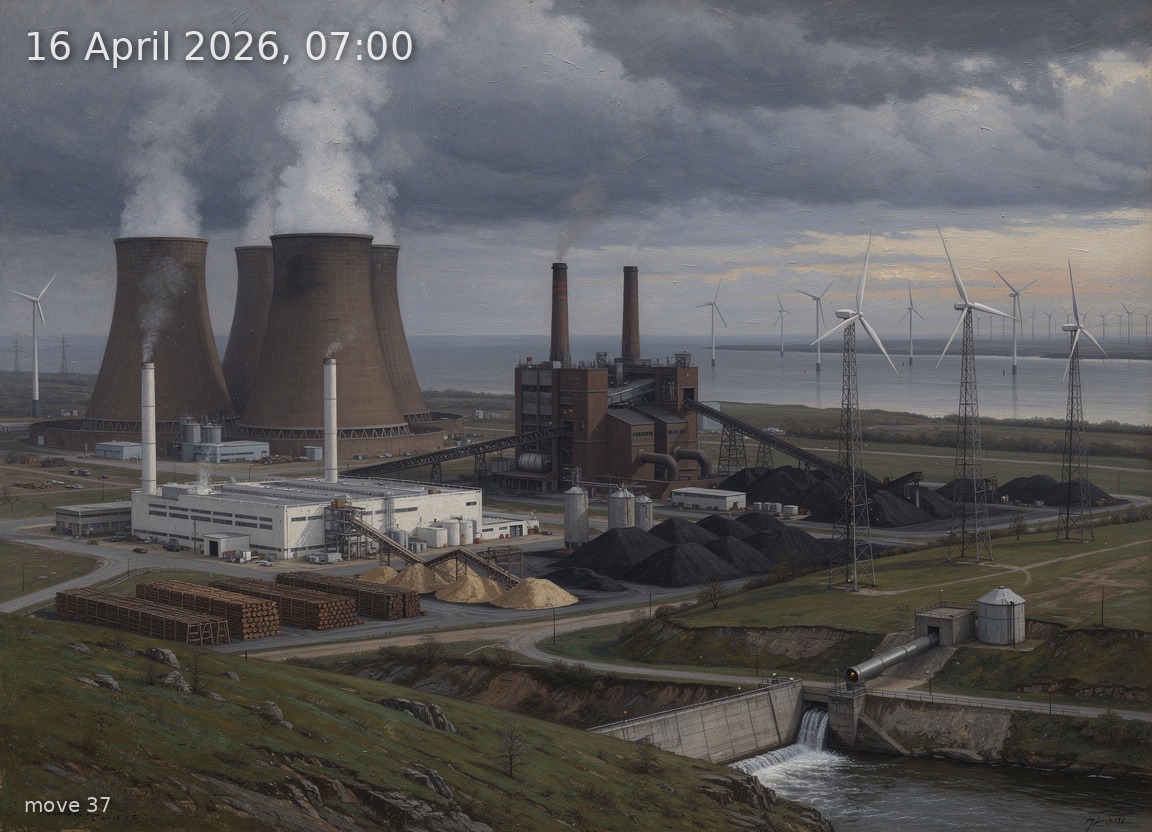
Coal and gas dominate domestic supply as overcast calm forces 20.9 GW of net imports at high prices.
Back
Generation mix
Wind onshore 13%
Wind offshore 4%
Solar 9%
Biomass 12%
Hydro 4%
Natural gas 23%
Hard coal 13%
Brown coal 22%
42%
Renewable share
6.9 GW
Wind (on + offshore)
3.4 GW
Solar
39.1 GW
Total generation
-20.9 GW
Net import
145.0 €/MWh
Day-ahead price
9.0°C / 2 km/h
Temp / Wind speed
Open-Meteo, Kassel (51.3°N 9.5°E)
100% / 0.0 W/m²
Cloud cover / Radiation
394
gCO₂/kWh
Image prompt
Brown coal 8.7 GW dominates the left quarter as a cluster of massive hyperbolic cooling towers with thick white steam plumes rising into grey sky; natural gas 8.9 GW occupies the centre-left as a row of compact CCGT plants with tall single exhaust stacks emitting thin heat shimmer; hard coal 5.3 GW appears centre-right as a large coal-fired station with rectangular chimneys and conveyor belts feeding dark fuel; wind onshore 5.2 GW spans the right third as a scattered line of three-blade turbines on lattice towers, their rotors nearly still in the calm air; wind offshore 1.7 GW is suggested by a distant row of smaller turbines on the far-right horizon above a grey estuary; biomass 4.5 GW sits in the mid-ground as a wood-chip power station with a modest smokestack and timber storage yard; hydro 1.4 GW appears as a small concrete dam and penstock in the right foreground between rolling hills; solar 3.4 GW is visible as a modest field of aluminium-framed crystalline silicon panels in the centre foreground reflecting only dull grey light. Time is early dawn at 07:00 in April: the sky is a deep blue-grey with the faintest pale glow along the eastern horizon, no direct sunlight, no warm tones — pre-dawn coolness. Cloud cover is total, a thick unbroken overcast pressing low. Temperature around 9°C: early spring vegetation, bare-branched trees just beginning to bud, damp green grass. Wind is nearly absent — no motion in branches or flags. The atmosphere feels heavy and oppressive, reflecting the 145 EUR/MWh price: the clouds sit dense and suffocating over the industrial panorama. Transmission lines on tall steel pylons stretch from the right edge toward the viewer, symbolising the massive import flows. Style: highly detailed oil painting in the tradition of 19th-century German Romantic landscape painters such as Caspar David Friedrich and Carl Blechen — rich muted earth tones, visible impasto brushwork, atmospheric aerial perspective with haze softening distant cooling towers, meticulous engineering accuracy on every turbine nacelle, every panel frame, every conveyor mechanism. The mood is sombre industrial grandeur. No text, no labels.