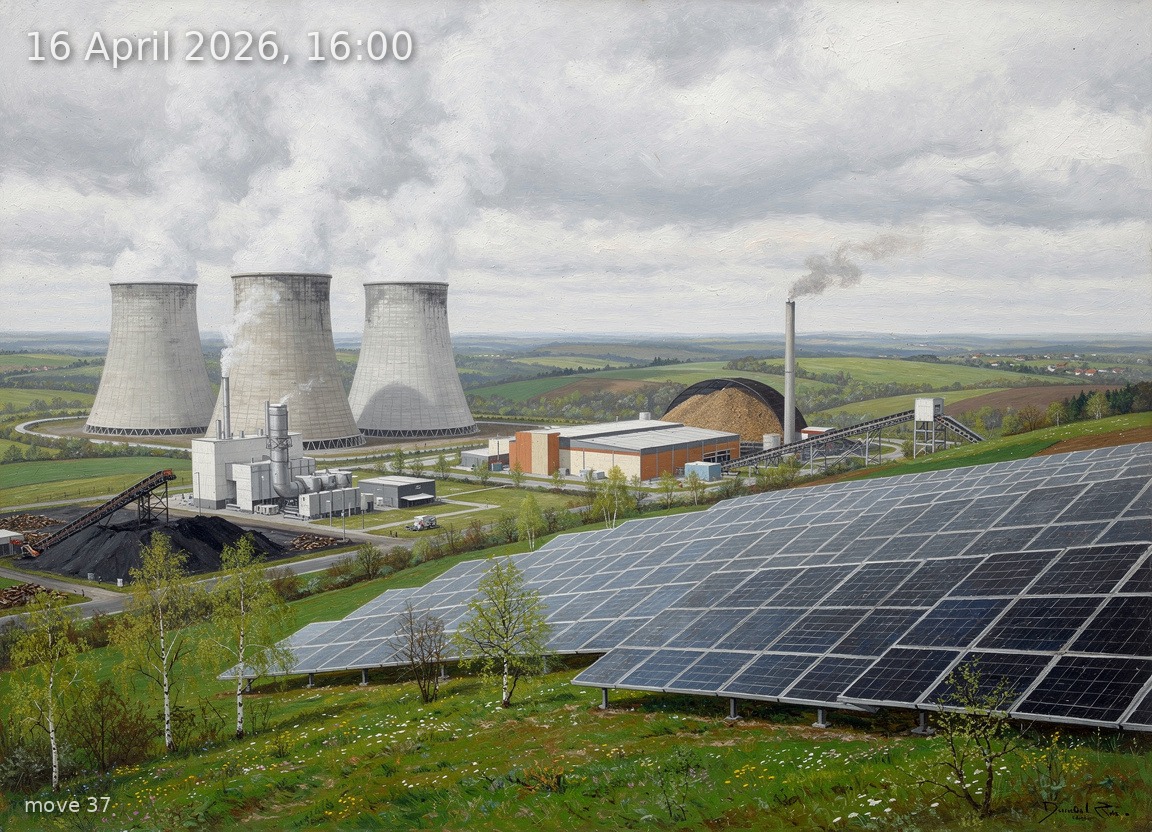
Solar leads at 24.2 GW under full overcast; brown coal and gas fill the gap as wind remains light.
Back
Generation mix
Wind onshore 12%
Wind offshore 4%
Solar 46%
Biomass 8%
Hydro 3%
Natural gas 7%
Hard coal 6%
Brown coal 14%
72%
Renewable share
8.0 GW
Wind (on + offshore)
24.2 GW
Solar
52.3 GW
Total generation
-2.8 GW
Net import
89.8 €/MWh
Day-ahead price
17.1°C / 5 km/h
Temp / Wind speed
Open-Meteo, Kassel (51.3°N 9.5°E)
100% / 158.0 W/m²
Cloud cover / Radiation
197
gCO₂/kWh
Image prompt
Solar 24.2 GW dominates the right half as vast fields of aluminium-framed crystalline silicon PV panels stretching across gentle rolling hills, catching diffuse white light; brown coal 7.4 GW occupies the left foreground as a cluster of massive hyperbolic cooling towers with thick steam plumes rising into the overcast; wind onshore 6.1 GW appears as a line of tall three-blade turbines on a distant ridge, rotors turning slowly; biomass 4.2 GW is rendered as a mid-ground industrial plant with a woodchip storage dome and a single smokestack trailing thin grey smoke; natural gas 3.8 GW sits centre-left as a compact CCGT facility with clean metallic exhaust stacks emitting faint heat shimmer; hard coal 3.2 GW appears as a smaller coal plant beside the lignite complex with conveyor belts and a single square cooling tower; wind offshore 1.9 GW is suggested by a distant row of turbines visible on the far horizon beyond a river estuary; hydro 1.6 GW is a modest concrete run-of-river dam in the lower-right corner with white water cascading through spillways. TIME AND LIGHT: 4 PM full daylight under a completely overcast sky — flat, even, bright white-grey illumination with no shadows, no visible sun disc, a heavy uniform blanket of stratus clouds filling the entire sky from horizon to horizon. The atmosphere feels slightly oppressive and dense, hinting at the elevated electricity price. SEASON: mid-April spring — fresh green leaves on birch and beech trees, wildflowers dotting meadow edges, grass lush and vivid. Temperature is mild at 17°C, the air damp. STYLE: highly detailed oil painting in the tradition of 19th-century German Romantic landscape painters such as Caspar David Friedrich and Carl Blechen — rich layered colour, visible impasto brushwork, atmospheric depth with subtle aerial perspective. Each energy technology rendered with meticulous engineering accuracy: turbine nacelles and lattice towers, PV panel grid patterns, hyperbolic cooling tower concrete ribbing, CCGT metallic housings. The composition balances the sublime Romantic landscape tradition with the industrial reality of the modern Energiewende. No text, no labels, no people in the foreground.