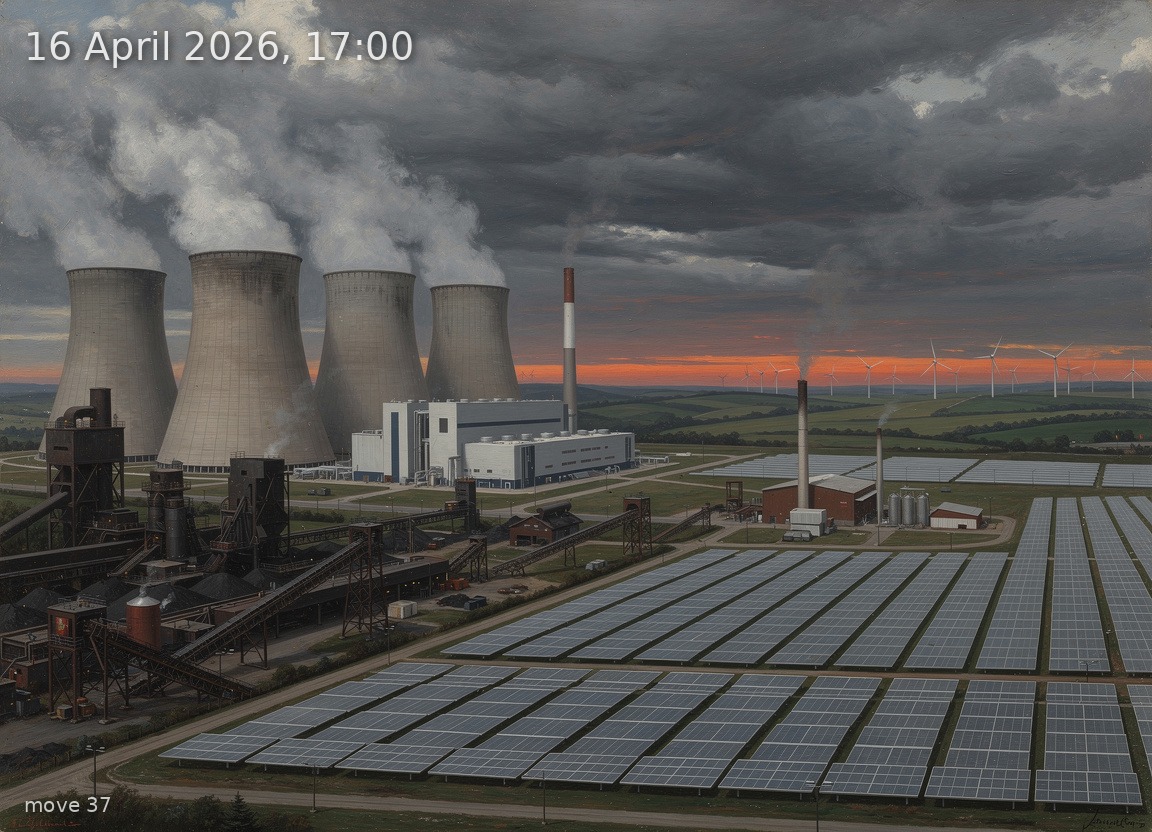
Solar leads at 16.6 GW but weak wind and high demand drive heavy thermal dispatch and 7.5 GW net imports.
Back
Generation mix
Wind onshore 11%
Wind offshore 3%
Solar 34%
Biomass 9%
Hydro 3%
Natural gas 13%
Hard coal 9%
Brown coal 17%
61%
Renewable share
7.1 GW
Wind (on + offshore)
16.6 GW
Solar
48.5 GW
Total generation
-7.6 GW
Net import
111.6 €/MWh
Day-ahead price
17.6°C / 5 km/h
Temp / Wind speed
Open-Meteo, Kassel (51.3°N 9.5°E)
100% / 198.0 W/m²
Cloud cover / Radiation
273
gCO₂/kWh
Image prompt
Brown coal 8.4 GW dominates the left quarter as a cluster of massive hyperbolic cooling towers with thick white-grey steam plumes rising into overcast skies; natural gas 6.3 GW sits just left of centre as three compact CCGT plants with tall single exhaust stacks venting thin heat shimmer; hard coal 4.3 GW appears centre-left as a dark industrial complex with conveyor belts and a squat smokestack; biomass 4.3 GW is rendered centre-right as a wood-chip-fed plant with a modest rectangular building and a single flue; solar 16.6 GW spans the entire right third and middle-ground as vast fields of aluminium-framed crystalline silicon photovoltaic panels reflecting the diffuse grey-white light of the overcast sky; wind onshore 5.5 GW appears as a scattered line of three-blade turbines on gentle green hills in the far background, their rotors barely turning in the still air; wind offshore 1.5 GW is suggested by a few distant turbines on the hazy horizon line; hydro 1.5 GW is a small run-of-river weir with white water cascading in the lower-right foreground. Time of day is 17:00 in mid-April in central Germany — dusk beginning, with a low orange-red glow barely visible at the western horizon beneath a thick, fully overcast sky that is darkening from slate-grey above to a thin warm band at the very edge; the atmosphere feels heavy, oppressive, dense, reflecting the high electricity price. Spring vegetation: fresh bright-green grass, budding deciduous trees with young leaves, wildflowers at field edges. Temperature is mild at 17.6°C — no frost, soft humid air. Highly detailed oil painting in the tradition of 19th-century German Romantic landscape painters such as Caspar David Friedrich and Carl Blechen — rich layered colour, visible confident brushwork, dramatic atmospheric depth, chiaroscuro between the glowing industrial steam and the darkening sky — but with meticulous engineering accuracy on every turbine nacelle, every PV panel frame, every cooling tower's parabolic concrete form. The scene feels monumental, a masterwork industrial landscape. No text, no labels.