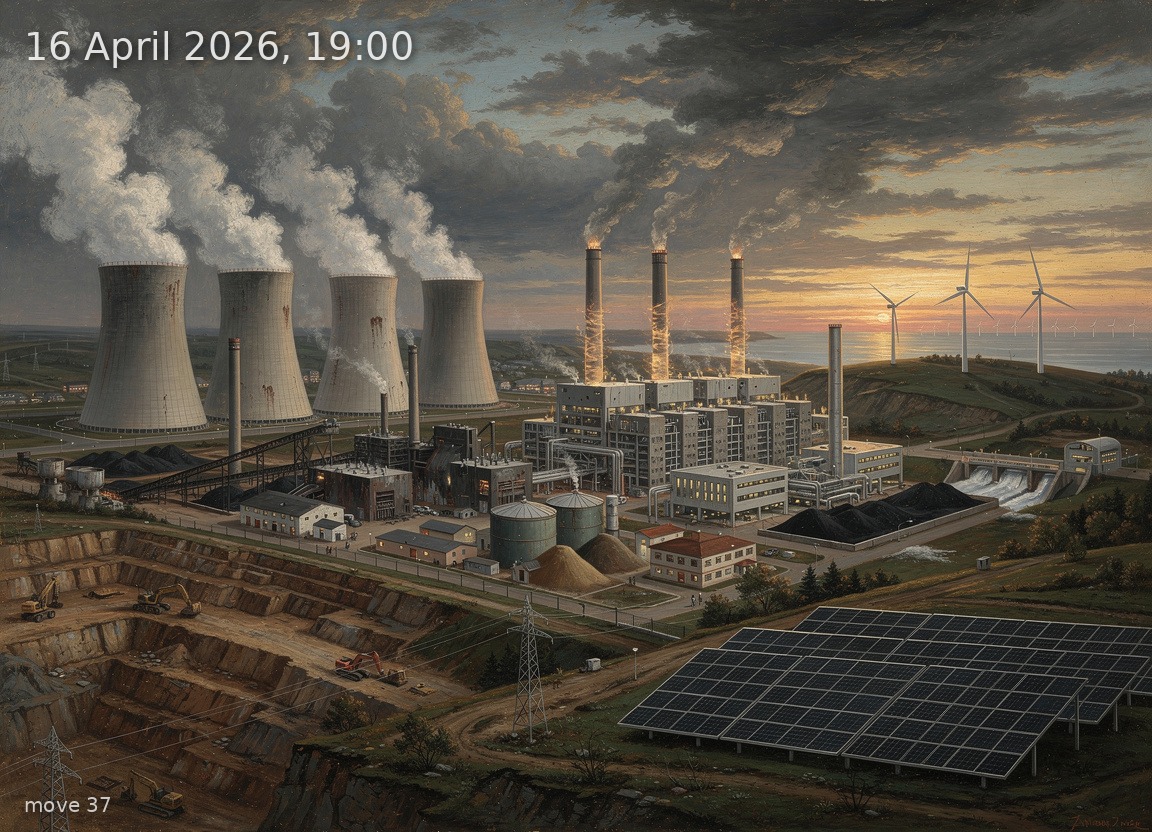
Gas, brown coal, and hard coal dominate domestic generation as fading renewables and high imports drive prices to 167 EUR/MWh.
Back
Generation mix
Wind onshore 8%
Wind offshore 2%
Solar 7%
Biomass 13%
Hydro 4%
Natural gas 27%
Hard coal 14%
Brown coal 24%
34%
Renewable share
3.7 GW
Wind (on + offshore)
2.3 GW
Solar
35.3 GW
Total generation
-24.2 GW
Net import
166.9 €/MWh
Day-ahead price
17.1°C / 5 km/h
Temp / Wind speed
Open-Meteo, Kassel (51.3°N 9.5°E)
53% / 63.0 W/m²
Cloud cover / Radiation
438
gCO₂/kWh
Image prompt
Natural gas 9.7 GW dominates the centre-right as a sprawling complex of compact CCGT units with tall single exhaust stacks venting shimmering heat plumes; brown coal 8.5 GW fills the left quarter with massive hyperbolic cooling towers emitting thick white steam columns and adjacent open-pit mine terraces; hard coal 5.0 GW appears as a dark gritty power station with conveyor belts and a pair of tall chimneys trailing grey smoke, positioned left of centre; biomass 4.6 GW sits in the mid-ground as a cluster of modest industrial buildings with wood-chip storage domes and short stacks releasing pale wisps; wind onshore 3.0 GW is rendered as a scattered line of three-blade turbines with lattice towers on a low ridge in the far right background, blades turning slowly in light breeze; solar 2.3 GW appears as a small field of aluminium-framed crystalline silicon panels in the right foreground catching the last weak amber glow of sunset; wind offshore 0.7 GW is barely visible as tiny turbine silhouettes on a distant grey sea horizon at far right; hydro 1.5 GW is shown as a modest dam and powerhouse nestled in a green valley in the far background. The lighting is late dusk at 19:00 in April: the lower horizon glows deep orange-red fading rapidly upward into darkening indigo-grey sky, with 53 percent cloud cover rendered as broken stratocumulus lit from below in copper and salmon tones. The atmosphere is heavy and oppressive, reflecting the extreme price — a thick industrial haze hangs across the middle distance, blurring the cooling towers' steam into the clouded sky. Spring vegetation at 17°C: fresh green grass and budding deciduous trees frame the foreground. High-voltage transmission pylons stride across the scene from left to right, cables catching the last amber light, symbolising the massive import flows. Painted in the style of a highly detailed 19th-century German Romantic oil painting — rich impasto brushwork, luminous atmospheric depth, dramatic chiaroscuro between the glowing horizon and the darkening industrial skyline — yet every turbine nacelle, every cooling tower's parabolic profile, every PV panel frame is rendered with meticulous engineering accuracy. No text, no labels.