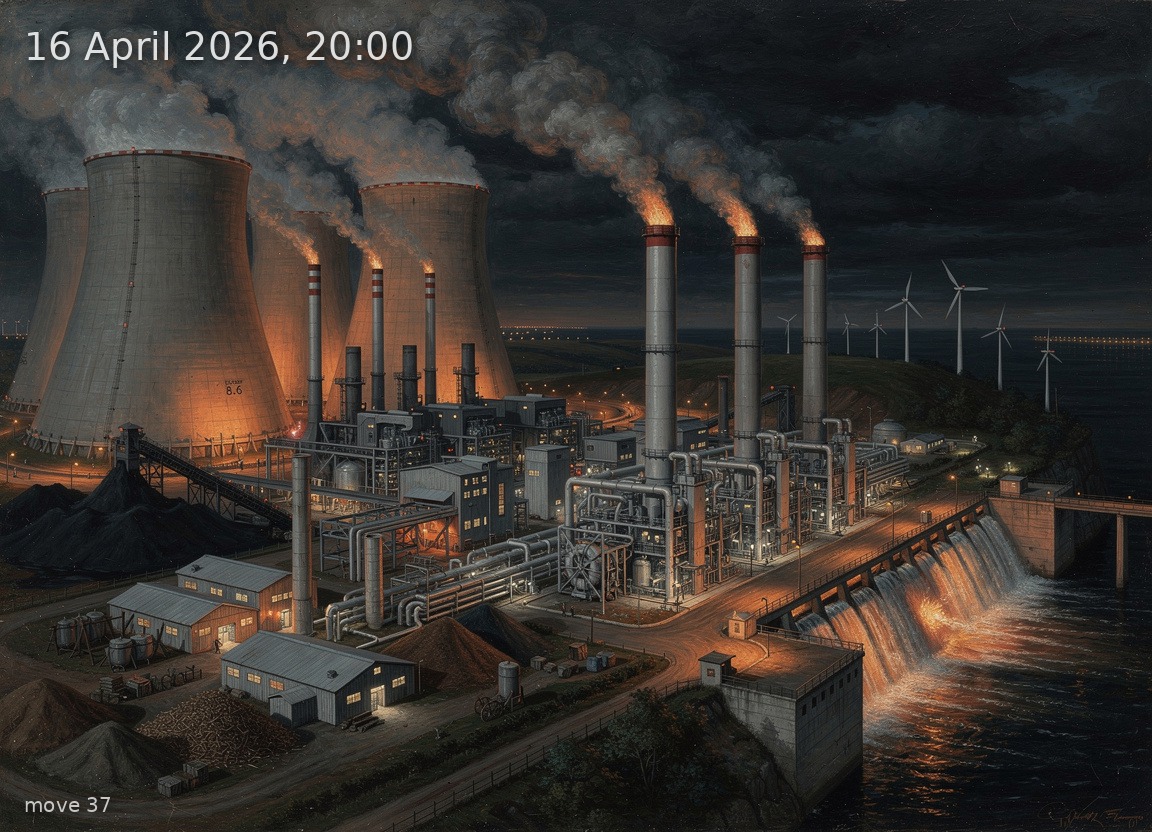
Gas, brown coal, and hard coal anchor a 32.9 GW domestic supply requiring 26.1 GW net imports at evening peak.
Back
Generation mix
Wind onshore 7%
Wind offshore 1%
Solar 0%
Biomass 14%
Hydro 5%
Natural gas 30%
Hard coal 16%
Brown coal 26%
27%
Renewable share
2.8 GW
Wind (on + offshore)
0.1 GW
Solar
32.9 GW
Total generation
-26.1 GW
Net import
187.3 €/MWh
Day-ahead price
16.6°C / 7 km/h
Temp / Wind speed
Open-Meteo, Kassel (51.3°N 9.5°E)
86% / 18.8 W/m²
Cloud cover / Radiation
484
gCO₂/kWh
Image prompt
Natural gas 10.0 GW dominates the centre-right as a sprawling complex of CCGT combined-cycle gas turbine units with tall single exhaust stacks venting heat shimmer into the night; brown coal 8.6 GW fills the left quarter as massive hyperbolic cooling towers with thick white-grey steam plumes lit from below by sodium-orange industrial lights; hard coal 5.2 GW appears centre-left as a cluster of smaller conventional boiler stacks with visible coal conveyors; biomass 4.6 GW sits in the mid-ground as several modest wood-chip-fed power stations with stockpiled fuel and moderate chimneys; onshore wind 2.4 GW is rendered as a sparse line of three-blade turbines on a low ridge in the right background, blades barely turning in light breeze; hydro 1.6 GW appears as a dam structure with illuminated spillway at the far right edge; offshore wind 0.3 GW is a faint cluster of turbines on a distant dark horizon line. The sky is completely dark — deep navy to black, no twilight, no sunset glow — it is 20:00 in April. An 86% overcast ceiling obscures any stars. The atmosphere is heavy and oppressive, reflecting the extreme 187.3 EUR/MWh price. All facilities are lit by harsh sodium streetlamps and industrial floodlights casting orange pools on wet tarmac and concrete. Spring vegetation — fresh green grass, budding deciduous trees at 16.6°C — is barely visible in the artificial light at the margins. Transmission pylons with high-voltage lines recede into the blackness, symbolising the massive import flows. Painted in the style of a highly detailed 19th-century German Romantic oil painting with rich impasto brushwork, dramatic chiaroscuro between the industrial glow and surrounding darkness, atmospheric depth with haze and steam diffusing the lights, meticulous engineering detail on every turbine nacelle, cooling tower, and exhaust stack. No text, no labels.