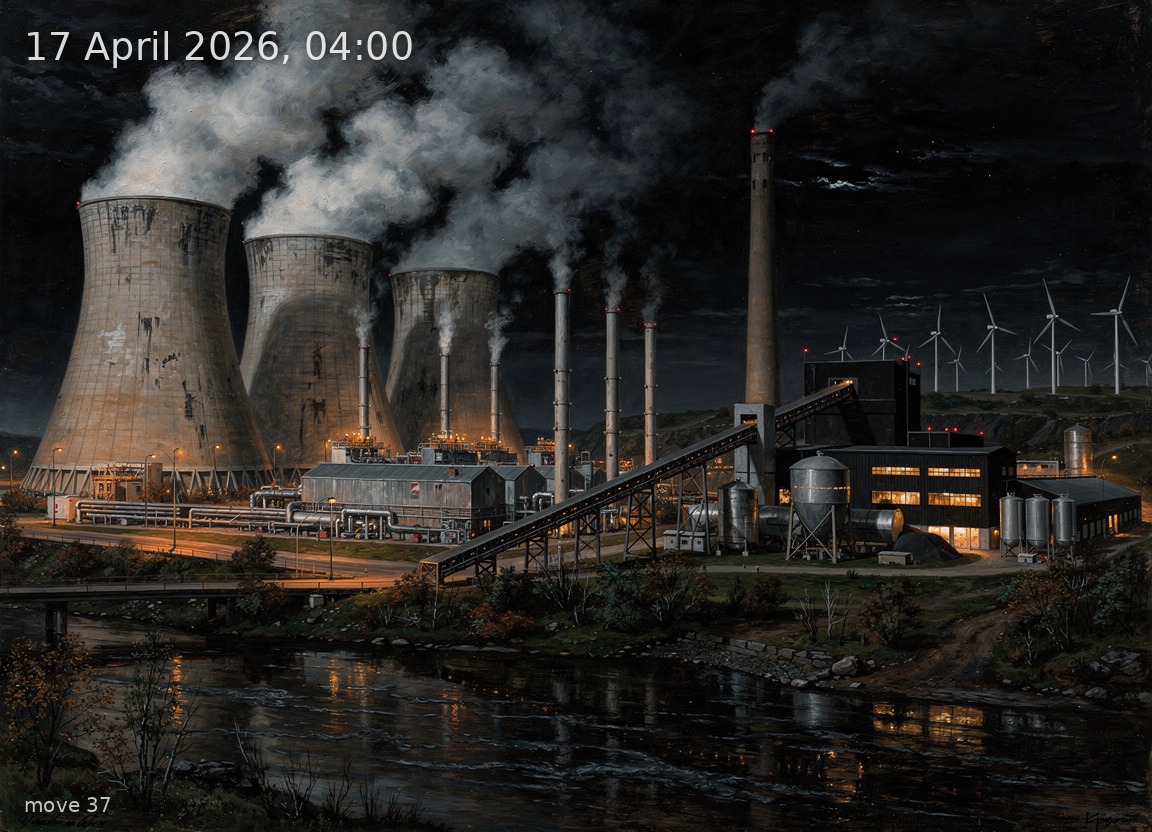
Brown coal, gas, and hard coal dominate pre-dawn generation as weak wind and absent solar drive 14.6 GW net imports.
Back
Generation mix
Wind onshore 9%
Wind offshore 3%
Biomass 13%
Hydro 5%
Natural gas 28%
Hard coal 14%
Brown coal 28%
29%
Renewable share
3.6 GW
Wind (on + offshore)
0.0 GW
Solar
31.6 GW
Total generation
-14.6 GW
Net import
111.5 €/MWh
Day-ahead price
8.3°C / 3 km/h
Temp / Wind speed
Open-Meteo, Kassel (51.3°N 9.5°E)
65% / 0.0 W/m²
Cloud cover / Radiation
479
gCO₂/kWh
Image prompt
Brown coal 9.0 GW dominates the left third of the scene as a dense cluster of massive hyperbolic cooling towers with thick white steam plumes rising into darkness; natural gas 8.9 GW fills the centre-left as a row of compact CCGT plants with tall single exhaust stacks emitting thin vapour trails, lit by sodium-orange floodlights; hard coal 4.6 GW appears centre-right as a smaller coal-fired station with a single large chimney and conveyor belts carrying fuel, illuminated by industrial work lights; biomass 4.1 GW is rendered as a mid-sized wood-chip power plant with a modest stack and glowing furnace windows at right-centre; wind onshore 2.7 GW appears as a sparse line of three-blade turbines on a low ridge in the right background, their red aviation warning lights blinking faintly, rotors nearly still; wind offshore 0.9 GW is suggested by a distant cluster of tiny red lights on the far-right horizon implying North Sea turbines; hydro 1.4 GW is a concrete dam structure with illuminated spillway in the far right foreground. The sky is completely dark — black to deep navy — with no twilight, no moon, 65% cloud cover creating an invisible overcast ceiling that reflects an oppressive orange-sodium glow from the industrial complexes below. The atmosphere feels heavy and close, hinting at the high electricity price. Early spring vegetation — bare-branched trees with the first tiny leaf buds — lines a river in the foreground reflecting the amber industrial light. Temperature around 8°C suggested by a thin mist hovering over the water. No solar panels anywhere. Highly detailed oil painting in the tradition of 19th-century German Romantic landscape painters such as Caspar David Friedrich and Carl Blechen — rich chiaroscuro, dramatic interplay of artificial light against profound darkness, visible thick brushwork, atmospheric depth and sfumato in the steam plumes, meticulous engineering detail on every turbine nacelle, cooling tower, and exhaust stack. No text, no labels.