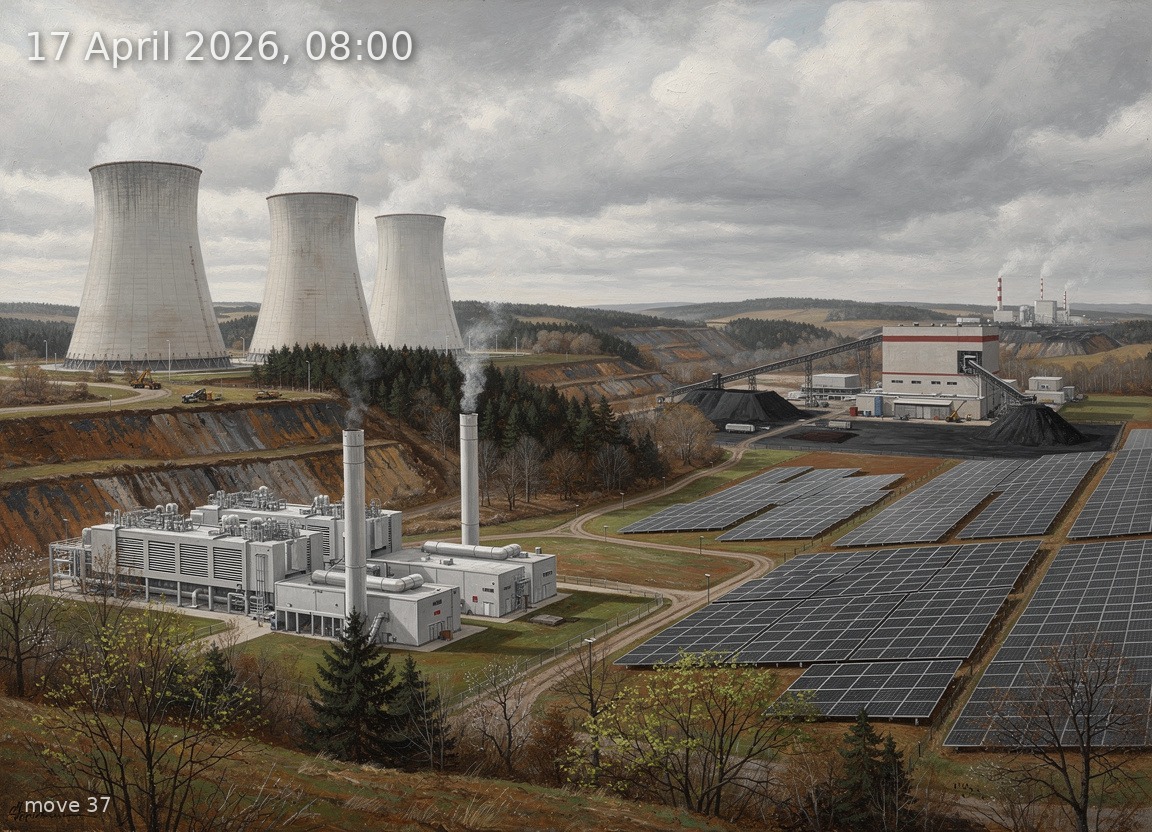
Solar leads at 17.3 GW but near-calm winds and high demand drive heavy fossil dispatch and 15.6 GW net imports.
Back
Generation mix
Wind onshore 4%
Wind offshore 3%
Solar 36%
Biomass 9%
Hydro 3%
Natural gas 19%
Hard coal 10%
Brown coal 15%
56%
Renewable share
3.4 GW
Wind (on + offshore)
17.3 GW
Solar
48.2 GW
Total generation
-15.6 GW
Net import
127.2 €/MWh
Day-ahead price
7.5°C / 2 km/h
Temp / Wind speed
Open-Meteo, Kassel (51.3°N 9.5°E)
84% / 19.8 W/m²
Cloud cover / Radiation
294
gCO₂/kWh
Image prompt
Solar 17.3 GW dominates the right third of the composition as vast fields of aluminium-framed crystalline silicon PV panels stretching across gently rolling farmland, their surfaces reflecting a flat white-grey sky; brown coal 7.5 GW occupies the left foreground as a cluster of massive hyperbolic cooling towers with thick white steam plumes rising into the overcast, beside open-pit lignite excavation terraces; natural gas 9.1 GW fills the centre-left as a row of modern combined-cycle gas turbine plants with tall single exhaust stacks and compact turbine halls emitting thin heat shimmer; hard coal 4.8 GW appears behind the gas plant as a classic coal-fired station with rectangular boiler houses, conveyor belts, and a coal stockyard; biomass 4.5 GW is represented by a mid-ground timber-clad biomass CHP plant with a modest stack and woodchip storage silos; wind onshore 2.1 GW appears as a small cluster of three-blade turbines on a distant ridge, their rotors virtually still; wind offshore 1.3 GW is suggested by tiny turbines on a far hazy horizon line beyond a narrow strip of sea glimpsed through a river valley; hydro 1.6 GW is a concrete run-of-river weir with low spillway visible along a river in the middle distance. The time is 08:00 on an April morning — full daylight but heavily overcast, 84% cloud cover producing a flat, diffuse, shadowless light with no visible sun disc, the sky a uniform blanket of grey-white stratocumulus pressing low over the landscape. The atmosphere is heavy and oppressive, conveying the tension of a 127 EUR/MWh price — a brooding weight in the air. Temperature is a cool 7.5°C: early spring vegetation shows bare deciduous branches with just the first pale green buds, brown winter grass, dark evergreen conifers. There is no wind: flags hang limp, smoke rises vertically, water surfaces are mirror-still. Rendered as a highly detailed oil painting in the tradition of 19th-century German Romantic landscape painters — rich, layered colour with visible impasto brushwork, atmospheric depth achieved through sfumato haze and careful aerial perspective, warm industrial earth tones contrasting with cool grey skies. Every technology is rendered with meticulous engineering accuracy: turbine nacelles and three-blade rotors, lattice transmission towers with sagging conductors, cooling tower parabolic geometries, PV panel grid patterns. The composition evokes Caspar David Friedrich's sense of sublime scale, with small human figures near the river weir providing perspective. No text, no labels.