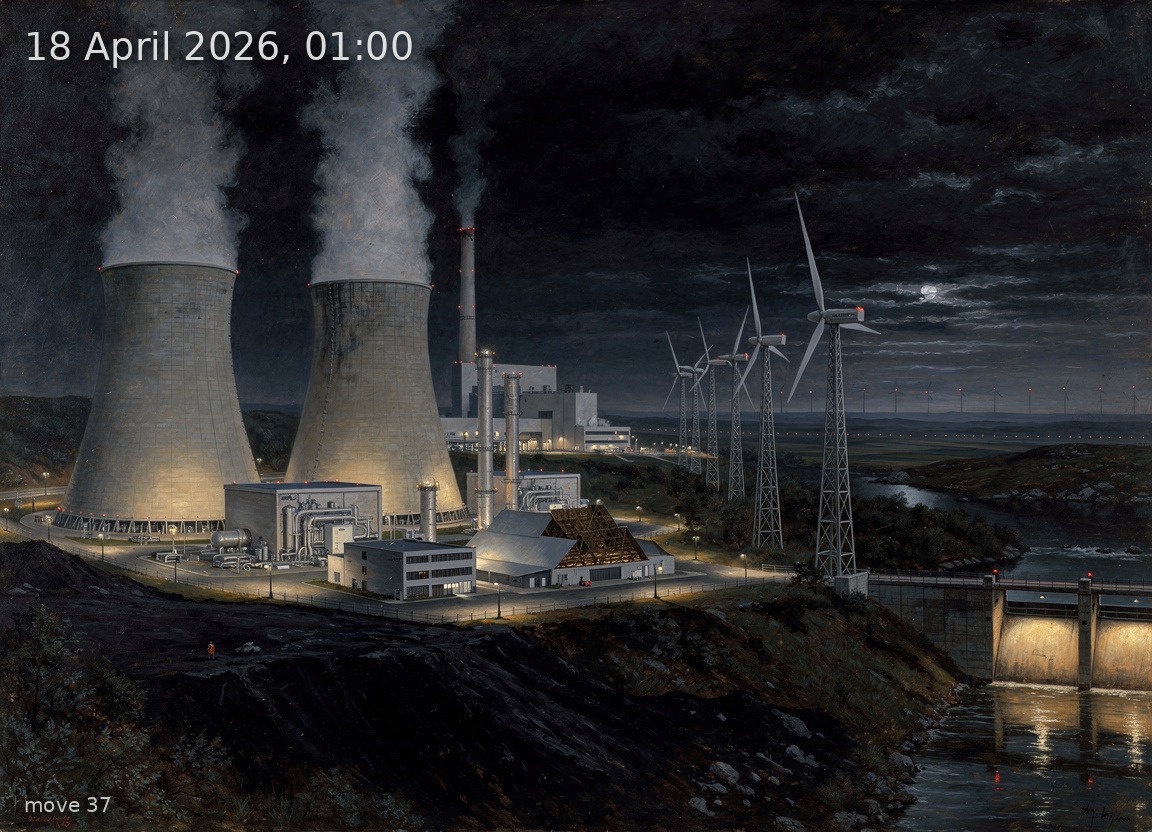
Brown coal, onshore wind, and gas dominate as large net imports cover a 17.5 GW overnight generation shortfall.
Back
Generation mix
Wind onshore 23%
Wind offshore 4%
Biomass 13%
Hydro 5%
Natural gas 19%
Hard coal 11%
Brown coal 25%
44%
Renewable share
8.3 GW
Wind (on + offshore)
0.0 GW
Solar
31.1 GW
Total generation
-17.5 GW
Net import
110.9 €/MWh
Day-ahead price
10.9°C / 2 km/h
Temp / Wind speed
Open-Meteo, Kassel (51.3°N 9.5°E)
98% / 0.0 W/m²
Cloud cover / Radiation
384
gCO₂/kWh
Image prompt
Brown coal 7.8 GW dominates the left third of the scene as a cluster of massive hyperbolic cooling towers with thick white-grey steam plumes rising into the darkness; onshore wind 7.2 GW fills the centre-right as a line of tall three-blade turbines on lattice towers with rotors barely turning in negligible wind; natural gas 6.0 GW appears centre-left as a pair of compact CCGT power stations with slender exhaust stacks emitting thin heat shimmer; biomass 4.1 GW is rendered as a medium-sized industrial plant with a wood-chip conveyor and a single smokestack glowing faintly; hard coal 3.4 GW sits behind the brown coal complex as a smaller conventional power station with a rectangular stack; offshore wind 1.1 GW is glimpsed in the far distance as faint red aviation warning lights on towers at the horizon; hydro 1.4 GW appears as a small concrete dam structure with illuminated spillway at the far right edge. TIME: 1:00 AM — completely dark night sky, deep black to navy, absolutely no twilight or sky glow, heavy 98% overcast obscuring all stars. Lighting comes only from sodium-orange streetlights along an access road, the warm glow of control-room windows, and red obstruction lights atop stacks and turbine nacelles. The atmosphere is dense and oppressive, reflecting the high electricity price — low mist clings to the ground between the cooling towers and turbine bases. Vegetation is early-spring: pale green buds on bare-branched trees, damp grass. Wind is nearly still — no motion blur on vegetation, flags hang limp. Style: highly detailed oil painting in the tradition of 19th-century German Romantic landscape painters such as Caspar David Friedrich and Carl Blechen — rich, sombre colour palette of deep indigos, warm ambers, and cool greys, with visible textured brushwork and atmospheric depth. Each energy technology rendered with meticulous engineering accuracy: three-blade rotor profiles, aluminium nacelle housings, hyperbolic concrete cooling tower geometry with condensation plumes, CCGT heat recovery steam generators. The composition evokes the sublime tension between industrial might and the quiet vulnerability of a sleeping land dependent on distant power. No text, no labels.