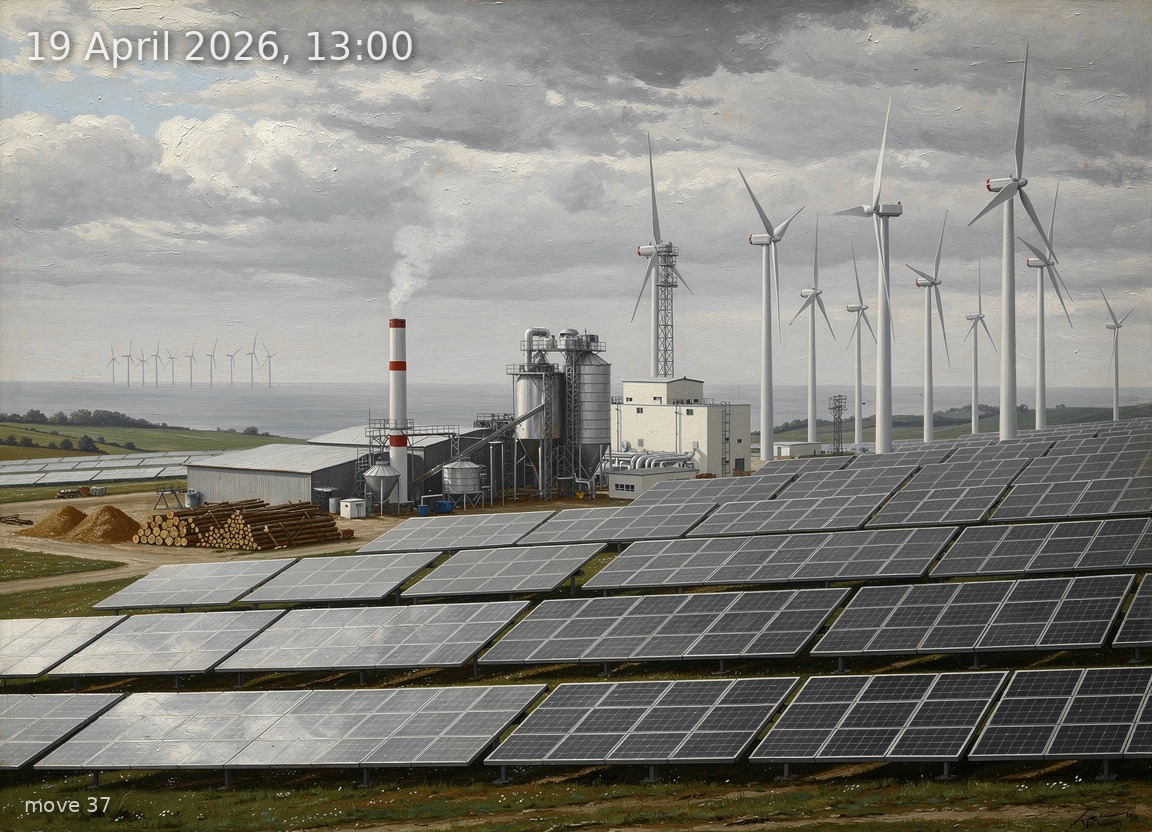
Diffuse solar (23.6 GW) and strong wind (16.2 GW) drive 87.6% renewable share, pushing prices slightly negative.
Back
Generation mix
Wind onshore 27%
Wind offshore 5%
Solar 45%
Biomass 8%
Hydro 3%
Natural gas 4%
Hard coal 3%
Brown coal 5%
88%
Renewable share
16.3 GW
Wind (on + offshore)
23.6 GW
Solar
51.8 GW
Total generation
+3.8 GW
Net export
-0.8 €/MWh
Day-ahead price
8.7°C / 18 km/h
Temp / Wind speed
Open-Meteo, Kassel (51.3°N 9.5°E)
99% / 15.0 W/m²
Cloud cover / Radiation
86
gCO₂/kWh
Image prompt
Solar 23.6 GW dominates the centre and right foreground as vast rolling fields of aluminium-framed crystalline silicon PV panels stretching to the horizon, their glass surfaces reflecting a flat pewter-grey sky; wind onshore 13.8 GW fills the mid-ground and left half as dozens of tall three-blade turbines on lattice and tubular towers, rotors turning briskly in moderate wind; wind offshore 2.4 GW appears in the far-left background as a cluster of offshore turbines on a distant grey sea horizon; biomass 4.0 GW is rendered as a mid-sized industrial plant with a timber-pile yard and a single smokestack emitting thin white vapour, positioned left of centre; brown coal 2.7 GW appears as a pair of hyperbolic cooling towers with faint steam plumes and a low conveyor-belt structure, tucked into the far left background; natural gas 2.1 GW shows as a compact CCGT unit with a single tall exhaust stack and slim heat-recovery housing, placed behind the biomass plant; hard coal 1.7 GW is a smaller power station with a single square chimney and coal bunkers, adjacent to the lignite towers; hydro 1.6 GW appears as a modest concrete dam and spillway nestled in a wooded valley at the far right edge. The sky is entirely overcast at 99% cloud cover—a uniform blanket of thick stratus in layered grey tones, no sun disc visible, yet full midday daylight illuminates the scene evenly with soft, shadowless diffused light. The landscape is early spring in central Germany at about 9°C: fresh green grass just emerging, bare-branched oaks and beeches beginning to bud, patches of brown earth, damp atmosphere with a slight haze. The mood is calm and expansive, matching the negative electricity price—open, unhurried, almost meditative. Painted in the style of a highly detailed 19th-century German Romantic oil painting—rich impasto brushwork, atmospheric aerial perspective fading to blue-grey in the distance, luminous cloud modelling reminiscent of Caspar David Friedrich and Carl Blechen, but every piece of energy infrastructure rendered with meticulous engineering accuracy: turbine nacelles, blade pitch mechanisms, PV cell grids, cooling tower parabolic curves, CCGT exhaust dampers. No text, no labels, no people in the immediate foreground.