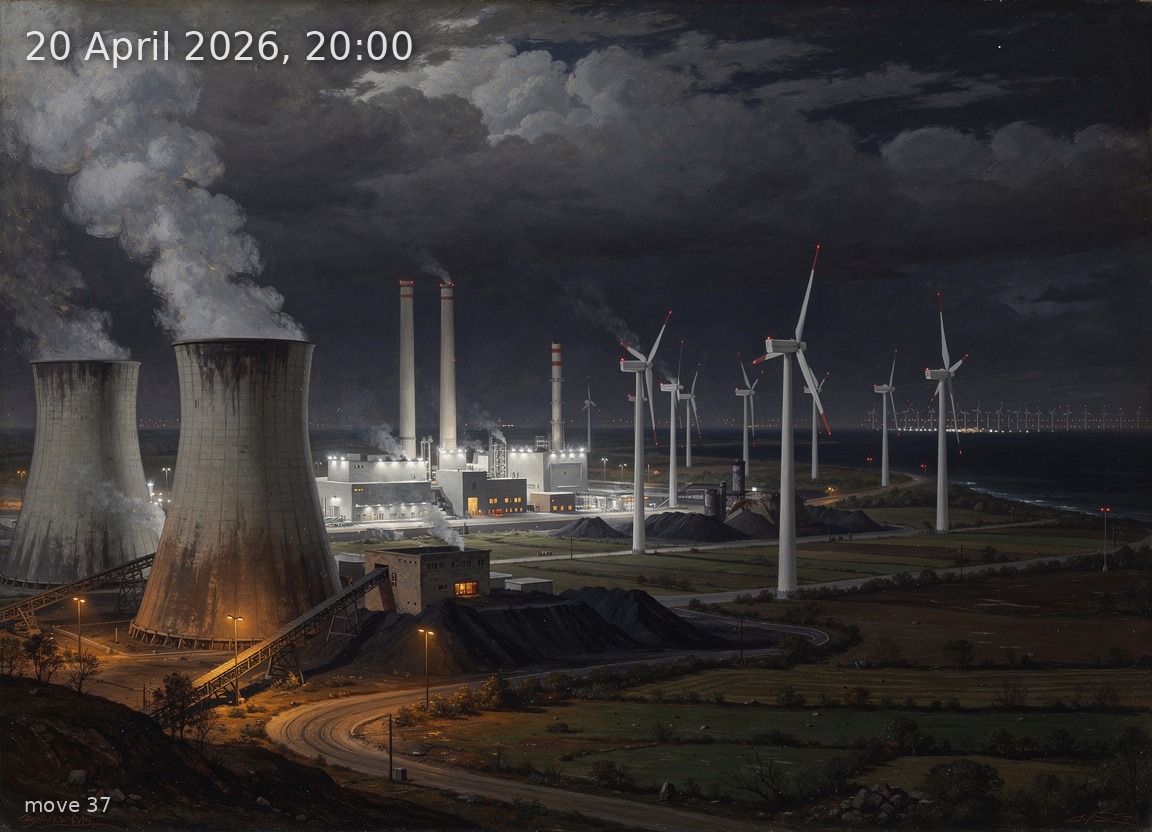
Wind leads at 21.3 GW but heavy thermal dispatch and 11.1 GW net imports cover evening peak demand.
Back
Generation mix
Wind onshore 34%
Wind offshore 12%
Solar 0%
Biomass 10%
Hydro 4%
Natural gas 17%
Hard coal 9%
Brown coal 14%
59%
Renewable share
21.3 GW
Wind (on + offshore)
0.1 GW
Solar
47.0 GW
Total generation
-11.1 GW
Net import
127.2 €/MWh
Day-ahead price
6.1°C / 8 km/h
Temp / Wind speed
Open-Meteo, Kassel (51.3°N 9.5°E)
93% / 4.0 W/m²
Cloud cover / Radiation
272
gCO₂/kWh
Image prompt
Wind onshore 15.8 GW dominates the right half of the canvas as dozens of tall three-blade turbines with white tubular towers and nacelles stretching across rolling farmland into the distance; wind offshore 5.5 GW appears as a faint row of larger turbines on the far-right horizon above a dark sea; brown coal 6.8 GW occupies the left foreground as massive hyperbolic cooling towers emitting thick white-grey steam plumes, with conveyor belts of lignite visible at their base; natural gas 8.2 GW fills the centre-left as a cluster of modern CCGT power stations with tall slender exhaust stacks releasing thin heat shimmer; hard coal 4.3 GW appears behind the gas plants as a blocky power station with squat chimneys and coal stockpiles; biomass 4.5 GW is rendered as a mid-ground industrial facility with wood-chip silos and a modest smokestack; hydro 1.9 GW is a small dam and spillway in a valley at centre-right. The sky is completely dark—deep navy to black—it is 20:00 in April, full nighttime with no twilight whatsoever. A heavy 93% overcast blankets everything, no stars visible. The scene is illuminated only by artificial light: sodium-orange streetlights along roads, warm yellow-white industrial floodlights on the power stations, red aviation warning lights blinking atop wind turbines and cooling towers, and the faint orange glow of furnace mouths in the coal plants. The atmosphere feels heavy and oppressive, reflecting the 127.2 EUR/MWh price—a dense humid haze clings to the cooling tower plumes. Temperature is 6.1°C: early spring, bare-branched trees with only the faintest green buds, dead grass still brown, patches of mud. Wind speed is moderate at 7.7 km/h—turbine blades turn steadily but not furiously, steam plumes drift gently to the east. Painted in the style of a highly detailed 19th-century German Romantic oil painting—rich impasto brushwork, dramatic chiaroscuro between the black sky and the glowing industrial facilities, atmospheric depth with distant turbines fading into murky darkness. Meticulous engineering accuracy: lattice transmission towers with sagging cables, three-blade rotor geometry, aluminium-clad nacelles, hyperbolic concrete cooling tower surfaces with condensation streaks. No text, no labels.