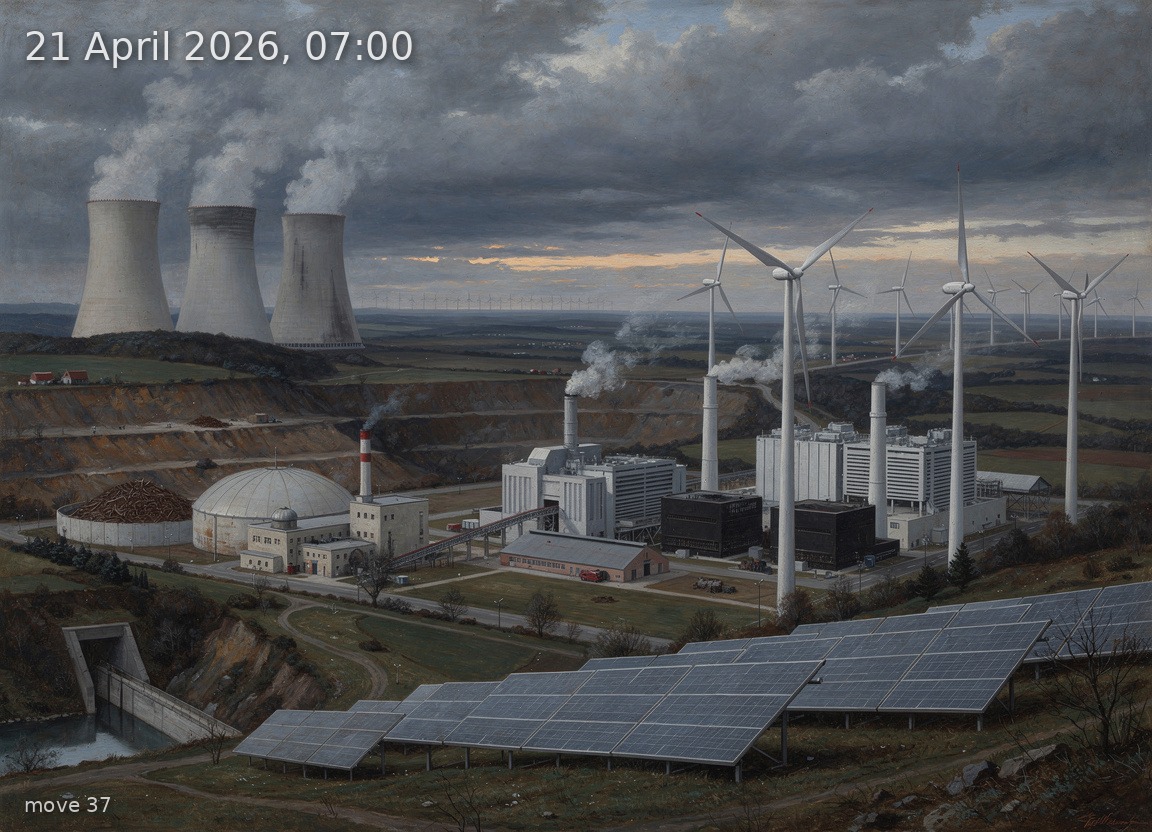
Gas, brown coal, and wind lead domestic generation as 16 GW of net imports cover a cold April morning peak.
Back
Generation mix
Wind onshore 26%
Wind offshore 5%
Solar 13%
Biomass 10%
Hydro 3%
Natural gas 18%
Hard coal 9%
Brown coal 16%
57%
Renewable share
13.9 GW
Wind (on + offshore)
5.9 GW
Solar
45.2 GW
Total generation
-16.2 GW
Net import
135.3 €/MWh
Day-ahead price
4.6°C / 4 km/h
Temp / Wind speed
Open-Meteo, Kassel (51.3°N 9.5°E)
72% / 1.5 W/m²
Cloud cover / Radiation
288
gCO₂/kWh
Image prompt
Wind onshore 11.6 GW dominates the right third of the scene as dozens of large three-blade turbines with white tubular towers and nacelles stretching across rolling hills into the distance, their rotors turning slowly in light wind. Natural gas 8.2 GW fills the centre-right as a cluster of modern CCGT power plants with slim exhaust stacks emitting thin plumes of vapour. Brown coal 7.3 GW occupies the centre-left as massive hyperbolic cooling towers with thick white steam columns rising into the overcast sky, beside open-pit mine terraces visible in the middle distance. Solar 5.9 GW appears in the lower foreground as rows of aluminium-framed crystalline silicon panels on a gentle slope, their surfaces reflecting only diffuse grey light under heavy clouds. Biomass 4.4 GW sits to the far left as a mid-sized industrial facility with a wood-chip storage dome and a single modest smokestack. Hard coal 4.0 GW appears behind the biomass plant as a traditional coal-fired station with rectangular cooling towers and conveyor belts. Wind offshore 2.4 GW is suggested by a faint line of turbines on the distant horizon. Hydro 1.4 GW is represented by a small dam and reservoir nestled in a valley at the far left edge. The sky is a deep blue-grey pre-dawn light at 07:00 in April, with no direct sunlight yet visible — only a faint pale luminescence along the eastern horizon beneath a heavy 72% overcast layer. The atmosphere feels oppressive and weighty, reflecting the high electricity price. The landscape is early spring in central Germany: bare-branched oaks and beeches with the faintest hint of green buds, frost-tinged meadows at 4.6°C, mist clinging to the valleys. Painted in the style of a highly detailed 19th-century German Romantic oil painting — rich, sombre colour palette of slate grey, umber, and cold blue, with visible impasto brushwork and atmospheric depth receding through layers of industrial infrastructure and natural terrain. Meticulous engineering detail on every turbine nacelle, every cooling tower's parabolic curve, every panel's silicon grid. No text, no labels.