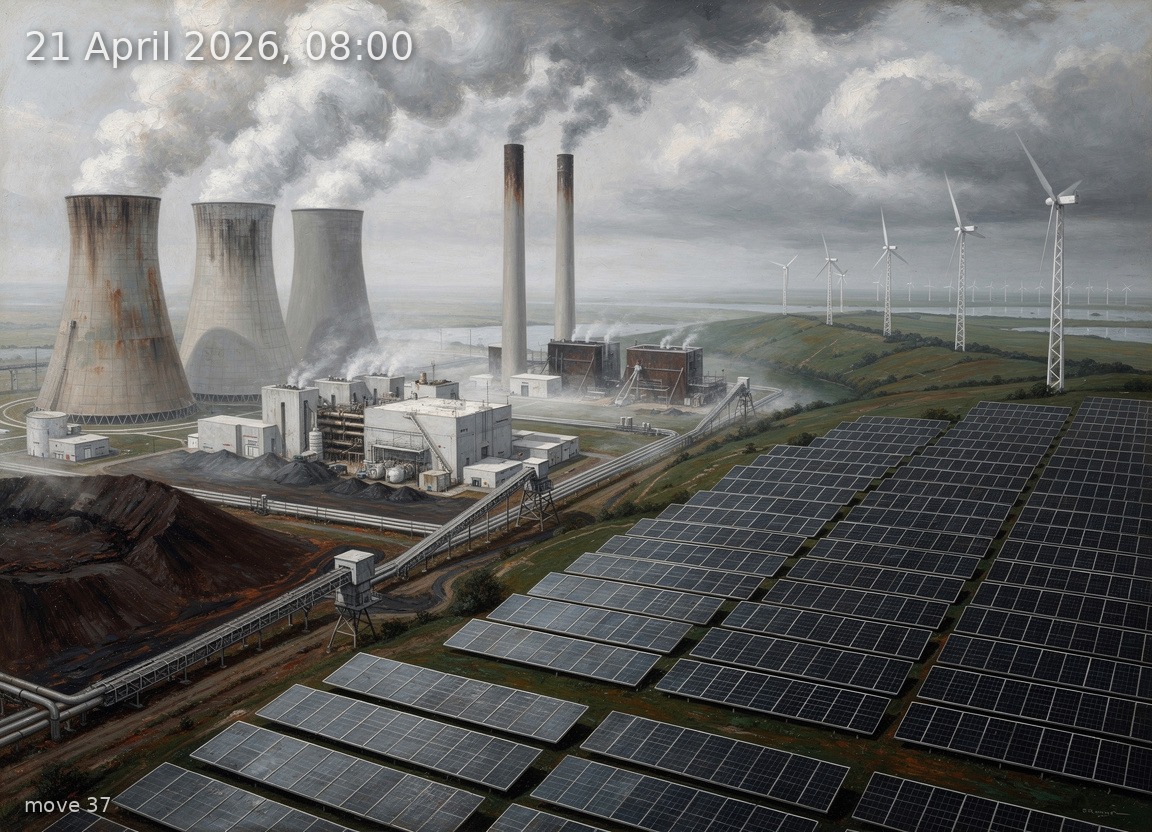
Solar ramps to 14.9 GW under overcast skies as coal and gas backstop a 14.1 GW import gap.
Back
Generation mix
Wind onshore 15%
Wind offshore 4%
Solar 30%
Biomass 9%
Hydro 3%
Natural gas 16%
Hard coal 8%
Brown coal 14%
62%
Renewable share
9.5 GW
Wind (on + offshore)
14.9 GW
Solar
49.3 GW
Total generation
-14.2 GW
Net import
119.0 €/MWh
Day-ahead price
5.0°C / 8 km/h
Temp / Wind speed
Open-Meteo, Kassel (51.3°N 9.5°E)
73% / 26.2 W/m²
Cloud cover / Radiation
255
gCO₂/kWh
Image prompt
Brown coal 7.0 GW dominates the left foreground as four massive hyperbolic cooling towers releasing thick white steam plumes into an overcast sky; natural gas 7.9 GW occupies the left-centre as a cluster of compact CCGT power blocks with tall single exhaust stacks venting thin grey plumes; hard coal 3.9 GW appears as a smaller coal-fired plant behind the gas units with a pair of rectangular chimneys and coal conveyors; solar 14.9 GW fills the right half of the composition as an expansive field of aluminium-framed crystalline silicon photovoltaic panels stretching across gently rolling farmland, their surfaces reflecting diffuse grey-white light under heavy cloud cover; wind onshore 7.5 GW appears as a line of fifteen tall three-blade turbines with white lattice towers on a distant ridge behind the solar field, blades turning slowly in light wind; wind offshore 2.0 GW is suggested by a handful of turbines visible on a far grey-green horizon where land meets haze; biomass 4.4 GW is represented by a wood-chip-fuelled CHP plant with a modest smokestack and timber storage yard in the right middle distance; hydro 1.7 GW appears as a small concrete run-of-river weir with churning white water along a tree-lined river in the far right background. Time is 08:00 in April—full diffuse daylight but no direct sun, sky heavy with 73% stratiform cloud in shades of pewter and ash-grey, oppressive atmosphere suggesting high electricity prices; temperature is 5°C with bare-branched deciduous trees just beginning to bud, damp green grass, patches of morning frost on metal structures. Style: highly detailed oil painting in the tradition of 19th-century German Romantic landscape painters such as Caspar David Friedrich and Carl Blechen—rich layered colour, visible impasto brushwork, dramatic atmospheric depth with misty industrial haze blending into clouds—but with meticulous engineering accuracy on every turbine nacelle, PV cell grid, cooling tower fluting, and exhaust stack. The composition conveys the monumental scale of an entire nation's power system as a single sweeping industrial panorama. No text, no labels.