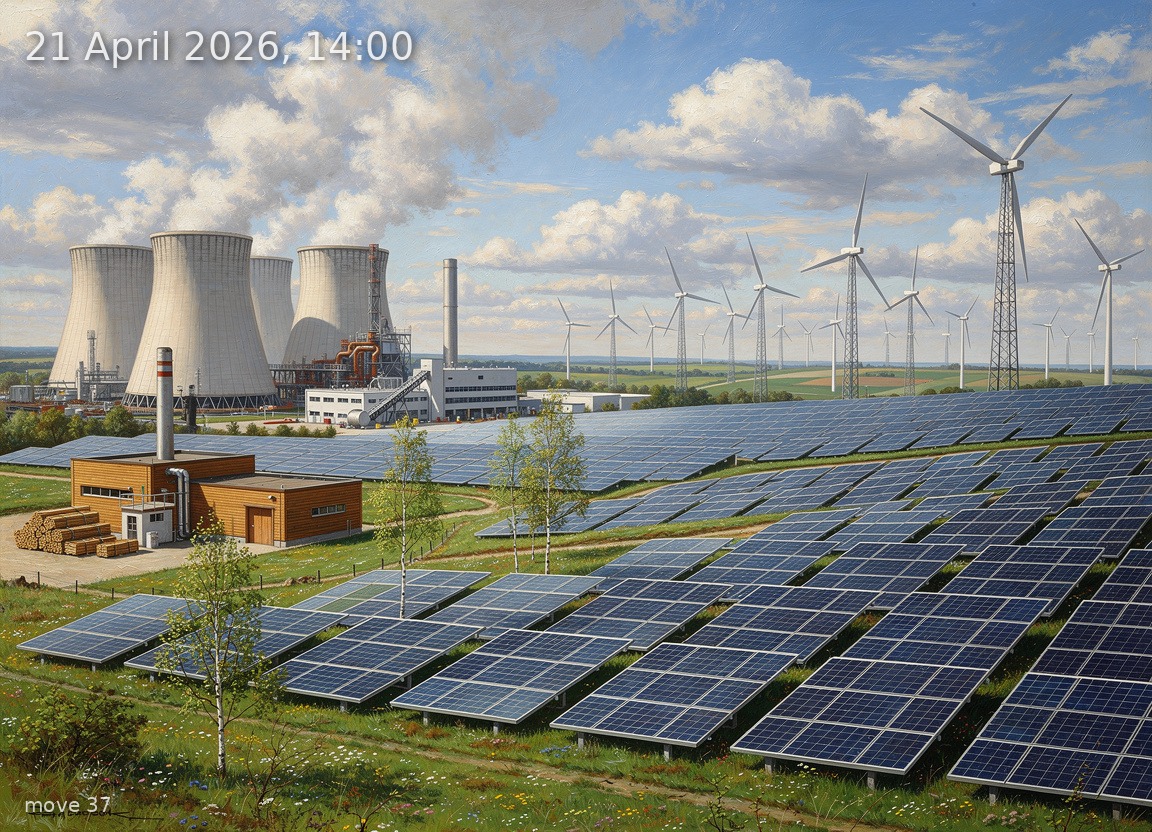
Solar at 40 GW drives 88% renewable share, pushing prices negative amid a 6.9 GW net export.
Back
Generation mix
Wind onshore 16%
Wind offshore 1%
Solar 62%
Biomass 6%
Hydro 2%
Natural gas 4%
Hard coal 2%
Brown coal 6%
88%
Renewable share
11.0 GW
Wind (on + offshore)
40.0 GW
Solar
64.1 GW
Total generation
+6.9 GW
Net export
-3.7 €/MWh
Day-ahead price
11.6°C / 9 km/h
Temp / Wind speed
Open-Meteo, Kassel (51.3°N 9.5°E)
67% / 357.5 W/m²
Cloud cover / Radiation
84
gCO₂/kWh
Image prompt
Solar 40.0 GW dominates the scene: the entire foreground and middle ground are covered with vast fields of aluminium-framed crystalline silicon photovoltaic panels stretching to the horizon, reflecting bright midday light under a partly cloudy sky. Wind onshore 10.4 GW fills the mid-right as dozens of three-blade turbines on tall lattice and tubular towers, blades turning slowly in light wind. Brown coal 4.0 GW occupies the far left as a cluster of massive hyperbolic cooling towers emitting pale steam plumes rising into the clouds. Biomass 4.0 GW appears as a mid-sized wood-clad power plant with a low square smokestack and stacked timber in its yard, positioned left of centre. Natural gas 2.4 GW is rendered as a compact CCGT facility with a single tall exhaust stack and a modest heat shimmer, tucked behind the solar arrays centre-left. Hydro 1.5 GW is a small concrete run-of-river dam on a green-banked stream at far right. Hard coal 1.2 GW is a single industrial boiler house with a square chimney and conveyor belt, small, nestled near the brown coal complex. Wind offshore 0.6 GW appears as a faint line of turbines on a distant hazy horizon suggesting the North Sea. The time is 14:00 in central Germany in spring: full bright daylight, sun high but partially veiled by broken cumulus clouds covering roughly two-thirds of a pale blue sky, creating dappled light across the landscape. Temperature is mild at 11.6°C: fresh green spring foliage on birch and linden trees, early wildflowers in meadow strips between panel rows. The atmosphere is calm and open, reflecting the negative electricity price—no oppressive haze, clean air, gentle pastoral mood. Style: highly detailed oil painting in the tradition of 19th-century German Romantic landscape painters such as Caspar David Friedrich and Carl Blechen—rich saturated colour, visible impasto brushwork, luminous atmospheric depth, dramatic yet serene composition—but with meticulous engineering accuracy on every turbine nacelle, PV module busbar, cooling tower shell, and CCGT stack. No text, no labels.