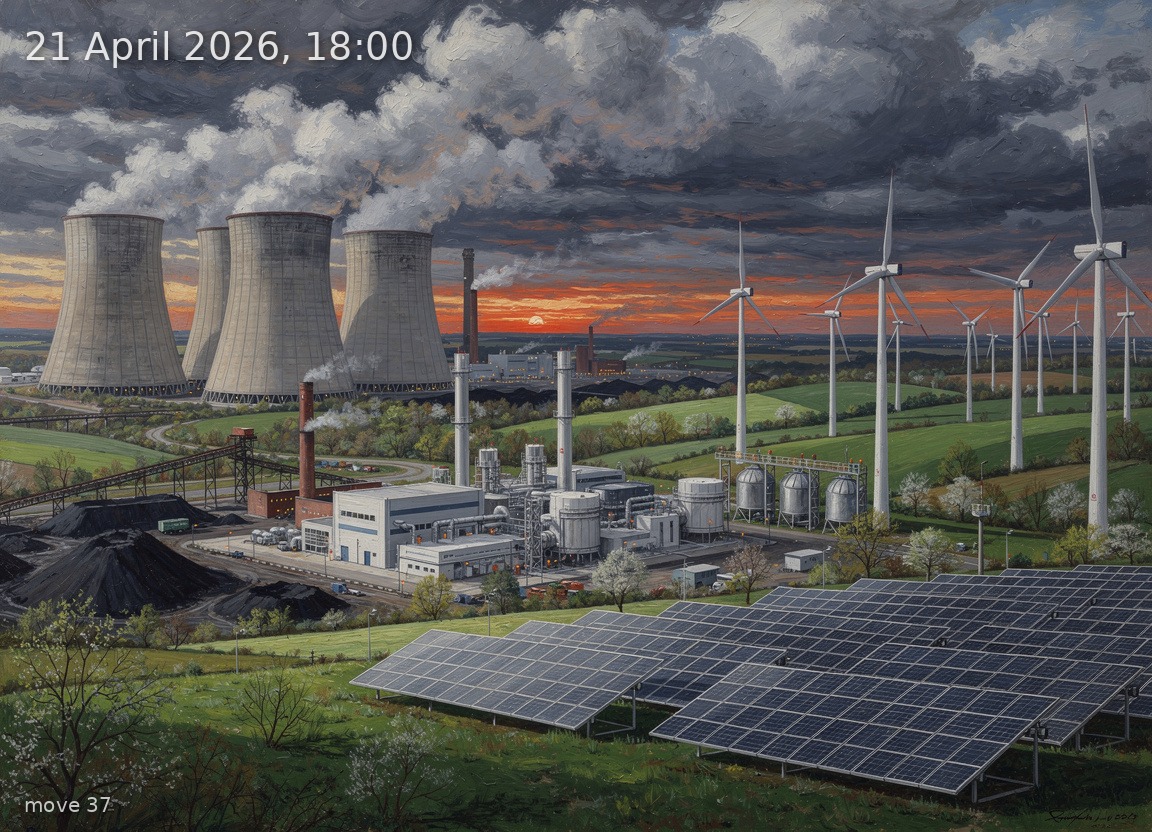
Wind, brown coal, and solar lead domestic generation while 11.2 GW of net imports cover evening demand under overcast skies.
Back
Generation mix
Wind onshore 25%
Wind offshore 2%
Solar 24%
Biomass 10%
Hydro 3%
Natural gas 14%
Hard coal 7%
Brown coal 16%
64%
Renewable share
12.5 GW
Wind (on + offshore)
11.3 GW
Solar
46.6 GW
Total generation
-11.2 GW
Net import
102.7 €/MWh
Day-ahead price
12.1°C / 10 km/h
Temp / Wind speed
Open-Meteo, Kassel (51.3°N 9.5°E)
96% / 84.0 W/m²
Cloud cover / Radiation
246
gCO₂/kWh
Image prompt
Onshore wind 11.6 GW dominates the right third of the scene as dozens of tall three-blade turbines with white tubular towers and detailed nacelles, their rotors turning slowly in light wind, stretching across rolling green spring fields; solar 11.3 GW occupies the centre-right foreground as vast arrays of aluminium-framed crystalline silicon PV panels angled on metallic racks, their surfaces dull and unreflective under the heavy overcast; brown coal 7.4 GW fills the left quarter as massive hyperbolic concrete cooling towers emitting thick white-grey steam plumes, with conveyor belts of lignite visible at their base; natural gas 6.3 GW appears centre-left as a cluster of compact combined-cycle gas turbine plants with tall single exhaust stacks venting thin heat shimmer; biomass 4.5 GW is rendered as a mid-ground industrial facility with cylindrical digesters and a short smokestack with faint emissions; hard coal 3.1 GW appears behind the gas plants as a smaller coal-fired station with a single wide chimney and coal yard; hydro 1.6 GW is depicted as a modest dam and spillway nestled in the far-left valley; offshore wind 0.9 GW appears as a handful of distant turbines visible on the far horizon line. The sky is dusk at 18:00 in late April—a rapidly fading orange-red glow lingers on the lower western horizon, while the upper sky darkens to slate grey and deep blue-grey, with 96% cloud cover forming a thick, oppressive blanket of stratocumulus reflecting the high electricity price as atmospheric weight and tension. The air feels cool at 12°C; spring vegetation is fresh pale green with budding trees. The landscape is central German rolling terrain. Highly detailed oil painting in the tradition of 19th-century German Romantic landscape painters—rich saturated colour, visible impasto brushwork, dramatic atmospheric depth and chiaroscuro—but with meticulous engineering accuracy on every turbine blade, every cooling tower rib, every solar panel cell. No text, no labels.