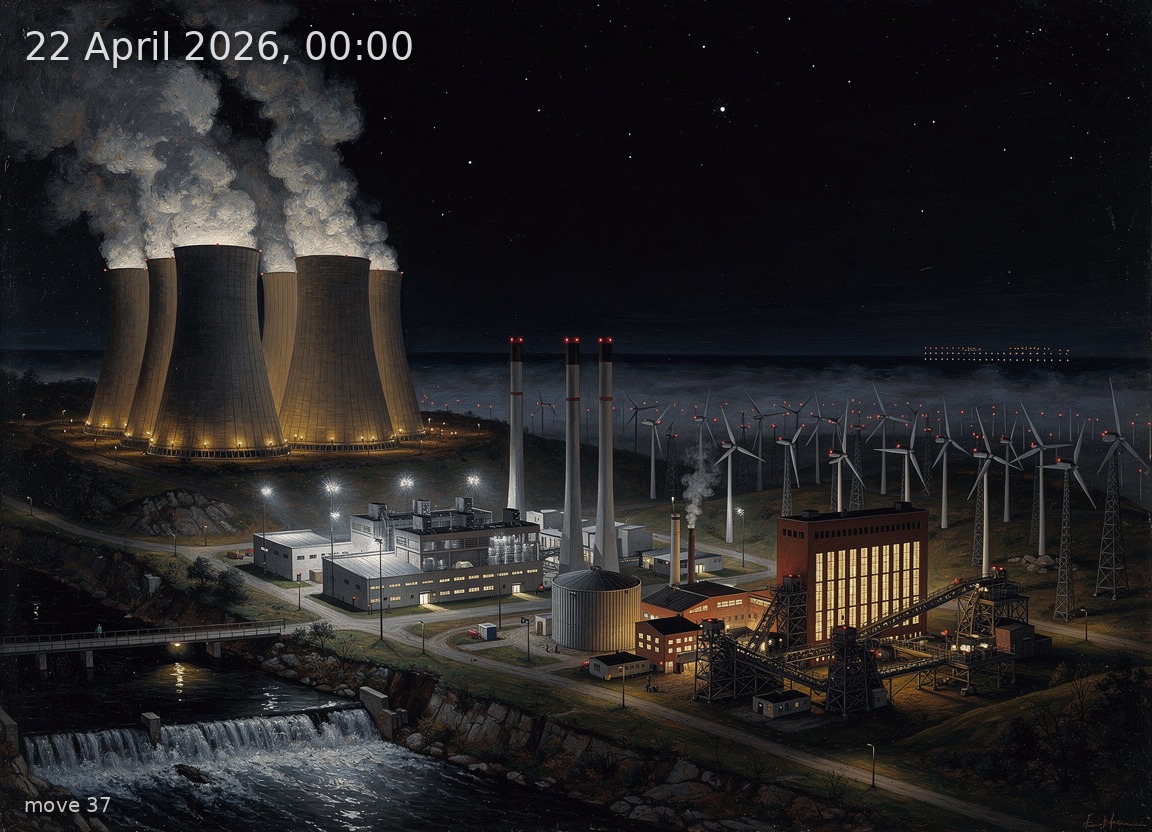
Wind and coal-gas thermal plants power a midnight grid requiring 7.3 GW net imports at elevated prices.
Back
Generation mix
Wind onshore 36%
Wind offshore 3%
Biomass 11%
Hydro 4%
Natural gas 19%
Hard coal 10%
Brown coal 17%
54%
Renewable share
14.9 GW
Wind (on + offshore)
0.0 GW
Solar
38.2 GW
Total generation
-7.3 GW
Net import
107.1 €/MWh
Day-ahead price
5.3°C / 2 km/h
Temp / Wind speed
Open-Meteo, Kassel (51.3°N 9.5°E)
0% / 0.0 W/m²
Cloud cover / Radiation
311
gCO₂/kWh
Image prompt
Brown coal 6.7 GW dominates the left quarter as a cluster of massive hyperbolic cooling towers with thick white steam plumes rising into the black sky, lit from below by amber sodium lamps; natural gas 7.2 GW occupies the centre-left as a row of compact CCGT power blocks with tall single exhaust stacks emitting translucent heat shimmer, illuminated by harsh industrial floodlights; hard coal 3.9 GW appears centre-right as a smaller coal-fired station with a single rectangular boiler house and conveyor belt infrastructure, glowing dull orange from internal furnaces; onshore wind 13.9 GW spans the entire right half and background as dozens of three-blade turbines on tall lattice and tubular towers, their red aviation warning lights blinking against the pitch-black sky, rotors slowly turning; offshore wind 1.0 GW is suggested by a faint cluster of distant turbine lights on the far-right horizon; biomass 4.2 GW appears as a medium-sized industrial plant with a rounded silo and modest stack emitting pale vapor, nestled between the gas plant and wind turbines; hydro 1.4 GW is a small run-of-river facility with illuminated spillway at the far left edge near a dark river. The sky is completely black with no twilight or sky glow—deep navy-black, a clear April night at 0°C to 5°C with zero cloud cover, so a scattering of cold sharp stars is visible above the industrial haze. Bare early-spring trees with just the faintest buds line the mid-ground. The atmosphere feels heavy and oppressive despite the clear sky, conveying the tension of a high-price hour—warm industrial light contrasts with the cold darkness. Painted in the style of a highly detailed 19th-century German Romantic oil painting, rich impasto brushwork, dramatic chiaroscuro between the glowing industrial complexes and the vast dark landscape, meticulous engineering detail on every turbine nacelle, cooling tower ribbing, and exhaust stack, evoking Caspar David Friedrich's sublime darkness merged with industrial reality. No text, no labels.