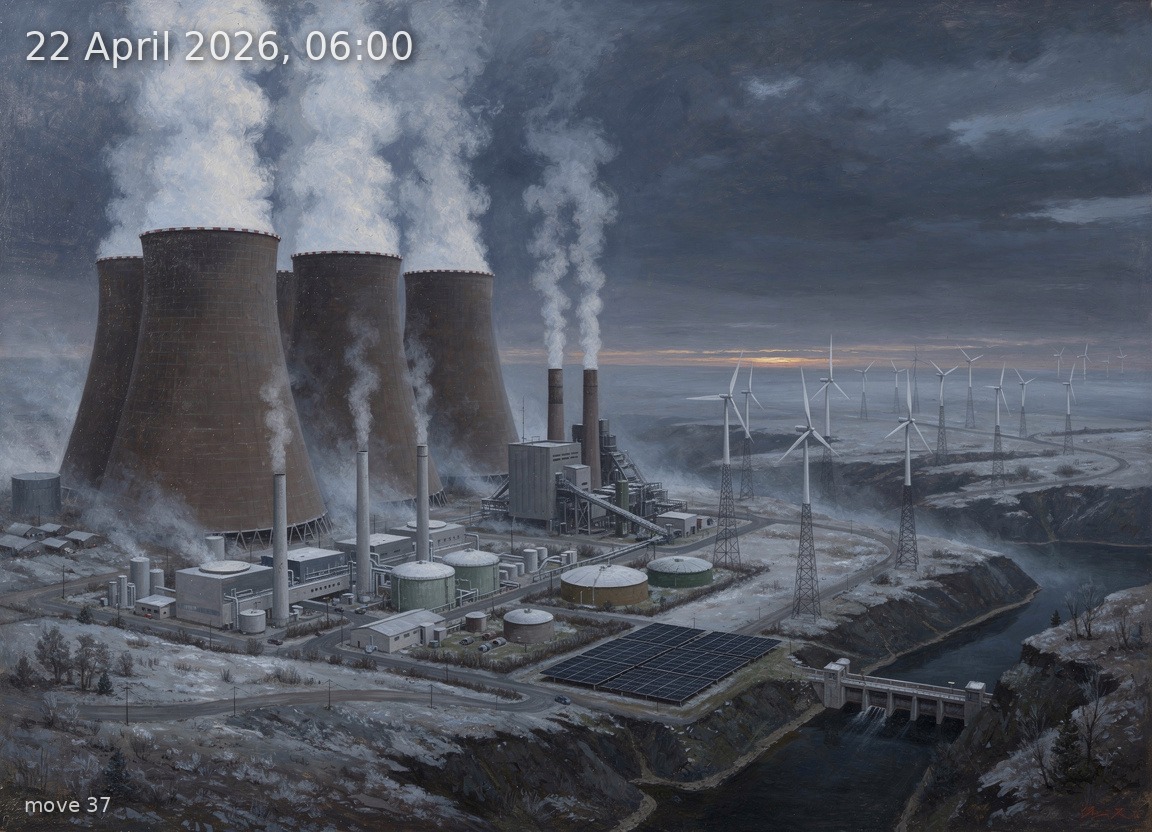
Cold dawn with light winds drives heavy thermal and import reliance at 139.8 EUR/MWh.
Back
Generation mix
Wind onshore 24%
Wind offshore 2%
Solar 3%
Biomass 12%
Hydro 5%
Natural gas 22%
Hard coal 12%
Brown coal 20%
46%
Renewable share
9.7 GW
Wind (on + offshore)
1.2 GW
Solar
36.7 GW
Total generation
-19.4 GW
Net import
139.8 €/MWh
Day-ahead price
0.2°C / 3 km/h
Temp / Wind speed
Open-Meteo, Kassel (51.3°N 9.5°E)
13% / 0.0 W/m²
Cloud cover / Radiation
360
gCO₂/kWh
Image prompt
Brown coal 7.3 GW dominates the left quarter as a cluster of massive hyperbolic cooling towers with thick white steam plumes rising into the still air; natural gas 7.9 GW fills the left-centre as compact CCGT plants with tall single exhaust stacks emitting thin heat shimmer; hard coal 4.4 GW appears as a smaller coal-fired station with rectangular chimneys and conveyor belts just right of centre; wind onshore 9.0 GW spans the right third as dozens of three-blade turbines on lattice and tubular towers scattered across a gently rolling plain, their blades turning almost imperceptibly in negligible wind; wind offshore 0.7 GW is suggested by a few distant turbines on the far-right horizon over a faint body of water; biomass 4.4 GW appears as mid-ground industrial biogas facilities with cylindrical digesters and small stacks; hydro 1.7 GW is rendered as a modest dam structure with a reservoir tucked into a hillside at the far right; solar 1.2 GW is shown as a small field of aluminium-framed crystalline silicon panels in the mid-ground, dark and barely catching any light. The sky is a deep blue-grey pre-dawn, with the faintest pale luminescence along the eastern horizon but no direct sunlight — no warm colours, no golden glow, just cold twilight. The atmosphere is heavy and oppressive, with a low haze clinging to the industrial structures reflecting the high electricity price. Frost covers the bare early-spring grass and leafless trees; temperature near 0°C is evident in the frozen landscape. Near-calm air means smoke and steam rise vertically. Highly detailed oil painting in the tradition of 19th-century German Romantic landscape painters — Caspar David Friedrich meets industrial sublime — rich deep blues, greys, and muted earth tones, visible impasto brushwork, atmospheric depth receding into misty distance, meticulous engineering detail on every turbine nacelle, cooling tower, and exhaust stack. No text, no labels.