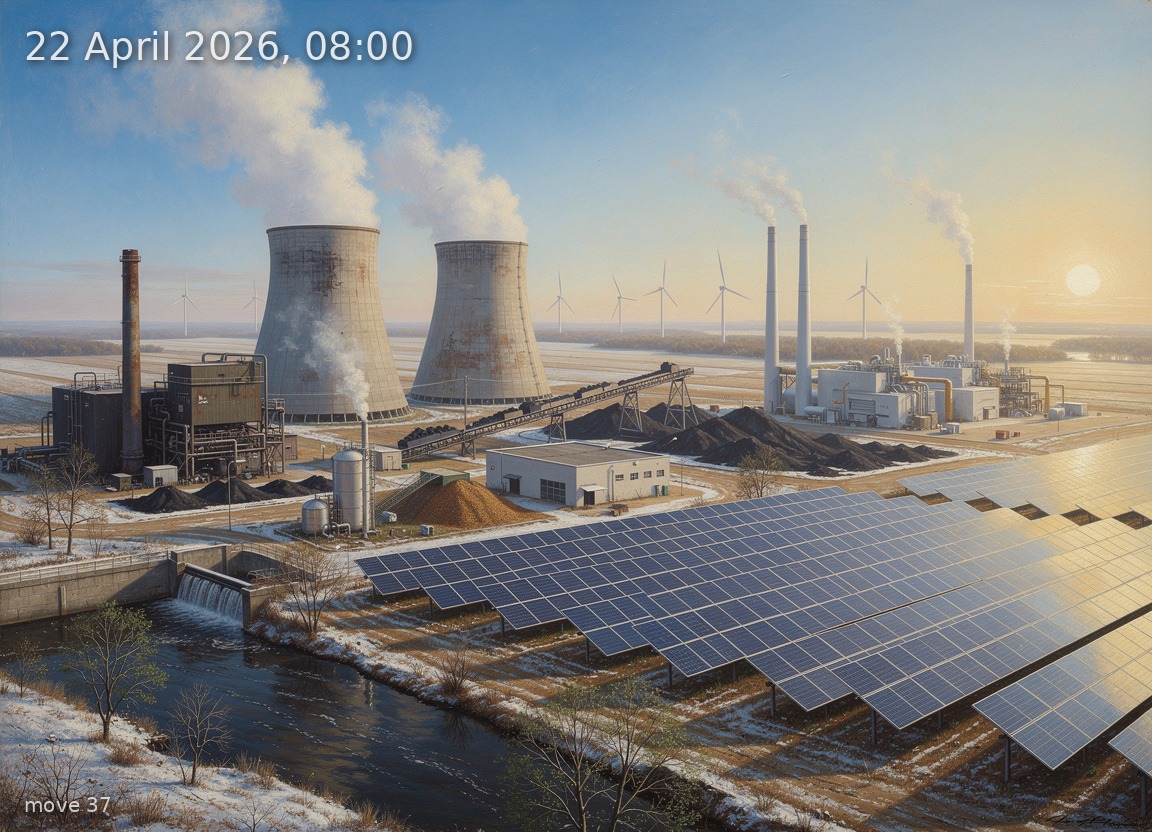
Strong solar leads at 21.8 GW, but cold temperatures and weak wind drive 11.6 GW net imports and high prices.
Back
Generation mix
Wind onshore 10%
Wind offshore 1%
Solar 42%
Biomass 9%
Hydro 3%
Natural gas 14%
Hard coal 9%
Brown coal 12%
65%
Renewable share
6.0 GW
Wind (on + offshore)
21.8 GW
Solar
51.5 GW
Total generation
-11.6 GW
Net import
113.9 €/MWh
Day-ahead price
1.7°C / 2 km/h
Temp / Wind speed
Open-Meteo, Kassel (51.3°N 9.5°E)
0% / 61.0 W/m²
Cloud cover / Radiation
231
gCO₂/kWh
Image prompt
Solar 21.8 GW dominates the right half of the scene as vast arrays of aluminium-framed crystalline silicon photovoltaic panels stretching across frost-dusted farmland, angled toward a brilliant low morning sun; natural gas 7.3 GW appears in the centre-right as a cluster of compact CCGT power plants with tall single exhaust stacks emitting thin white plumes; brown coal 6.1 GW occupies the centre-left as three massive hyperbolic cooling towers releasing thick columns of steam into the cold air, beside conveyor belts feeding raw lignite; hard coal 4.5 GW sits to the left as a dark industrial plant with rectangular boiler houses and a tall smokestack; wind onshore 5.3 GW appears as a sparse line of three-blade turbines on a distant ridge, their rotors barely turning in the still air; wind offshore 0.8 GW is suggested by a tiny cluster of turbines on a far hazy horizon line; biomass 4.5 GW is depicted as a mid-sized wood-chip-fed plant with a modest cylindrical silo and gently steaming flue near the coal facilities; hydro 1.4 GW appears as a small concrete dam with a thin cascade of water at the far left edge. The sky is perfectly clear, zero clouds, a crisp gradient from pale gold near the low eastern sun to cold cerulean blue overhead — full morning daylight at 08:00 in April. The landscape is a broad, flat German plain with bare deciduous trees and patches of white frost on brown stubble fields, temperature near freezing, sparse early-spring vegetation. The atmosphere feels oppressive and heavy despite the sunshine — a faint industrial haze clings to the middle distance, reflecting the high electricity price. Rendered as a highly detailed oil painting in the tradition of 19th-century German Romantic landscape painters such as Caspar David Friedrich and Carl Blechen — rich impasto brushwork, luminous atmospheric depth, dramatic chiaroscuro between the golden sunlit panels and the shadowed coal infrastructure, meticulous engineering accuracy on every turbine nacelle, lattice tower, cooling tower profile, and PV module frame. No text, no labels.