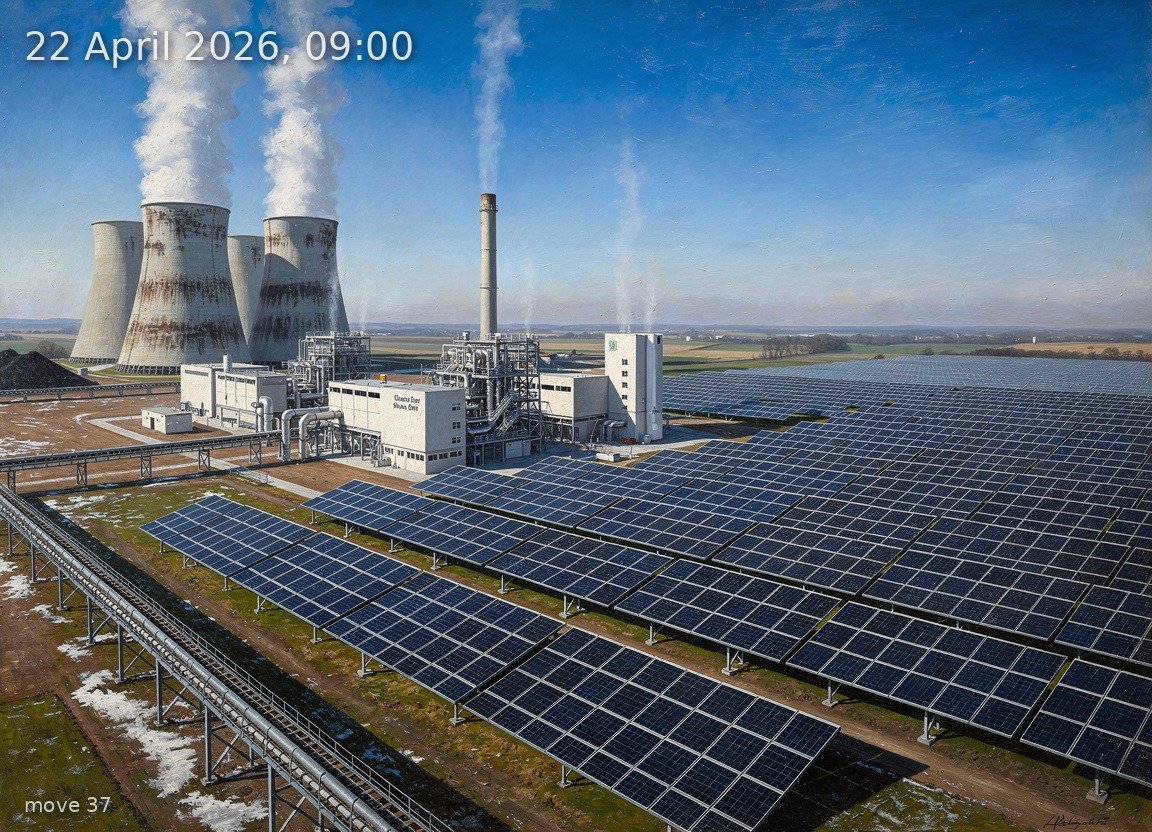
Solar at 35.6 GW leads under clear skies; thermal plants and 3 GW net imports cover remaining demand.
Back
Generation mix
Wind onshore 5%
Wind offshore 1%
Solar 61%
Biomass 7%
Hydro 3%
Natural gas 9%
Hard coal 6%
Brown coal 8%
77%
Renewable share
3.6 GW
Wind (on + offshore)
35.6 GW
Solar
58.6 GW
Total generation
-3.0 GW
Net import
79.6 €/MWh
Day-ahead price
4.6°C / 3 km/h
Temp / Wind speed
Open-Meteo, Kassel (51.3°N 9.5°E)
0% / 197.8 W/m²
Cloud cover / Radiation
156
gCO₂/kWh
Image prompt
Solar 35.6 GW dominates the scene as vast fields of aluminium-framed crystalline silicon photovoltaic panels stretching across the entire right half and centre-right of the composition, their blue-black surfaces glinting under brilliant morning sunshine. Natural gas 5.3 GW appears centre-left as a cluster of compact CCGT power stations with tall single exhaust stacks releasing thin heat shimmer. Brown coal 4.8 GW occupies the far left as three massive hyperbolic cooling towers with thick white-grey steam plumes rising vertically in the still air, beside conveyor belts of dark lignite. Hard coal 3.6 GW sits just left of centre as a smaller coal-fired station with rectangular boiler houses and a single wide chimney trailing darker smoke. Biomass 4.4 GW appears as a mid-sized industrial facility with rounded storage silos and a modest stack nestled between the coal plant and gas turbines. Wind onshore 3.1 GW is represented by a short row of three-blade turbines with white lattice towers on a distant ridge at the far right, their blades nearly motionless in the calm air. Wind offshore 0.5 GW is a tiny cluster of turbines barely visible on the far horizon line. Hydro 1.5 GW appears as a small concrete dam and penstock structure in a shallow valley at the far left edge. The sky is completely cloudless, a deep spring blue with the sun at roughly 35 degrees elevation casting crisp directional morning light from the east, with long shadows stretching westward. The landscape is early spring in central Germany: bare deciduous trees just beginning to show pale green buds, brown-green fields, patches of frost lingering in shadowed hollows reflecting the 4.6°C temperature. The atmosphere feels slightly heavy and oppressive despite the sunshine—a faint industrial haze hangs at the horizon, suggesting the elevated 79.6 EUR/MWh price and the weight of thermal generation still needed. Highly detailed oil painting in the tradition of 19th-century German Romantic landscape painters—Caspar David Friedrich's sense of atmospheric depth combined with Adolph Menzel's industrial precision—rich colour, visible impasto brushwork, luminous glazes in the sky, meticulous engineering detail on every turbine nacelle, panel frame, and cooling tower. No text, no labels.