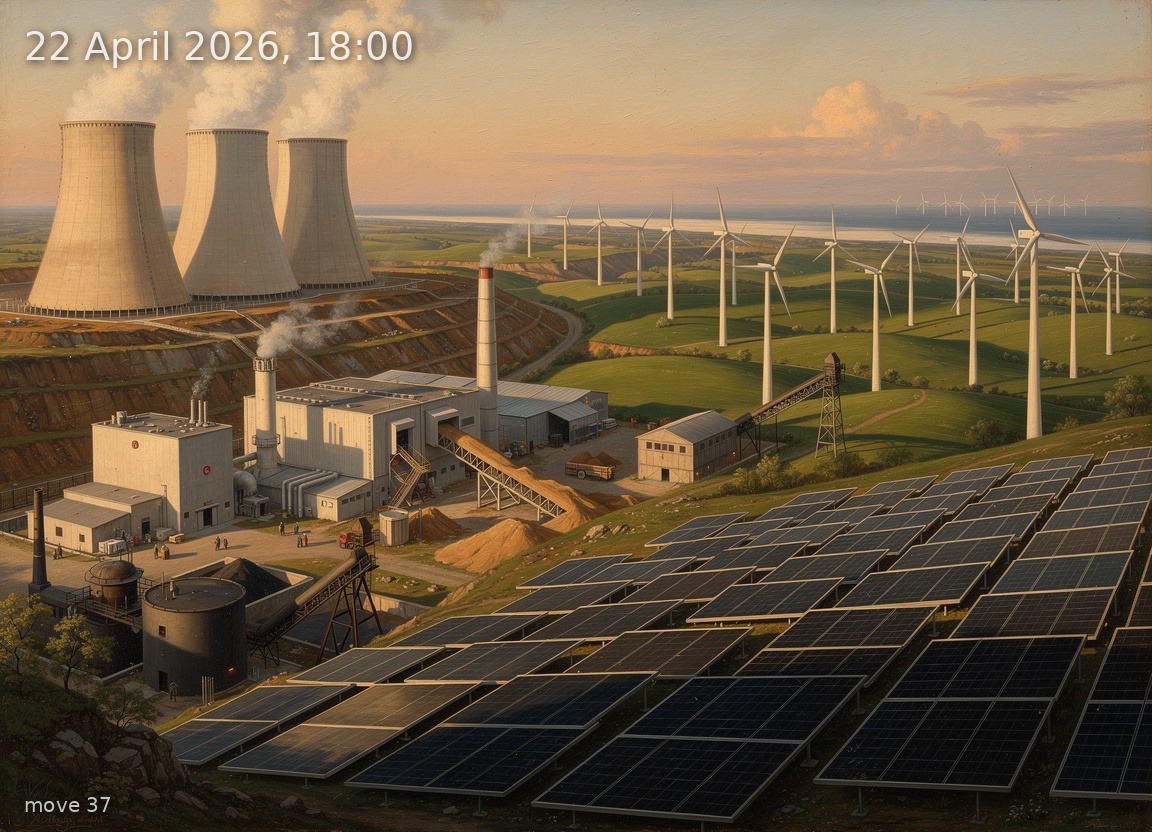
Solar and wind lead at 69% renewables, but 7.6 GW net imports and thermal baseload cover the evening ramp.
Back
Generation mix
Wind onshore 22%
Wind offshore 6%
Solar 29%
Biomass 9%
Hydro 3%
Natural gas 12%
Hard coal 6%
Brown coal 13%
69%
Renewable share
13.7 GW
Wind (on + offshore)
14.4 GW
Solar
49.1 GW
Total generation
-7.5 GW
Net import
105.3 €/MWh
Day-ahead price
15.6°C / 8 km/h
Temp / Wind speed
Open-Meteo, Kassel (51.3°N 9.5°E)
0% / 327.8 W/m²
Cloud cover / Radiation
209
gCO₂/kWh
Image prompt
Solar 14.4 GW dominates the right third of the scene as vast fields of aluminium-framed crystalline silicon PV panels catching the last low-angle golden light; wind onshore 10.6 GW fills the centre-right as dozens of tall three-blade turbines on lattice and tubular towers stretching across rolling green April hills with gentle blade rotation; wind offshore 3.0 GW appears in the distant far right as a cluster of turbines on the hazy horizon above a thin sliver of sea; brown coal 6.3 GW occupies the left foreground as massive hyperbolic cooling towers emitting thick white steam plumes, with open-pit mine terraces visible behind; natural gas 5.9 GW sits centre-left as a pair of compact CCGT power blocks with tall single exhaust stacks venting thin heat shimmer; biomass 4.5 GW appears as a mid-ground industrial facility with a wood-chip conveyor and a modest smokestack with pale grey exhaust; hard coal 2.9 GW is rendered as a smaller conventional plant with coal bunkers and a single cooling tower beside the brown coal complex; hydro 1.4 GW is a concrete run-of-river weir with churning white water in the lower-left corner. The sky is a dusk scene at 18:00 in late April Berlin time — the sun is very low on the western horizon, casting a deep orange-red glow along the lower sky while the upper sky transitions from warm amber to deepening blue; clear sky with zero clouds; the atmosphere feels heavy and oppressive despite the clarity, with a warm golden-brown haze suggesting expensive electricity. Spring vegetation: fresh bright-green grass, budding deciduous trees, wildflowers dotting meadow edges; temperature around 16°C conveyed by light jackets on tiny figures near the gas plant. Painted in the style of a highly detailed 19th-century German Romantic oil painting — rich impasto brushwork, luminous atmospheric depth reminiscent of Caspar David Friedrich crossed with industrial realism, meticulous engineering detail on every turbine nacelle, every cooling tower flute, every PV cell grid line. No text, no labels.