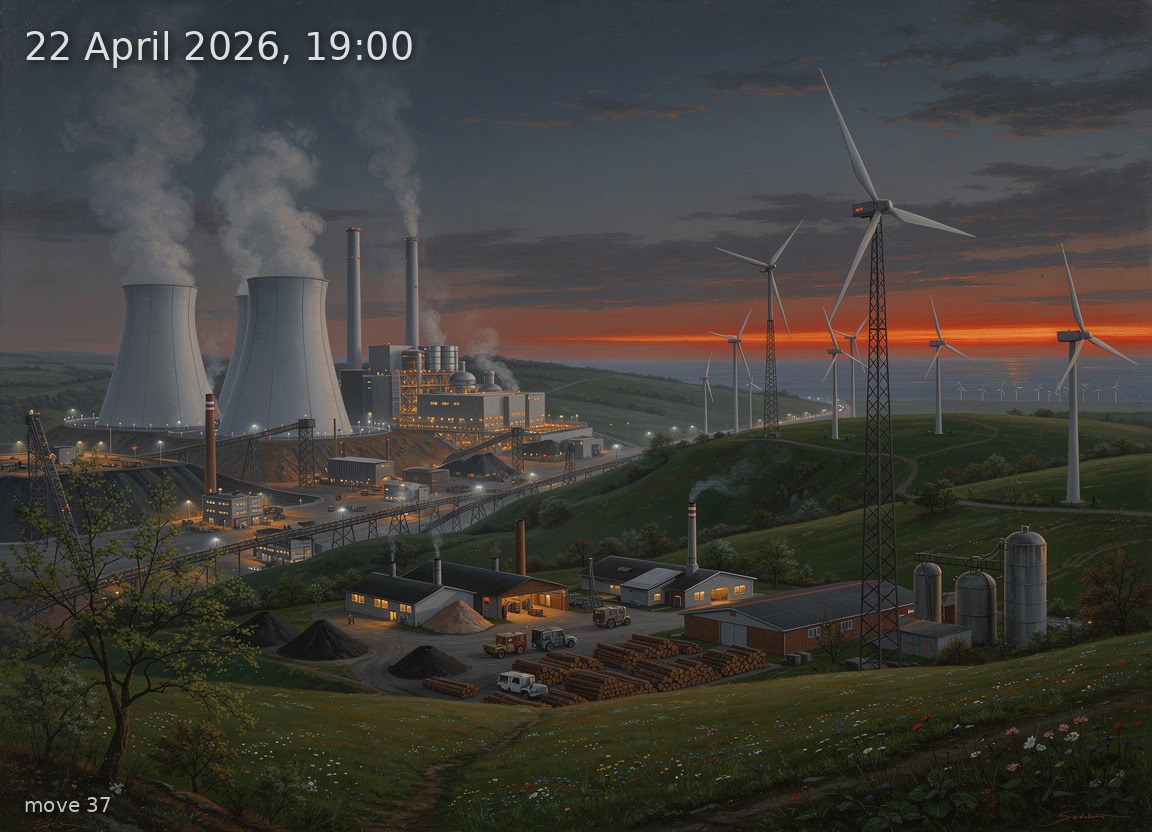
Wind and thermal plants anchor domestic supply while 16.2 GW of net imports cover peak evening demand at high prices.
Back
Generation mix
Wind onshore 24%
Wind offshore 8%
Solar 9%
Biomass 11%
Hydro 4%
Natural gas 19%
Hard coal 9%
Brown coal 16%
56%
Renewable share
13.4 GW
Wind (on + offshore)
4.0 GW
Solar
42.3 GW
Total generation
-16.2 GW
Net import
140.1 €/MWh
Day-ahead price
15.0°C / 8 km/h
Temp / Wind speed
Open-Meteo, Kassel (51.3°N 9.5°E)
0% / 175.8 W/m²
Cloud cover / Radiation
294
gCO₂/kWh
Image prompt
A sweeping 19th-century German Romantic oil painting of the German energy landscape at dusk, 19:00 in late April — the sky shows a narrow band of deep orange-red along the lower horizon fading rapidly into darkening steel-blue and indigo above, last light catching clouds at the edges. Wind onshore 10.2 GW dominates the right third of the canvas as dozens of tall three-blade turbines on lattice and tubular towers stretching across rolling green hills, their blades turning slowly in a light breeze. Wind offshore 3.2 GW appears as a cluster of turbines on the far-right horizon standing in a faintly visible North Sea. Natural gas 8.1 GW fills the center-left as a complex of compact CCGT power stations with tall single exhaust stacks emitting thin heat shimmer against the twilight sky, warmly lit by sodium-orange industrial lights beginning to glow. Brown coal 6.9 GW occupies the left quarter as massive hyperbolic cooling towers with thick white steam plumes rising into the darkening sky, a sprawling lignite plant with conveyor belts and coal bunkers, lit by harsh floodlights. Hard coal 3.7 GW sits beside the brown coal as a smaller but detailed coal-fired station with a tall chimney and visible coal stockpiles. Biomass 4.6 GW appears in the mid-ground as a cluster of wood-chip fueled CHP facilities with modest stacks and steam, surrounded by timber yards. Solar 4.0 GW is rendered as rows of aluminium-framed crystalline silicon panels on a south-facing hillside catching the last amber rays of the setting sun, their surfaces reflecting the orange horizon light. Hydro 1.6 GW is a small dam and powerhouse nestled in a river valley in the background, white water spilling over a weir. The atmosphere is heavy and oppressive, reflecting the 140.1 EUR/MWh price — a thick, brooding quality to the air, haze gathering around the thermal plants. Spring vegetation at 15°C: fresh green leaves on deciduous trees, wildflowers in meadows. Clear sky with zero cloud cover but the dusk paints the sky in dramatic gradients. Highly detailed visible brushwork, rich chiaroscuro, atmospheric depth, meticulous engineering accuracy on all infrastructure — turbine nacelles, PV cell grids, cooling tower parabolic geometry, CCGT exhaust stacks. No text, no labels.