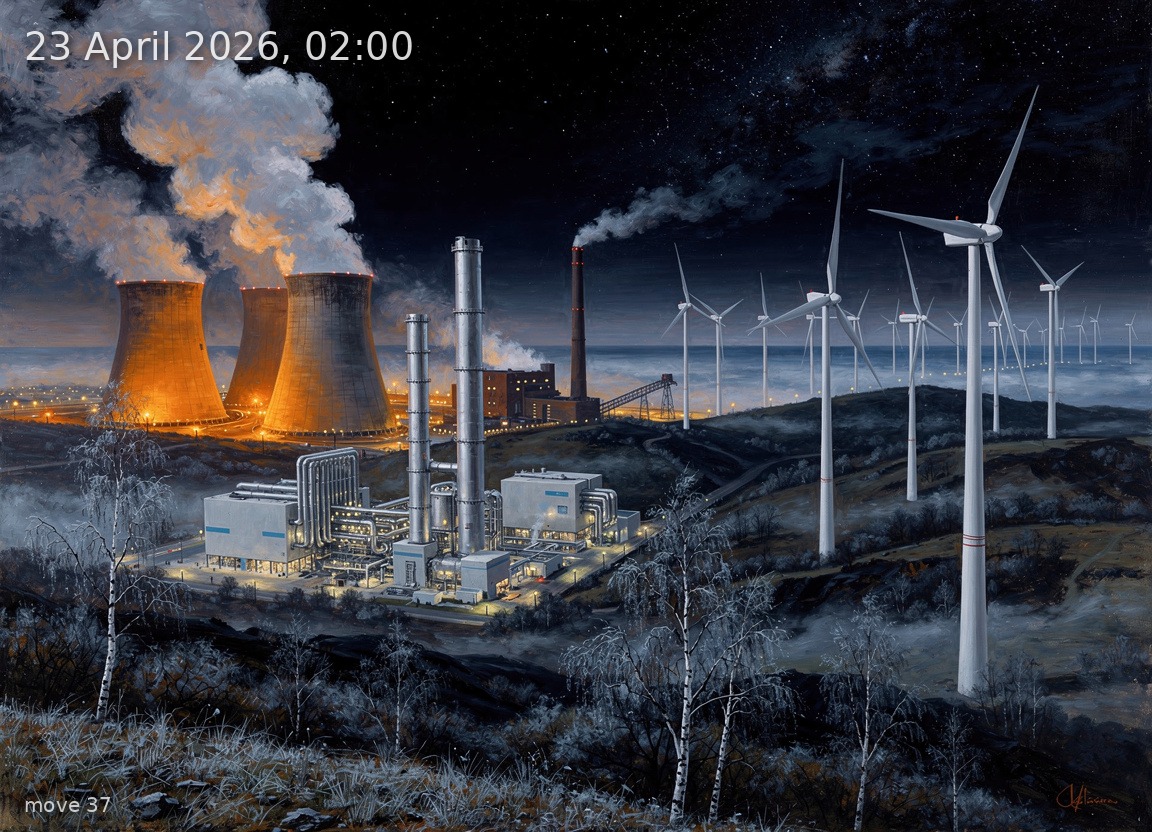
Wind leads at 18.6 GW but coal and gas fill 15.3 GW of residual load on a cold, dark April night.
Back
Generation mix
Wind onshore 37%
Wind offshore 10%
Biomass 10%
Hydro 3%
Natural gas 13%
Hard coal 8%
Brown coal 17%
61%
Renewable share
18.5 GW
Wind (on + offshore)
0.0 GW
Solar
39.3 GW
Total generation
-3.1 GW
Net import
96.7 €/MWh
Day-ahead price
2.6°C / 3 km/h
Temp / Wind speed
Open-Meteo, Kassel (51.3°N 9.5°E)
0% / 0.0 W/m²
Cloud cover / Radiation
270
gCO₂/kWh
Image prompt
Wind onshore 14.5 GW dominates the right half of the scene as dozens of tall three-blade turbines with white tubular towers and nacelles, their rotors slowly turning, arrayed across dark rolling hills receding into deep perspective; wind offshore 4.1 GW appears as a distant cluster of turbines on the far-right horizon above a faintly visible sea line. Brown coal 6.7 GW occupies the left foreground as a massive lignite power station with three hyperbolic concrete cooling towers emitting thick white steam plumes lit from below by orange sodium floodlights; natural gas 5.3 GW sits left-of-centre as two compact CCGT combined-cycle blocks with tall single exhaust stacks and smaller vapour trails, their metal structures gleaming under industrial lighting. Hard coal 3.3 GW appears behind the gas plant as a darker, older station with a single large smokestack and conveyor gantry. Biomass 4.1 GW is rendered centre-right as a wood-clad CHP plant with a modest chimney and warm-lit loading yard stacked with timber. Hydro 1.3 GW is a small run-of-river weir in the lower-centre foreground, water glinting under floodlights. The sky is completely black with no twilight or glow — a clear, star-filled deep-navy vault, consistent with 0% cloud cover at 2 AM in April; the Milky Way is faintly visible. Frost glitters on bare early-spring grass and leafless birch branches in the immediate foreground. The atmosphere feels heavy and oppressive despite the clear sky, conveying high electricity prices — a faint amber industrial haze hugs the cooling towers. No solar panels anywhere. Highly detailed oil painting in the tradition of 19th-century German Romantic landscape art — Caspar David Friedrich meets industrial sublime — rich impasto brushwork, dramatic chiaroscuro between the sodium-orange lit plants and the cold starlit darkness, atmospheric depth with layers of mist, meticulous engineering accuracy on turbine nacelles, cooling tower geometry, and CCGT exhaust stacks. No text, no labels.