Wind and solar dominate at 37.4 GW combined, but 3°C temperatures and 5.8 GW net imports push prices above 109 EUR/MWh.
Back
Generation mix
Wind onshore 22%
Wind offshore 10%
Solar 35%
Biomass 8%
Hydro 2%
Natural gas 11%
Hard coal 5%
Brown coal 8%
76%
Renewable share
17.7 GW
Wind (on + offshore)
19.7 GW
Solar
56.5 GW
Total generation
-5.8 GW
Net import
109.7 €/MWh
Day-ahead price
3.0°C / 1 km/h
Temp / Wind speed
Open-Meteo, Kassel (51.3°N 9.5°E)
67% / 53.0 W/m²
Cloud cover / Radiation
155
gCO₂/kWh
Image prompt
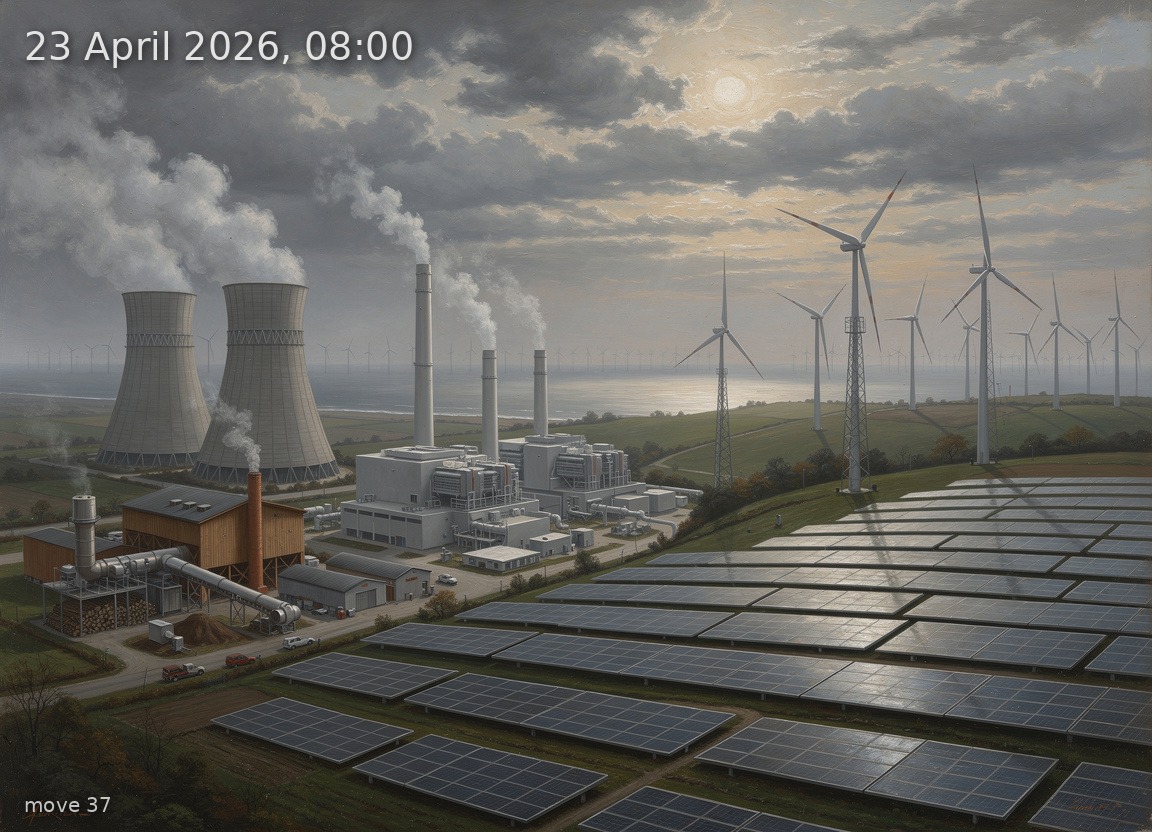
Solar 19.7 GW dominates the right third of the scene as vast fields of aluminium-framed crystalline silicon photovoltaic panels stretching across gentle rolling farmland, catching diffused morning light through broken clouds. Wind onshore 12.2 GW fills the centre-right as dozens of tall three-blade turbines on lattice and tubular towers dotting ridgelines, their blades nearly still in the calm 0.8 km/h air. Wind offshore 5.5 GW appears in the far background as a row of turbines on the hazy horizon above a distant grey sea. Natural gas 6.0 GW occupies the centre-left as a compact modern CCGT plant with twin exhaust stacks emitting thin transparent heat shimmer. Brown coal 4.5 GW fills the left as two massive hyperbolic cooling towers releasing thick white steam plumes that merge into the overcast sky. Biomass 4.4 GW sits beside the coal as a timber-clad biomass facility with a short stack and visible woodchip conveyors. Hard coal 2.8 GW appears as a smaller conventional power station with a single tall chimney and coal bunkers. Hydro 1.4 GW is a modest concrete dam and penstock visible in a narrow valley at the far left edge. The sky is 67% cloud-covered morning daylight at 08:00 in April — the sun is low in the east, partially obscured by stratocumulus clouds, casting soft diffused light with occasional brighter patches where cloud thins; no harsh shadows. The atmosphere feels heavy and oppressive, reflecting the high electricity price — a brooding grey-blue overcast pressing down on the landscape. Vegetation is early spring: bare branches with first pale green buds, brown-green fields, patches of frost on shaded grass at 3°C. Highly detailed oil painting in the tradition of 19th-century German Romantic landscape painters — rich muted colour palette of slate grey, steel blue, moss green, and warm ochre; visible confident brushwork; atmospheric depth with aerial perspective fading distant turbines into haze. Meticulous engineering detail on every technology: turbine nacelles, rotor hubs, PV cell grids, cooling tower ribbing, conveyor mechanisms. No text, no labels.