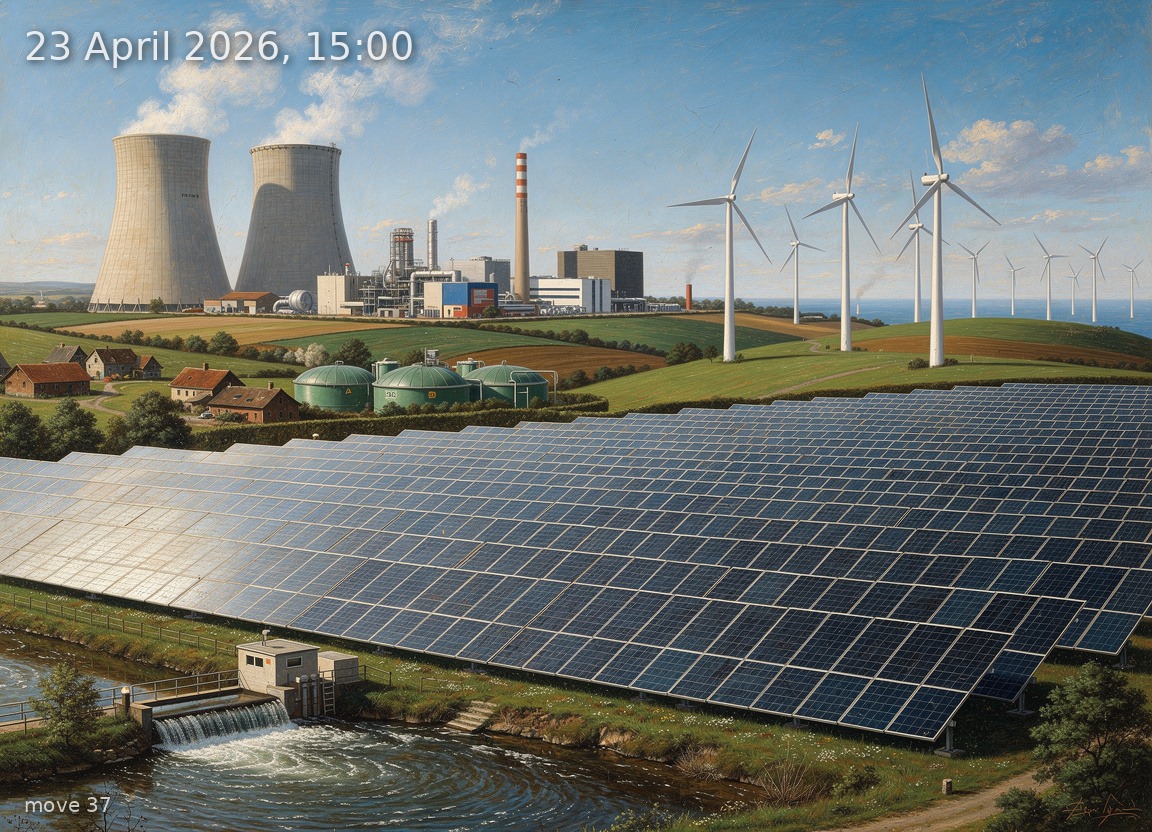
Solar at 43 GW drives 91% renewable share and negative prices as 10.5 GW of net exports flow outward.
Back
Generation mix
Wind onshore 13%
Wind offshore 3%
Solar 67%
Biomass 6%
Hydro 2%
Natural gas 3%
Hard coal 2%
Brown coal 4%
91%
Renewable share
10.5 GW
Wind (on + offshore)
43.0 GW
Solar
64.6 GW
Total generation
+10.5 GW
Net export
-22.9 €/MWh
Day-ahead price
17.0°C / 14 km/h
Temp / Wind speed
Open-Meteo, Kassel (51.3°N 9.5°E)
1% / 649.2 W/m²
Cloud cover / Radiation
64
gCO₂/kWh
Image prompt
Solar 43.0 GW dominates the entire scene: vast rolling fields of crystalline silicon photovoltaic panels stretching from the foreground deep into the middle distance, their aluminium frames glinting under an almost cloudless brilliant sky, occupying roughly two-thirds of the canvas. Wind onshore 8.7 GW appears as several dozen three-blade turbines with white tubular towers and visible nacelles arrayed across gentle green hills in the right-middle ground, blades turning lazily in a moderate breeze. Wind offshore 1.8 GW is suggested by a small cluster of larger turbines on a hazy horizon line at the far right, barely visible through atmospheric perspective. Brown coal 2.6 GW occupies the far left background as two hyperbolic concrete cooling towers emitting thin white steam plumes against the blue sky. Natural gas 2.0 GW sits just right of the cooling towers as a compact combined-cycle gas turbine facility with a slender exhaust stack and modest heat shimmer. Hard coal 1.3 GW appears as a smaller conventional power station with a single rectangular boiler house and a shorter smokestack beside the lignite plant. Biomass 4.1 GW is represented by a cluster of modest biogas digesters—green domed tanks—nestled among farm buildings in the left-middle ground. Hydro 1.1 GW appears as a small run-of-river weir and powerhouse beside a glimmering stream in the lower-left foreground. The lighting is full mid-afternoon April daylight at 15:00 in central Germany: the sun high in the southwest, warm and direct, casting short defined shadows, the sky a luminous cerulean blue with only the faintest wisp of cirrus. The landscape is springtime—fresh green meadows, emerging deciduous foliage on scattered oaks and birches, wildflowers dotting field margins—temperature a comfortable 17°C. The atmosphere feels calm, spacious, and serene, reflecting the deeply negative electricity price: an unhurried openness, no oppressive haze or tension. Painted in the style of a highly detailed 19th-century German Romantic oil painting—rich saturated color, visible impasto brushwork in the clouds and foliage, luminous atmospheric depth receding to a soft blue horizon—yet every piece of energy infrastructure is rendered with meticulous engineering accuracy: turbine blade profiles, PV cell grid patterns, cooling tower parabolic geometry, CCGT exhaust ducting. The composition evokes Caspar David Friedrich's sense of sublime scale but populated with the machinery of the modern energy transition. No text, no labels, no people.