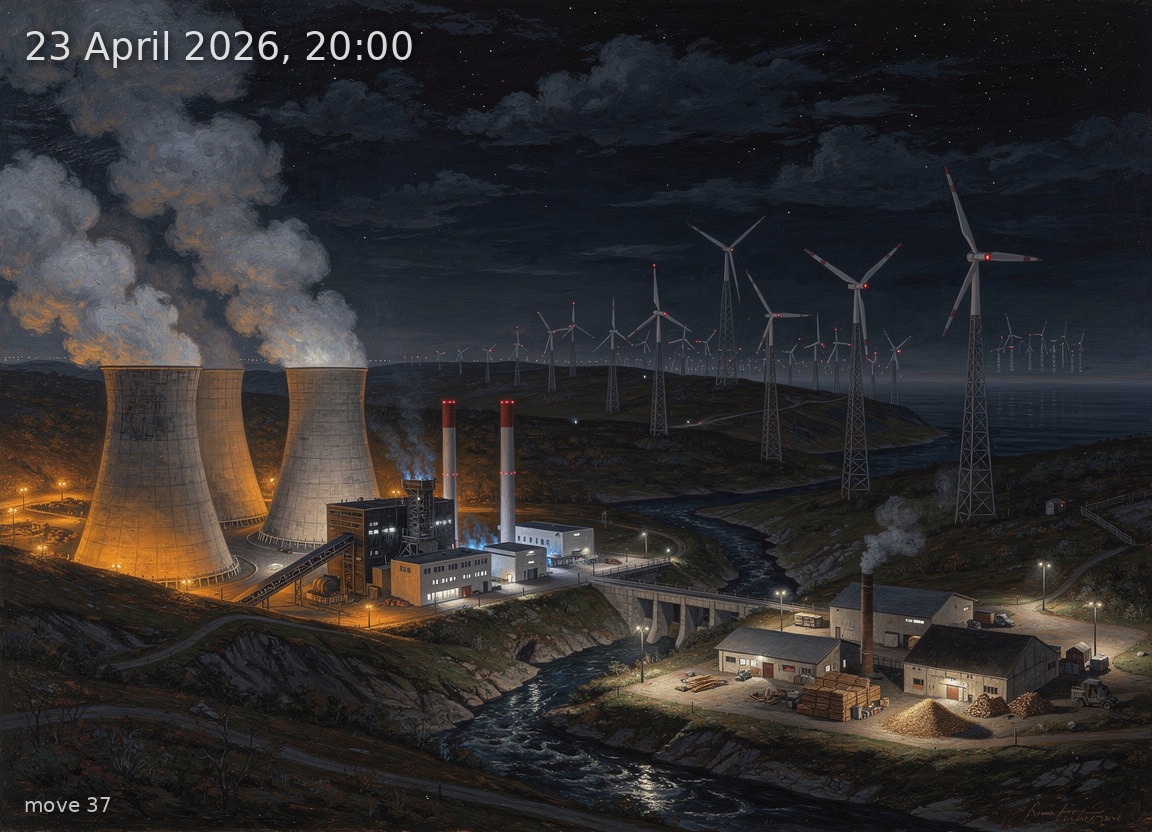
Strong wind supports a 66% renewable share at nightfall, but 12 GW net imports and coal fill the evening gap.
Back
Generation mix
Wind onshore 42%
Wind offshore 9%
Solar 1%
Biomass 10%
Hydro 4%
Natural gas 16%
Hard coal 7%
Brown coal 12%
66%
Renewable share
23.5 GW
Wind (on + offshore)
0.2 GW
Solar
45.7 GW
Total generation
-12.2 GW
Net import
136.9 €/MWh
Day-ahead price
15.2°C / 10 km/h
Temp / Wind speed
Open-Meteo, Kassel (51.3°N 9.5°E)
41% / 46.2 W/m²
Cloud cover / Radiation
226
gCO₂/kWh
Image prompt
Wind onshore 19.3 GW dominates the right half and background as dozens of tall three-blade turbines on lattice towers stretching across rolling hills into the darkness, their red aviation lights blinking; wind offshore 4.2 GW appears as a distant cluster of turbines on the far-right horizon above a dark sea; brown coal 5.4 GW occupies the left foreground as three massive hyperbolic cooling towers emitting thick white steam plumes lit from below by sodium-orange industrial lighting; hard coal 3.2 GW sits just right of the cooling towers as a smaller power station with a single tall smokestack and conveyor belts visible under floodlights; natural gas 7.1 GW fills the centre-left as two compact CCGT units with sleek exhaust stacks and a faint blue-tinged flame glow from the turbine housing; biomass 4.6 GW appears centre-right as a modest wood-chip-fed plant with a gently smoking chimney and stacked timber visible under work lights; hydro 1.6 GW is a small concrete dam and penstock in the middle distance with water faintly reflecting artificial light; solar 0.2 GW is effectively invisible — no panels shown. The sky is completely dark, a deep navy-black with no twilight glow whatsoever, only scattered stars partly obscured by 41% cloud cover rendered as dark grey patches. The atmosphere is heavy and oppressive, reflecting the high electricity price — a dense, humid quality to the air with industrial haze pooling in the valleys. Spring vegetation with fresh green grass and budding deciduous trees is barely visible in the peripheral sodium light, temperature a mild 15°C suggested by light mist near the ground. A moderate breeze animates the turbine blades mid-rotation. Rendered as a highly detailed oil painting in the tradition of 19th-century German Romantic landscape painters — rich, dark colour palette dominated by deep blues, amber industrial glows, and warm ochres; visible impasto brushwork; atmospheric depth with layers of industrial haze receding into the night. Each technology rendered with meticulous engineering accuracy: turbine nacelles, three-blade rotors, aluminium-framed structures, hyperbolic concrete cooling towers with realistic condensation plumes, CCGT exhaust stacks with heat shimmer. The scene evokes Caspar David Friedrich's nocturnal sublime reinterpreted for the industrial energy landscape. No text, no labels.