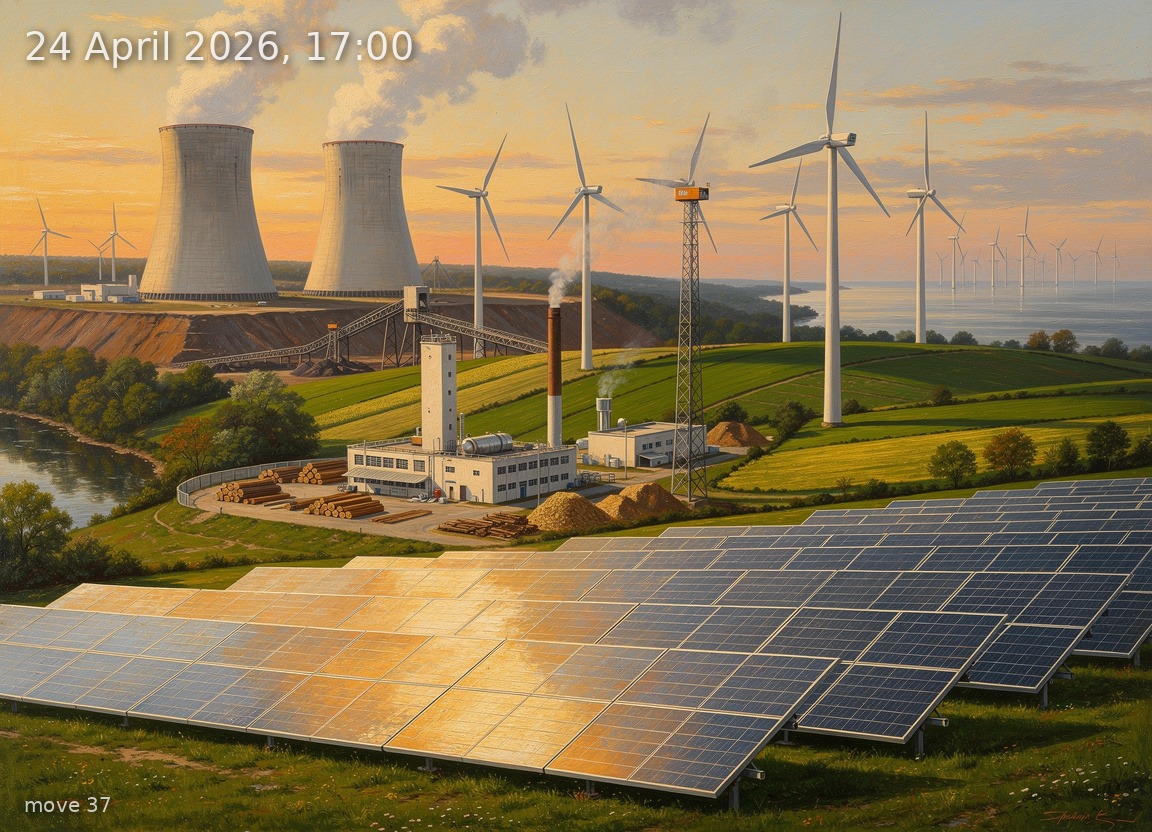
Solar at 26 GW and wind at 20 GW dominate a high-renewable spring evening with 6.8 GW net export.
Back
Generation mix
Wind onshore 25%
Wind offshore 8%
Solar 44%
Biomass 7%
Hydro 2%
Natural gas 5%
Hard coal 2%
Brown coal 6%
87%
Renewable share
19.8 GW
Wind (on + offshore)
26.1 GW
Solar
59.3 GW
Total generation
+6.7 GW
Net export
50.9 €/MWh
Day-ahead price
15.2°C / 11 km/h
Temp / Wind speed
Open-Meteo, Kassel (51.3°N 9.5°E)
36% / 357.0 W/m²
Cloud cover / Radiation
88
gCO₂/kWh
Image prompt
Solar 26.1 GW dominates the foreground and centre as vast arrays of aluminium-framed crystalline silicon photovoltaic panels stretching across rolling green spring meadows, their glass surfaces catching the low golden-orange light. Wind onshore 14.9 GW fills the middle distance as dozens of tall three-blade turbines on lattice and tubular towers, rotors turning gently in moderate wind, spread across cultivated hills with fresh green crops. Wind offshore 4.9 GW appears on the far right horizon as a cluster of turbines rising from a narrow strip of grey-blue sea. Biomass 4.3 GW is represented by a mid-sized wood-fired power station with a rectangular stack emitting thin white exhaust, surrounded by timber yards, positioned at centre-left. Brown coal 3.6 GW occupies the left background as two hyperbolic concrete cooling towers with billowing white steam plumes, adjacent to a lignite conveyor and open-pit edge. Natural gas 2.8 GW appears as a compact CCGT plant with a single tall exhaust stack and a smaller heat-recovery unit, placed between the coal towers and the biomass plant. Hard coal 1.2 GW is a single smaller stack with a dark plume, tucked behind the gas plant. Hydro 1.3 GW is shown as a small run-of-river weir with white cascading water on the far left beside a wooded riverbank. The sky is a dusk scene at 17:00 in late April: the sun is low on the western horizon casting deep orange-red light along the lower sky, the upper sky transitioning from warm amber to deepening blue-grey, with scattered cumulus clouds (36% cover) lit dramatically from below in peach and gold. The landscape is lush early-spring Germany — fresh lime-green deciduous trees beginning to leaf, wildflowers in meadow edges, 15°C mild air with soft atmospheric haze. The mood is calm and moderately warm, not oppressive. Rendered as a highly detailed oil painting in the tradition of 19th-century German Romantic landscape painters such as Caspar David Friedrich and Carl Blechen — rich saturated colour, visible confident brushwork, deep atmospheric perspective, dramatic but truthful light. Every technology is rendered with meticulous engineering accuracy: turbine nacelles, three-blade rotors, PV cell grids, cooling tower hyperbolic curvature, steam plume physics. No text, no labels.