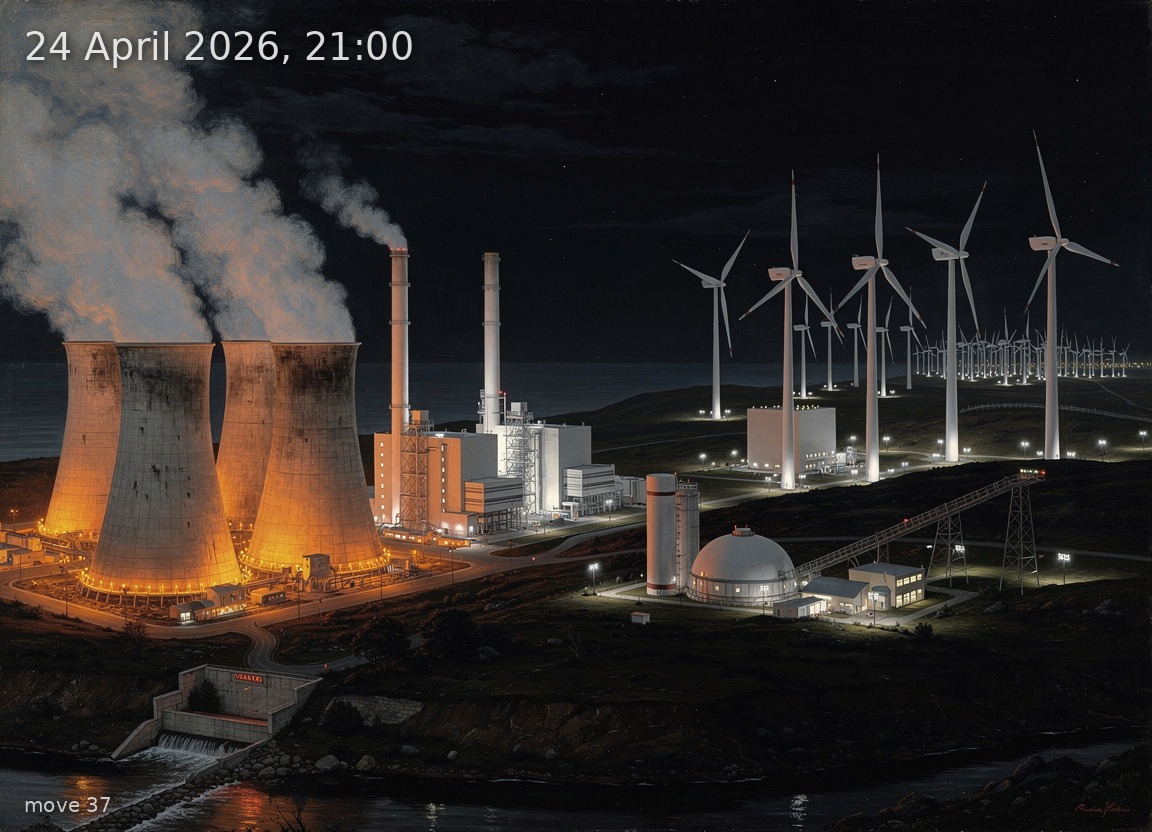
Wind leads at 20 GW but 10.7 GW net imports needed as post-sunset demand peaks at 50.4 GW.
Back
Generation mix
Wind onshore 42%
Wind offshore 9%
Solar 0%
Biomass 12%
Hydro 4%
Natural gas 14%
Hard coal 5%
Brown coal 15%
66%
Renewable share
20.2 GW
Wind (on + offshore)
0.0 GW
Solar
39.7 GW
Total generation
-10.7 GW
Net import
131.0 €/MWh
Day-ahead price
13.3°C / 5 km/h
Temp / Wind speed
Open-Meteo, Kassel (51.3°N 9.5°E)
1% / 1.0 W/m²
Cloud cover / Radiation
229
gCO₂/kWh
Image prompt
Wind onshore 16.7 GW dominates the right half of the scene as dozens of tall three-blade turbines with white tubular towers and nacelles stretching across dark rolling hills in staggered rows; wind offshore 3.4 GW appears as a distant cluster of turbines on the far-right horizon above a faintly reflective sea; brown coal 5.9 GW occupies the left foreground as three massive hyperbolic cooling towers with thick pale steam plumes rising into the black sky, lit from below by orange sodium lights of an industrial complex; natural gas 5.6 GW sits center-left as two compact CCGT power blocks with tall single exhaust stacks emitting thin exhaust streams, illuminated by facility floodlights; biomass 4.6 GW appears center as a mid-sized industrial plant with a domed storage silo and short stack, warmly lit; hard coal 2.0 GW is a smaller plant behind the gas units with a single square cooling tower and conveyor belt structure; hydro 1.4 GW is suggested by a small dam spillway in the lower-left corner catching reflected light. TIME: 21:00 in late April — completely dark sky, no twilight whatsoever, deep black-navy firmament with scattered stars visible through a nearly clear sky (1% cloud cover). All structures are illuminated only by artificial light — sodium-orange and white industrial floodlights casting harsh pools of light on concrete and steel. The spring landscape shows fresh green grass and budding deciduous trees faintly visible near lit areas. Light ground-level breeze barely moves the grass but the turbine blades rotate steadily. ATMOSPHERE: oppressive, heavy industrial mood reflecting the high 131 EUR/MWh price — the steam plumes hang dense and imposing, the artificial lights create an almost menacing glow against the vast dark sky. Style: highly detailed oil painting in the tradition of 19th-century German Romantic landscape painters such as Caspar David Friedrich — rich, deep colour palette of indigo, black, warm orange, and cool steel grey; visible confident brushwork; profound atmospheric depth and chiaroscuro contrast between industrial light and surrounding darkness; meticulous engineering accuracy on all turbine nacelles, cooling tower geometries, and CCGT stacks. No text, no labels.