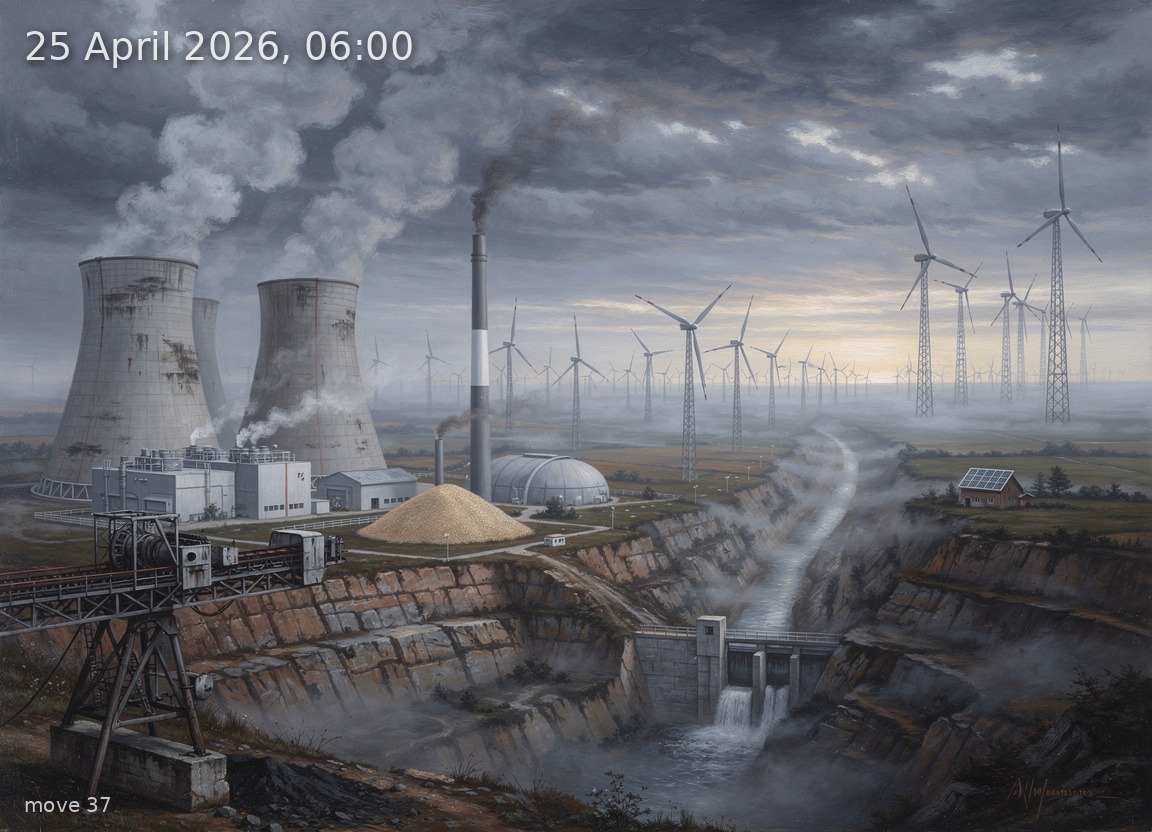
Wind leads at 22.7 GW with brown coal and gas balancing under full overcast; 2.5 GW net import covers remaining demand.
Back
Generation mix
Wind onshore 44%
Wind offshore 13%
Solar 3%
Biomass 11%
Hydro 3%
Natural gas 11%
Hard coal 3%
Brown coal 12%
74%
Renewable share
22.7 GW
Wind (on + offshore)
1.2 GW
Solar
40.2 GW
Total generation
-2.5 GW
Net import
83.2 €/MWh
Day-ahead price
4.4°C / 4 km/h
Temp / Wind speed
Open-Meteo, Kassel (51.3°N 9.5°E)
100% / 0.0 W/m²
Cloud cover / Radiation
179
gCO₂/kWh
Image prompt
Wind onshore 17.6 GW dominates the right half of the canvas as dozens of three-blade turbines on lattice towers receding across flat northern plains into misty distance; wind offshore 5.1 GW appears as a cluster of tall offshore turbines on the far-right horizon above a grey sea strip. Brown coal 5.0 GW occupies the left foreground as three massive hyperbolic cooling towers with thick white-grey steam plumes merging into the overcast, flanked by a lignite conveyor belt and open-pit edge. Natural gas 4.2 GW sits left-centre as two compact CCGT units with slim exhaust stacks emitting thin vapour. Biomass 4.5 GW appears centre-left as a wood-chip dome storage facility beside a small industrial stack with faint smoke. Hard coal 1.4 GW is a single smaller stack with dark exhaust near the lignite complex. Hydro 1.3 GW is a modest concrete dam and penstock visible in a valley fold centre-right. Solar 1.2 GW is barely present — a small rooftop array on a farmhouse, panels dull and unlit, reflecting no sunlight. Sky: pre-dawn early morning at 06:00 in late April — deep blue-grey sky transitioning to the faintest pale steel-blue glow along the eastern horizon, no direct sunlight visible, 100% cloud cover forming a heavy unbroken low stratus layer pressing down on the landscape. Atmosphere is oppressive and dense, reflecting the 83 EUR/MWh price — mist clings to fields, air feels heavy and damp. Temperature 4.4°C: early spring, grass is green but trees show only partial leaf-out, patches of frost on fence posts and turbine bases. Calm air at ground level — no visible motion in grass or flags, though turbine blades turn slowly overhead. Style: highly detailed oil painting in the tradition of Caspar David Friedrich and Carl Blechen — rich layered glazes, visible confident brushwork, dramatic atmospheric depth, moody chiaroscuro between the dark foreground industrial infrastructure and the pale pre-dawn glow. Meticulous engineering detail on every turbine nacelle, cooling tower reinforcement ring, CCGT stack, and conveyor mechanism. The scene feels monumental and contemplative — an industrial Romantic landscape. No text, no labels.