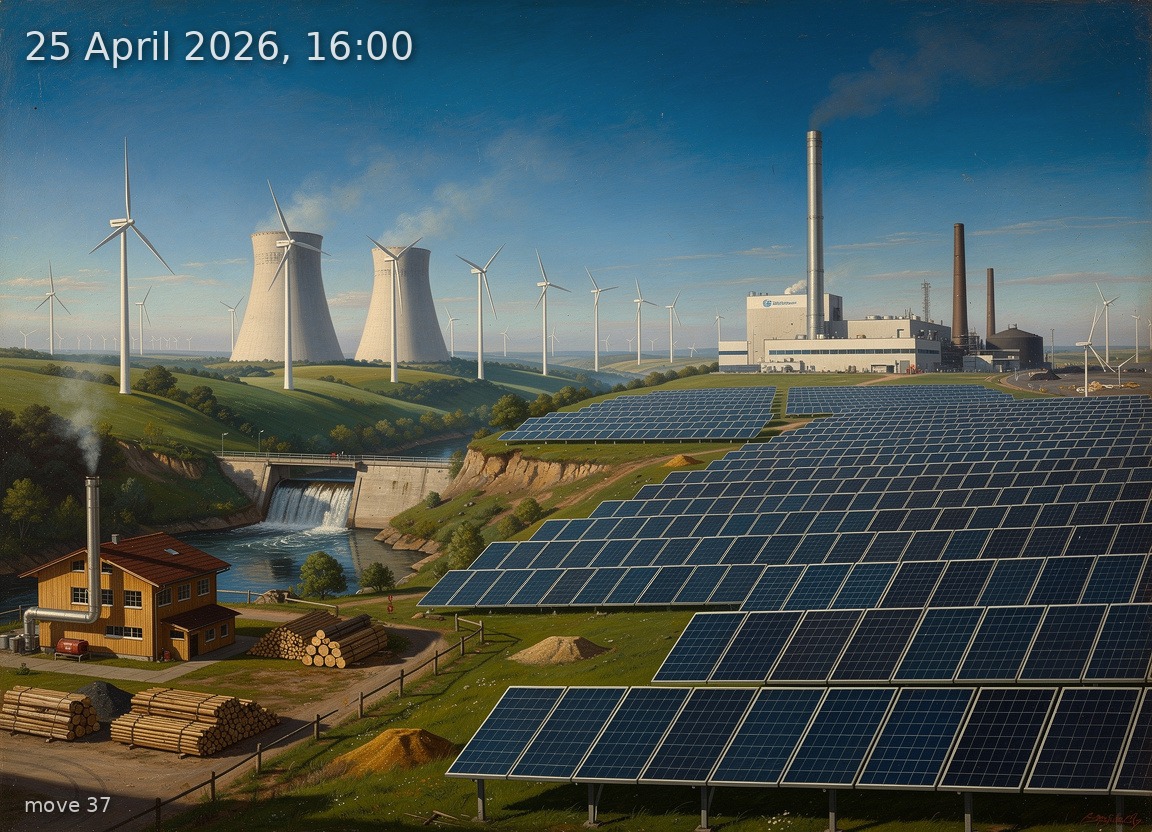
Solar at 32.3 GW and wind at 14.1 GW drive 13.9 GW net export under deeply negative prices.
Back
Generation mix
Wind onshore 22%
Wind offshore 3%
Solar 58%
Biomass 8%
Hydro 2%
Natural gas 3%
Hard coal 1%
Brown coal 3%
93%
Renewable share
14.1 GW
Wind (on + offshore)
32.3 GW
Solar
55.8 GW
Total generation
+13.9 GW
Net export
-54.0 €/MWh
Day-ahead price
16.9°C / 14 km/h
Temp / Wind speed
Open-Meteo, Kassel (51.3°N 9.5°E)
0% / 592.0 W/m²
Cloud cover / Radiation
51
gCO₂/kWh
Image prompt
Solar 32.3 GW dominates the scene as a vast plain of crystalline silicon photovoltaic panels stretching across the entire right two-thirds of the composition, angled south, their aluminium frames glinting sharply under direct afternoon sun. Wind onshore 12.5 GW appears as dozens of three-blade turbines on rolling green hills in the mid-ground left, rotors turning moderately in a light breeze. Wind offshore 1.6 GW is suggested by a small cluster of turbines on a distant hazy horizon line at far left. Biomass 4.2 GW occupies a modest industrial compound in the left foreground—a wooden-clad plant with a short smokestack emitting thin white vapor beside stacked timber. Brown coal 1.9 GW appears as a pair of hyperbolic cooling towers in the far left background, their steam plumes thin and wispy, nearly idle. Natural gas 1.6 GW is rendered as a compact CCGT unit with a single tall exhaust stack beside the cooling towers, barely venting. Hydro 1.1 GW is a small dam and spillway visible in a valley fold at mid-left. Hard coal 0.6 GW is a single smaller stack adjacent to the brown coal towers, almost dormant. The sky is entirely clear, deep cerulean blue, with intense late-afternoon spring sunlight casting long golden shadows from the west at roughly 45 degrees—the hour is 16:00 in central Germany. The atmosphere is calm, luminous, and open, reflecting the deeply negative electricity price. Lush green April vegetation—fresh beech leaves, flowering rapeseed fields in bright yellow—fills the foreground between the panels. Temperature is mild at 17°C. Highly detailed oil painting in the tradition of 19th-century German Romantic landscape painters such as Caspar David Friedrich and Carl Blechen: rich saturated colour, visible confident brushwork, atmospheric depth with haze softening the distant coal towers, meticulous engineering detail on every turbine nacelle, PV cell grid pattern, and cooling tower curvature. The composition conveys the overwhelming dominance of solar energy flooding a green spring landscape. No text, no labels.