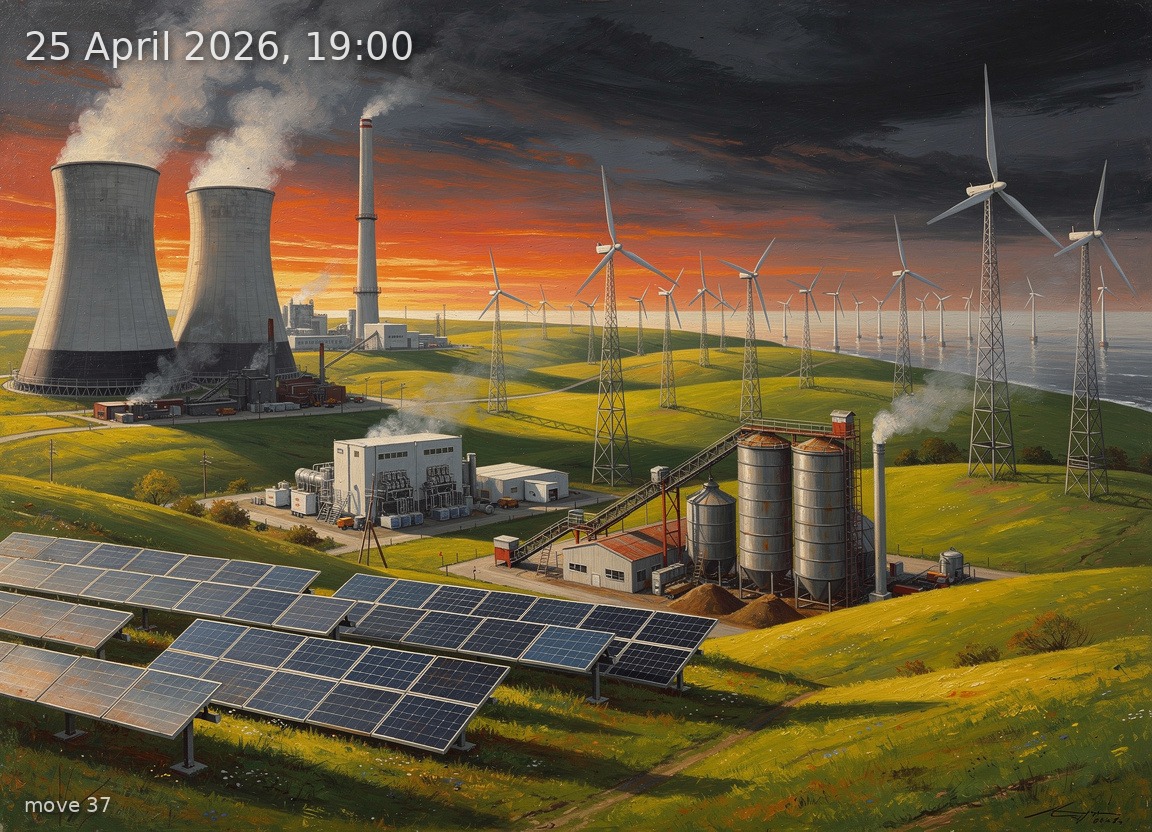
Strong onshore wind at 28.9 GW dominates an 86% renewable grid exporting 4.8 GW at dusk.
Back
Generation mix
Wind onshore 57%
Wind offshore 9%
Solar 8%
Biomass 9%
Hydro 3%
Natural gas 6%
Hard coal 2%
Brown coal 6%
86%
Renewable share
33.6 GW
Wind (on + offshore)
3.9 GW
Solar
50.6 GW
Total generation
+4.7 GW
Net export
65.2 €/MWh
Day-ahead price
15.6°C / 12 km/h
Temp / Wind speed
Open-Meteo, Kassel (51.3°N 9.5°E)
0% / 184.0 W/m²
Cloud cover / Radiation
92
gCO₂/kWh
Image prompt
Wind onshore 28.9 GW dominates the scene, filling roughly 57% of the panorama as vast ranks of three-blade turbines on lattice towers stretching across rolling green hills from centre to far right, rotors visibly turning in moderate wind. Wind offshore 4.8 GW appears at the far right horizon as a cluster of taller turbines rising from a sliver of grey sea. Solar 3.9 GW occupies a modest foreground strip at left-centre as rows of aluminium-framed crystalline silicon panels catching the last orange-red glow of sunset. Biomass 4.7 GW is rendered as a mid-ground industrial facility with stacked wood-chip silos and a single steam stack, proportionally sized. Natural gas 3.0 GW appears as a compact CCGT plant with a single clean exhaust stack emitting a thin heat shimmer, placed in the left-centre middle distance. Brown coal 2.8 GW sits at the far left as a pair of hyperbolic cooling towers with lazy white steam plumes rising against the darkening sky. Hard coal 1.2 GW is a smaller single smokestack facility adjacent to the brown coal, with a thin grey exhaust trail. Hydro 1.4 GW appears as a modest concrete dam and spillway nestled in a valley at the left foreground. The sky is dusk at 19:00 in late April: the lower horizon glows deep orange-red fading quickly to purple and then dark blue overhead, with the first faint stars appearing at the zenith. The sky is completely clear, zero clouds, and direct radiation casts long warm shadows across the spring landscape of bright green meadows and emerging deciduous foliage at 15.6°C. The atmosphere is moderately weighted — not oppressive but with a hint of industrial haze near the coal plants reflecting the 65.2 EUR/MWh price. Style: highly detailed oil painting in the tradition of 19th-century German Romantic landscape painters such as Caspar David Friedrich and Carl Blechen — rich saturated colour, visible confident brushwork, dramatic atmospheric depth, chiaroscuro between the glowing horizon and the darkening sky. Every energy technology rendered with meticulous engineering accuracy: turbine nacelles, blade pitch mechanisms, PV cell grids, cooling tower parabolic geometry, CCGT exhaust diffusers. The scene feels like a masterwork Romantic painting of a modern industrial landscape. No text, no labels.