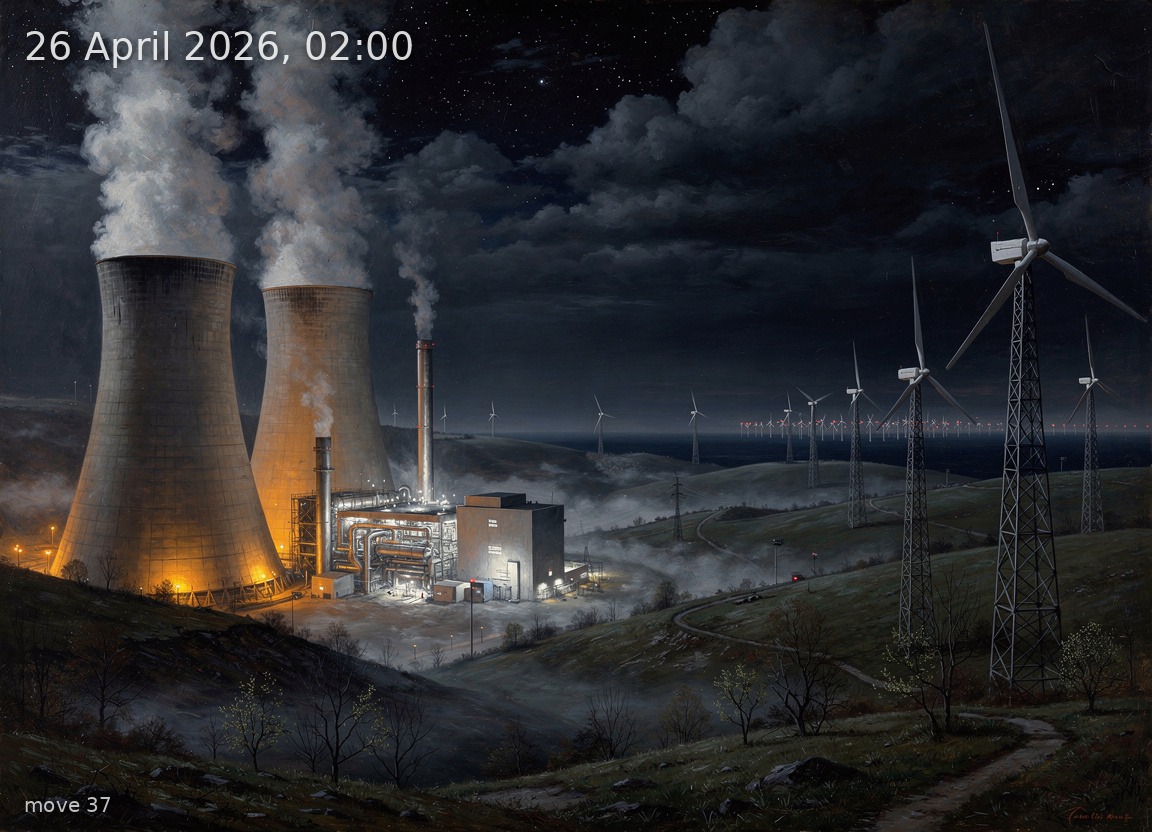
Strong overnight wind at 21.5 GW nearly meets demand, with coal and gas bridging a small net import gap.
Back
Generation mix
Wind onshore 48%
Wind offshore 14%
Biomass 12%
Hydro 3%
Natural gas 9%
Hard coal 3%
Brown coal 10%
78%
Renewable share
21.5 GW
Wind (on + offshore)
0.0 GW
Solar
34.5 GW
Total generation
-1.0 GW
Net import
87.1 €/MWh
Day-ahead price
6.8°C / 9 km/h
Temp / Wind speed
Open-Meteo, Kassel (51.3°N 9.5°E)
33% / 0.0 W/m²
Cloud cover / Radiation
150
gCO₂/kWh
Image prompt
Wind onshore 16.7 GW dominates the right two-thirds of the scene as dozens of tall three-blade turbines on lattice towers, rotors turning steadily, spread across rolling dark hills; wind offshore 4.8 GW appears in the far-right background as a cluster of turbines standing in a dark sea glimpsed beyond the hills. Brown coal 3.5 GW occupies the left foreground as two massive hyperbolic cooling towers with thick white steam plumes rising into the night sky, lit from below by amber sodium lamps. Natural gas 3.2 GW sits left-centre as a compact CCGT plant with a single tall exhaust stack venting a thin heat shimmer, illuminated by facility floodlights. Biomass 4.1 GW appears centre-left as a mid-sized industrial plant with a domed digester and short smokestack emitting faint vapour, warmly lit. Hydro 1.2 GW is a small dam structure in the middle distance with water cascading, caught by a single floodlight. Hard coal 0.9 GW is a smaller power station just visible behind the brown coal towers, with a single stack and modest plume. TIME: 02:00 at night—completely dark sky, deep navy-black, scattered stars visible through 33% partial cloud cover, no twilight, no sky glow. April landscape: bare early-spring trees with first tiny buds, damp grass, temperature near 7°C conveyed by mist low on the ground. The atmosphere is heavy and oppressive, reflecting the elevated 87 EUR/MWh price—clouds seem to press downward, the air thick. Moderate wind animates the turbine blades and bends the grass. All artificial lighting is sodium-orange and industrial white. NO solar panels, NO sunshine. Style: highly detailed oil painting in the tradition of 19th-century German Romantic landscape painters—rich, dark palette of Prussian blue, amber, slate grey, and ivory; visible impasto brushwork; dramatic chiaroscuro between the inky sky and the glowing industrial facilities; atmospheric depth with misty middle distance; meticulous engineering detail on turbine nacelles, cooling tower reinforced concrete, CCGT stainless-steel stacks. The scene evokes Caspar David Friedrich reimagined for the industrial energy age. No text, no labels.