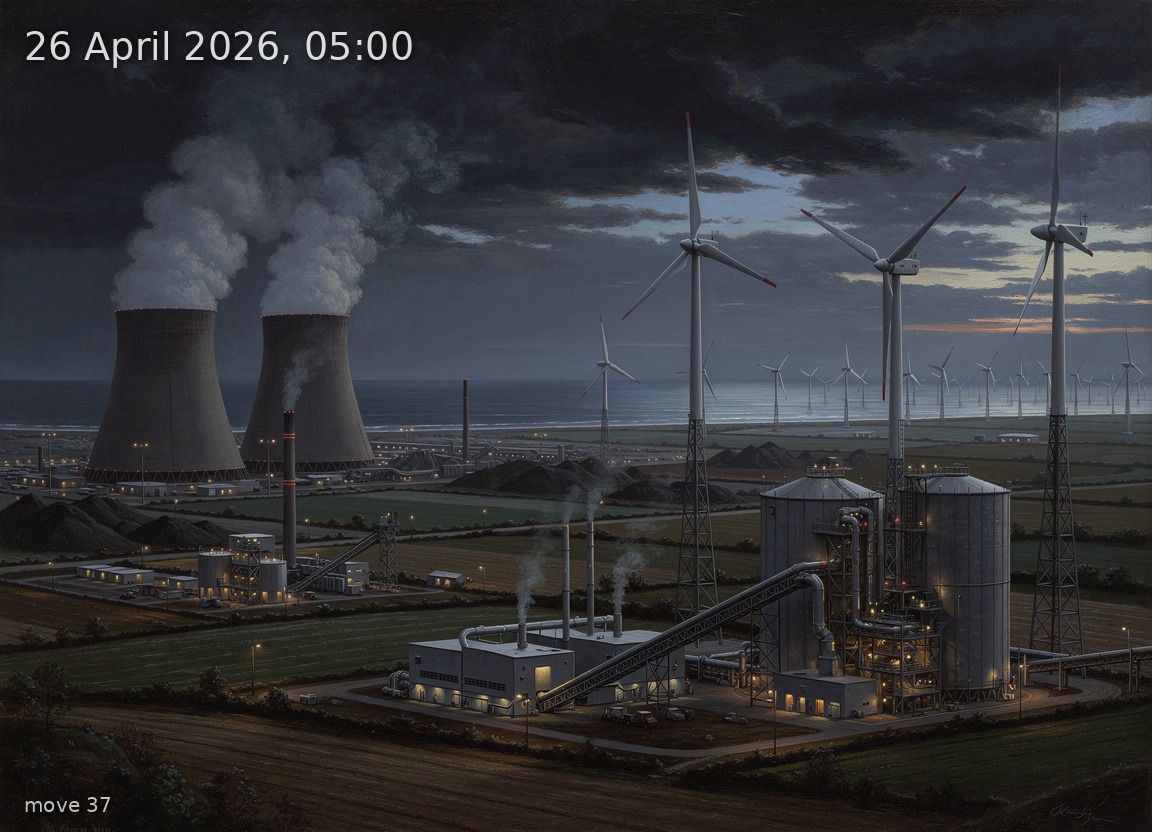
Pre-dawn wind leads at 12.9 GW but 9.5 GW net imports are needed as thermal and biomass fill the gap.
Back
Generation mix
Wind onshore 40%
Wind offshore 9%
Solar 0%
Biomass 16%
Hydro 5%
Natural gas 13%
Hard coal 4%
Brown coal 12%
70%
Renewable share
12.9 GW
Wind (on + offshore)
0.0 GW
Solar
26.2 GW
Total generation
-9.4 GW
Net import
98.6 €/MWh
Day-ahead price
4.5°C / 4 km/h
Temp / Wind speed
Open-Meteo, Kassel (51.3°N 9.5°E)
54% / 0.0 W/m²
Cloud cover / Radiation
202
gCO₂/kWh
Image prompt
Wind onshore 10.5 GW dominates the right half of the scene as dozens of tall three-blade turbines on lattice and tubular towers stretching across rolling farmland into the distance; wind offshore 2.4 GW appears as a cluster of turbines on the far-right horizon above a faint grey sea line; biomass 4.1 GW occupies the centre-right as a mid-sized industrial plant with wood-chip silos, steam vents, and warm amber-lit windows; natural gas 3.5 GW fills the centre as two compact CCGT units with slender exhaust stacks releasing thin plumes; brown coal 3.3 GW sits centre-left as a pair of massive hyperbolic cooling towers with heavy white steam rising into the dark sky, connected to a sprawling lignite facility with conveyor belts; hard coal 1.2 GW is a smaller single-stack power station to the left with a modest coal yard; hydro 1.2 GW appears at the far left as a concrete dam with illuminated spillway. The sky is deep blue-grey pre-dawn, 05:00 in late April — the faintest pale strip of cold steel-blue light barely visible at the eastern horizon, the rest of the sky nearly black, scattered clouds dimly suggested against the darkness. The atmosphere is heavy and oppressive, hinting at the high electricity price — a brooding, weighty sky pressing down on the industrial landscape. Temperature is near freezing: bare early-spring trees with only the first tiny buds, patches of frost on the fields, breath-like mist around the facilities. Sodium streetlights cast orange pools along access roads connecting the plants. The scene is rendered as a highly detailed oil painting in the tradition of 19th-century German Romantic landscape painters — Caspar David Friedrich meets industrial sublime — with rich, dark colour palette of indigo, slate grey, amber, and coal-black, visible expressive brushwork, deep atmospheric perspective, meticulous engineering accuracy on every turbine nacelle, cooling tower curve, and exhaust stack. No text, no labels.